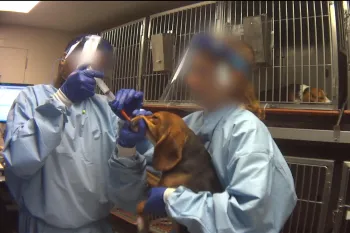
Every day in the U.S., beagles—known for their calm, gentle demeanor—are bred for use as compliant test subjects in the commercial testing industry. Most of the puppies are born just to be a living body on which chemicals can be tested and the results observed. The vast majority of these dogs will never feel grass beneath their paws or play with a ball. Instead, they will live and die in laboratories.
One of these procedures is the 90-day dog test for pesticides. Chemicals designed to kill rodents, insects, fungus or weeds are force-fed to dogs in an attempt to help protect people. In nearly all cases, this cruel test provides no added value in determining pesticide risks to humans.
Force-feeding chemicals to dogs
Every time a company wants to get a new pesticide approved in the U.S., the Environmental Protection Agency requires the company to test the chemical on more than two dozen dogs every day for three months. This can mean adding the pesticide to their food or forcing a tube down the dogs’ throats to ensure that they ingest the pesticides. At the end of the 90 days they are killed.
Three years ago, we published peer-reviewed research showing that the 90-day dog test rarely provided any added value in determining pesticide risks to humans—but nothing has changed.
We know this cruel and unnecessary test can be stopped because we’ve stopped similar tests in the past.
In 2018, our months-long undercover investigation at a laboratory in Mattawan, Michigan revealed that dozens of dogs were being force-fed fungicides daily for a year-long test then required by Brazilian authorities. Following intense public pressure from nearly 500,000 of our supporters, the test was halted, and 32 dogs (including a beagle named Teddy) were released from the lab and adopted by loving families. Brazil ended its requirement that pesticides undergo a year-long dog test for approval soon after.
That requirement is what compelled the company involved to contract with the Michigan laboratory to conduct the test. Brazil’s ban was the end of a 10-year campaign to eliminate the one-year dog test requirement, after the U.S. eliminated it in 2007.
If we can end the one-year test, we can end the 90-day test, too.
Jo-Anne McArthur/We Animals
End cruel animal testing
Tell the U.S. Environmental Protection Agency (EPA) to uphold their commitment to replace tests on tens of thousands of dogs, rats, rabbits and other mammals with alternative technologies that are better for both humans and animals.
40,000 dogs in labs is 40,000 too many
In January 2026, the EPA recommitted to ending all tests on mammals by 2035, including the 90-day test. But we believe that these tests can and should be phased out much more quickly.
According to the U.S. Department of Agriculture, approximately 40,000 dogs were used in experiments in the U.S. just last year alone. While that number has thankfully declined by more than 20,000 over the last 10 years—in part because of our work and the advocacy of Humane World for Animals supporters—40,000 is still 40,000 too many.
While some of these dogs are finding loving homes—thanks to adoption laws we’ve helped pass in 17 states—the vast majority are killed after the tests. Often this is because the experiment requires that dogs be killed at the end so their organs can be examined.
Ending animal testing cruelties, state by state
While we push the EPA for national testing reforms, we are actively partnering with state lawmakers to protect dogs still being used in laboratories.
We worked with Maryland lawmakers on a bill that was signed into law in April, The bill would direct laboratories to report the number of dogs and cats who have been adopted after the experiments on them have ended. This builds on a 2018 law that encourages such adoptions, while also banning cruel laboratory practices like devocalizing dogs and cats, and prohibiting companies from conducting animal tests for pesticides, industrial chemicals, household cleaners and other products as soon as regulatory agencies approve a non-animal method or decide that a test is no longer necessary.
A Pennsylvania bill nicknamed the Beagle Bill would prohibit labs from using state taxpayer dollars to fund harmful experiments that don’t provide pain relief on dogs and cats. It would also ensure that dogs and cats in laboratories have the opportunity to be adopted after the experiments end and ban breeders with multiple federal animal welfare violations from selling dogs or cats to animal testing facilities. The Beagle Bill unanimously passed the Pennsylvania Senate in September but is still awaiting a vote in the House.
You can help spare beagles from suffering and dying in labs
Ending the 90-day dog test would save hundreds of dogs each year and be a monumental milestone towards our global fight to end dog testing.
Join our campaign to end this archaic test. Send a message to the EPA Administrator urging him to eliminate the requirement for the 90-day dog test—and all tests on animals.
Kitty Block is president and CEO of Humane World for Animals. Follow Kitty Block on X. Sara Amundson is president of Humane World Action Fund.