When Peter Li was around 8 years old and growing up in China during the 1970s, he visited a relative’s house and met a litter of five cute puppies. He wanted badly to take one home. He asked his mother, but she said no. He begged and begged over several days, but still, she would not allow him to get a dog.
She explained why. Back in the 1950s, while living in a rural area, his parents and older sisters had a dog. For eight years, the dog faithfully saw each family member off as they left home and was always there to greet them when they returned.
Then, in 1959, a famine came. One evening, when Li’s family arrived home, their dog was not there. They searched for days, but he had disappeared. The family assumed he had been eaten, like many other dogs stolen by desperately hungry people. Li’s sisters cried for weeks.
By the 1970s, Li’s family had moved to the city. His mother worried about a government law that barred apartment dwellers from keeping dogs and might lead to any new dog they got being taken from them. She told Li she never wanted their family to go through that loss again. “It’s like losing a family member,” says Li. “The suffering [is] unbelievable.”
Li grew up to have cats, bonding with each one so that the cats followed him around. But he never forgot the story of his family’s terrible loss or the dog he was not allowed to have. Ultimately, that memory helped lead him to work as a consultant with Humane World for Animals to end the dog and cat meat trade in China.
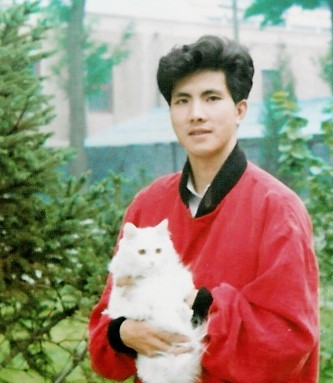
Courtesy of Peter Li
Lessons in the U.S. and the path to animal protection
Li went to grad school at Syracuse University during the ‘80s to study international relations. He was already, as he recalls, unusual for a Chinese student at that time: He arrived with his pet cat Mimi and soon he was helping feed community cats on campus.
At Syracuse, Li says he was enchanted by the squirrels running happily around the campus. He joined a field trip to a local orchard and was amazed to learn that the owner left five apples on every tree when he harvested the fruit so birds would have food over the winter.
“I said, ‘Oh my God, to be caring about the birds,” Li recalls. “Profits are not that important. Caring for the weak and the disadvantaged—the birds—is.”
The experiences inspired him to shift the focus of his studies to the politics of environmental protection and animal policy.
After Syracuse, Li became a professor at the University of Houston, where he still works. While he offers courses on American government, foreign policy and Chinese politics, he also teaches animal rights and politics. (In 2021, he published the book Animal Welfare in China: Culture, Politics and Crisis and in 2026 an article in Animal Law Review on the legality and politics of dog meat sales in China.)
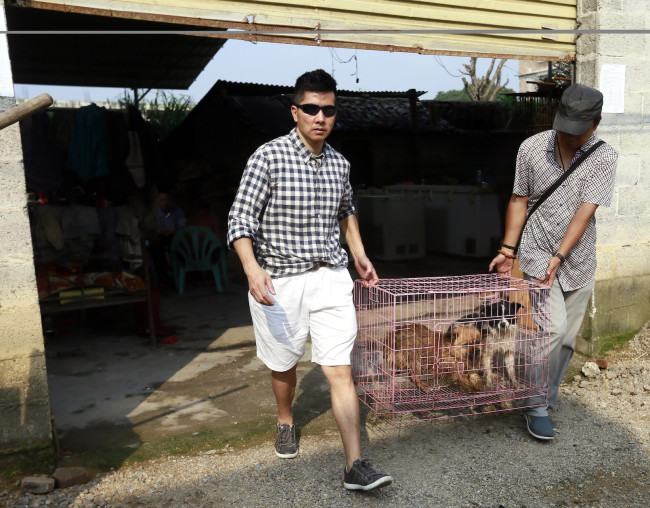
AP Images for Humane World for Animals
Returning to China to confront the dog meat trade
Li started to work with Humane World in 2005, researching China’s animal agriculture. Three years later, he was hired as the organization’s China policy specialist, a consultant position, and went back to China for a conference on farm animal welfare in Beijing. During the trip, Li rescued a dog on a busy highway. The dog, Zoey, was later flown out of China and joined the Li family in Houston.
In 2009, local traders in Yulin launched an annual dog meat festival, designed to bring tourists to their city. Li worked with Humane World and local activists in China to try and shut it down. In the years that followed, they rescued hundreds of dogs from the festival, including Colby, a pup Li saved from a Yulin live dog market in 2014 and then adopted.
Li describes the festival and the larger dog meat trade in China as a “pseudo tradition” that violates the country’s laws because traders steal dogs and transport and slaughter them in ways that spread diseases such as rabies. While traders have tried to destigmatize eating dog meat, arguing it is part of Chinese culture, Li says even in ancient times dog meat consumption was not accepted by the majority of Chinese people. Those who ate dog meat were despised and considered thugs and hooligans, so it was consumed by only a small number of people in secret, not as a typical household food.
“It’s not a true culture, not a true traditional food—it’s a fake,” Li says. “Scholars in ancient times were telling people, ‘Don’t eat the dogs because they have feelings and emotions just as people do.’”
Today, relatively few people in China consume dogs and cats, and many oppose the trade.
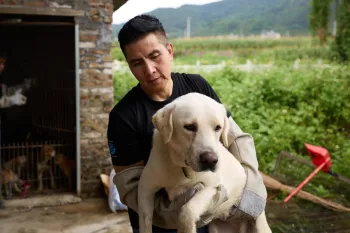
This Labrador, who rescuers named An An (also pictured in the top photo), is one of nine dogs saved through Yulin’s first ever alternative livelihood conversion program.
Chris Green, executive director of the Animal Legal Defense Fund, says Li has pioneered the intersection of animal law in the U.S. and China, bringing Chinese scholars to the U.S. for a roundtable and organizing an animal law forum in Beijing that drew 300 people from the West and China.
“He’s coming in there as [someone who is] from there,” Green says. “No one else would be able to come in and just talk to folks in a sort of honest way. No one else would be able to straddle both sides.”
Wendy Higgins, Humane World director of international media, says Li moves seamlessly between the two worlds and has earned the respect of people in China.
“It’s very easy to bring your heart and your passion, but it’s really important to make sure that you stay connected with the facts in order to advance change,” she says. “He is an academic, but he’s also a complete softy. He is totally emotionally invested in improving the welfare of animals in China.”
Peter J. Li/Humane World for Animals
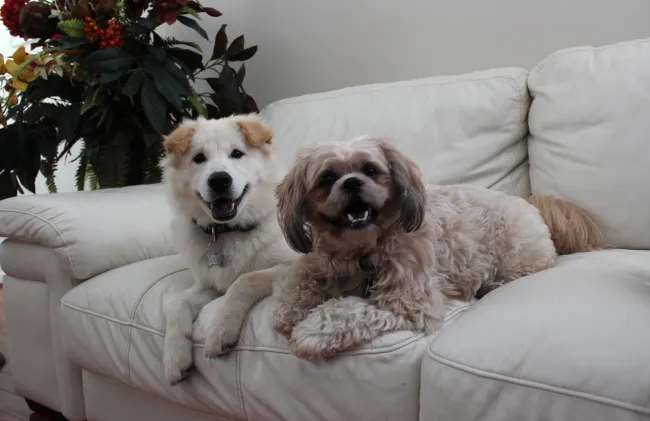
Li knows what that means, for both animals and people. Four decades after he was denied a puppy, Li finally got to bring a dog home, when his daughter Madeline turned 8 in 2012. Li had not yet saved Colby from Yulin or been able to bring Zoey to Houston. The family had only cats. Madeline asked him for a dog and Li was able to do what his mother could not: say yes.
Li brought home his and his family’s first dog, Teddy, a shih tzu rescued from the streets of Houston. Madeline was overjoyed.
“I showed her [Teddy] and she was just so happy,” Li says. “The dog has been my daughter’s best friend.”
Jean Chung/For Humane World for Animals
End the dog meat trade
Dogs used for this industry are mostly stolen pets and they endure immense suffering before being slaughtered. The dog meat trade is not only cruel and unnecessary, but is also linked to the spread of diseases.
Related Stories
Jean Chung/For Humane World for Animals
As the February 2027 ban nears, the South Korean dog meat industry crumbles. Here's what the last days of the industry look like.

Peter Li
Peter Li reflects on his experiences in Yulin, how far we’ve come in fighting the dog and cat meat trade, and the work that remains.
Wilis Yudha Baskoro/AP Images for Humane World for Animals
Two Lyras: One a dog in the U.S. and the other rescued from a dog meat farm in Indonesia. Here's what it's like when a rescue story on the other side of the world hits close to home.