Editor’s note: This story includes discussion of suicide. If you or someone you know needs help, please call or text 988, the national suicide and crisis lifeline in the United States. There is also an online chat at 988 LIFELINE. For those outside the U.S., you can search for your local hotline here.
Two pups, one name
Every animal has a story. As a member of the editorial team at Humane World for Animals, I have the privilege of working with people around the globe to share these stories with our international community every day.
Many are joyful in the end, and I live for the moments that I see people smile when certain names are mentioned: pigs Hope and Blossom, Teddy the beagle, tigress Elsa. But there are so many others about abuse, neglect, disasters and systems—like the dog and cat meat trade—that cause harm to millions of animals around the world each year.
When those stories start to feel too much, I turn to the dog snoozing (and snoring) by me right now.
Vickie Carter/Humane World for Animals
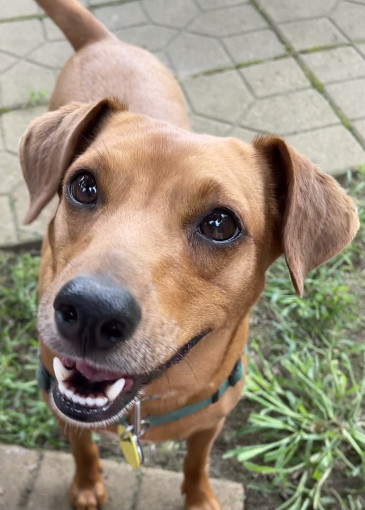
Meet Lyra from Boston
She’s an amber-colored, 30-pound mishmash of Mountain Cur, miniature pinscher and other assorted breeds. An 8-year-old who thinks she’s a puppy, a small- to mid-sized gal who thinks she’s a big dog. Healthy lungs for howling, a short tail that wags like a speedboat propeller when she gets excited and a never-ending supply of kisses on the ready whenever her mom needs a moment.
This rescue pup lived almost 18 months without a name, “that dog” in an outdoor kennel in Tennessee before foster care and a trip north to Massachusetts to join my family. It was my first time naming another living creature, and I felt responsibility for us to get it right. We chose Lyra—pronounced LYE-ruh—inspired by the strong female lead in Philip Pullman’s His Dark Materials trilogy, as well as its connections to both mythology and astronomy.
In the years since, I’ve often thought back to a comment our rescue coordinator made as we finalized Lyra’s adoption: “She has no idea just how good her life is about to get.” Lyra’s life has proven to be one full of love and treats, most of the space in our bed at night, and becoming a big sister to a younger rescue pup.
For five years, she was the one and only Lyra pup in my universe, a one-of-a-kind creature with a name to match.
That’s when I learned about another rescue story—nearly 10,000 miles from home—that stopped me in my tracks.
Wilis Yudha Baskoro/AP Images for Humane World for Animals
Meet Lyra from Indonesia
In the video, her eyes were big and dark as they looked out toward the camera from behind a cage door. The narrow bars were nearly the same shade of blue as the tape that held the pup’s mouth shut—a detail I focused on until text appeared on-screen.
“This is Lyra. She was at this slaughterhouse in Indonesia.”
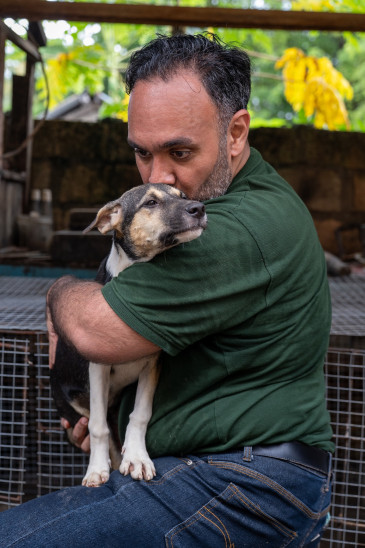
Seeing the name made me freeze. A few moments later in the video, Dr. Karan Kukreja—principal for our Ending the Dog and Cat Meat Trade campaign—spoke her name out loud.
LYE-ruh. The same pronunciation. That brought the tears.
Forddhanto Bimantoro
While I was familiar with the backstory of this slaughterhouse, I came to learn much more over the coming weeks. It had operated in Kupang, a large city in Indonesia’s East Nusa Tenggara province. Through Humane World for Animals video updates, I learned about the facility, its owner, the local restaurant to which they sold dog meat and the 50,000 dogs estimated to have been killed there since it started operating in 2007.
The slaughterhouse owner had told our team about his struggles running this business. It had taken a physical and emotional toll. Thick, acrid smoke damaged his lungs. And then there was the regular act of slaughtering the dogs.
Dogs were clubbed, stabbed and bled to death. The employee originally responsible for killing the dogs died by suicide, and the owner was forced to take over. The slaughterhouse owner felt badly for the animals and asked the people who sold and delivered the dogs to put them in sacks—it was harder to hit them if he saw their tails wag.
But things are changing in Kupang, and in Indonesia as a whole, Kukreja says.
“We’re at a really key point in Indonesia. One hundred and forty-five provinces, cities and regencies have now banned the trade, including Jakarta, Indonesia’s capital,” he explains. “There is also a national animal welfare and protection bill, which incorporates a ban on the dog and cat meat trade, [that] is up for consideration in Indonesian parliament this year.”
With these shifts in legislative and public sentiment looming, both the slaughterhouse owner and restaurant owner decided it was time to get out. They joined our Models for Change program, which we first launched in South Korea in 2015 and which now provides dog and cat meat farmers, slaughterhouse owners and dog and cat meat vendors a pathway out of the industry and into humane alternative livelihoods.
Following the program model, the owners signed a legally binding agreement to permanently close their dog meat-related business—pledging never to work in an animal-related industry again.
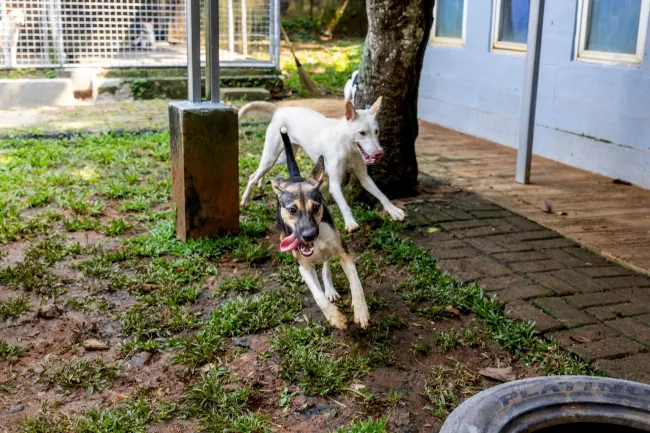
And, per the terms, the 10 dogs awaiting death at the slaughterhouse at the time were rescued and transported to a local clinic for veterinary care by Humane World for Animals and our local partner, Jakarta Animal Aid Network.
Wilis Yudha Baskoro/AP Images for Humane World for Animals
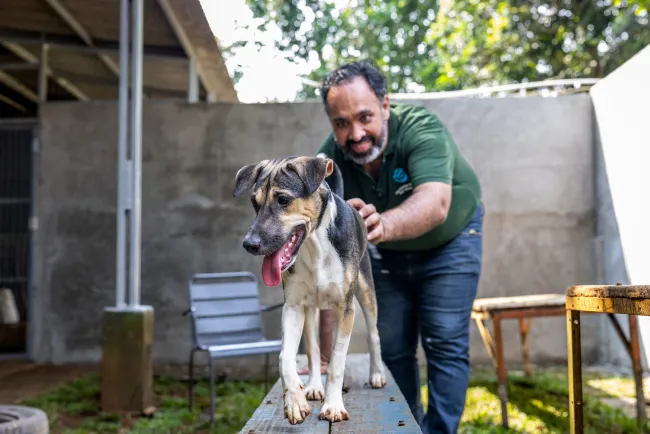
Ten pups total. And the very last to be rescued?
I went back to rewatch that first video that had captured my attention and smiled as a lean, tricolored pup appeared on screen. A black back, white belly and legs, taupe markings on her sweet face and ears. A wiggly tail and an obvious fondness for giving kisses.
Lyra. One very special pup who had no idea just how good her life may get.
See Lyra after rescue
Related Stories
Forddhanto Bimantoro
For the past 45 years, two men in Kupang, Indonesia, have been in the dog meat business. All of that has changed. Both men have closed their businesses as part of our Models for Change program. The 10 dogs who were caged at the slaughterhouse have now been rescued.
Forddhanto Bimantoro
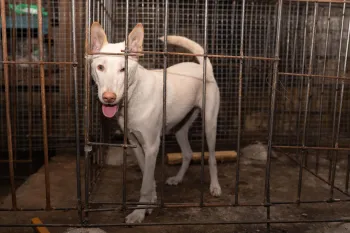
Stella was pregnant when our team rescued her from a farm in Cheongju, South Korea, in 2025. This is her story.
Jean Chung/For Humane World for Animals
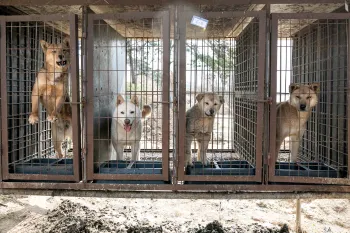
In another blow to a shuttering industry, Humane World for Animals leads a rescue on a South Korean dog meat farm.