
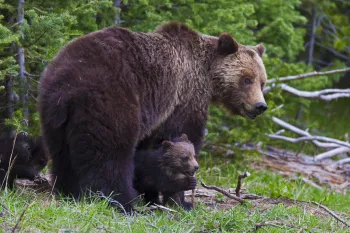
WASHINGTON—Trump administration leaders and some Western state governors appeared to announce a new policy shift aimed at removing Endangered Species Act protections for grizzly bears, another action in the war on wildlife that could jeopardize the recovery of the approximately 2,000 bears remaining in tiny, isolated populations across the Lower 48 states.
Humane World for Animals and Humane World Action Fund, formerly called Humane Society of the United States and Humane Society Legislative Fund, are deeply concerned that federal protections for the great American bear under the Endangered Species Act appear to be in jeopardy.
“This looks to be a politically expedient proposal that retreats from the protections grizzly bears still need to survive in the American West. In the 18 months since the federal government wisely chose to continue protecting grizzly bears, there has been no change in science or public opinion, only who holds the trifecta of power in Washington,” said Sara Amundson, president of Humane World Action Fund. “Interior Secretary Doug Burgum and U.S. Fish and Wildlife Service Director Brian Nesvik should abandon any planning underway for such a harmful proposal and stand aligned with the 85% of Americans, including majorities in rural Western states, who support keeping these bears protected.”
“Grizzly bears are magnificent animals who deserve our protection so they can thrive and not be reduced to political targets. With fewer than 2,000 great American bears left in the wild, removing their federal protections now would be a devastating and senseless step backward,” said Kitty Block, president and CEO of Humane World for Animals. “Killing bears doesn’t solve human-bear conflicts but implementing simple coexistence methods does. Ranchers can install electric fences, homeowners can secure garbage, and hikers can carry bear spray. These are measures that will enable us to reduce conflicts, live alongside grizzlies, marvel at their beauty, and keep them protected."
Removing the safeguards that the ESA provides could wreak terrible havoc on grizzly bears, a species that has already been hunted to the brink of extinction in the United States. This move could also erode the local economies of Yellowstone-area states and disrupt the natural environment that future generations will inherit.
What do you need to know about grizzly bears in the United States?
- The Endangered Species Act helped save grizzly bears from extinction. Grizzly bears were one of the species that inspired passage of the Endangered Species Act in 1973 and were listed as threatened soon afterward. Under the law, a threatened species is one that is likely to become endangered in the foreseeable future across all or a significant portion of its range.
- Grizzly bears have not yet recovered from the killing campaigns that brought them to the brink of extinction. Once an estimated 50,000 to 100,000 grizzly bears roamed the contiguous United States. Today, about 2,000 remain in isolated populations in Montana, Idaho and Wyoming, occupying only about 6% of their historic range. Conservation biologists warn that these small and disconnected grizzly bear populations limit genetic diversity and reduce their long-term resilience.
- Grizzly bears reproduce more slowly than most mammals. They do not reach adulthood until they are 4 to 8 years old, females typically have litters only every three to four years, and it can take about 10 years for a single female to replace herself in the population. As a result, the loss of even a small number of bears can slow population recovery.
- Federal protection remains critical. Prematurely removing Endangered Species Act protections could lead to expanded trophy hunting and other harmful state management practices before populations have fully recovered, putting decades of conservation progress and billions of dollars in public investment at risk. In a lawsuit brought by Humane World and our allies, a 2017 delisting rule was rejected by a federal court because it failed to account for the species' precarious genetic health and failed to ensure that sufficient protections would remain in place at the state level following delisting.
-
Most Americans support protecting grizzly bears. Recent polling has found broad bipartisan support—including among residents of grizzly bear states, including supermajorities of conservatives, ranchers and hunters—for maintaining federal protections under the Endangered Species Act.
Humane World for Animals and Humane World Action Fund have a long history of advocating for stronger protections for species like grizzly bears and gray wolves.
Resources for media:
- Fact sheet on grizzly bear mortalities in the Greater Yellowstone Ecosystem (Humane World for Animals)
- Map of current estimated occupied range for grizzly bears in the lower-48 States (U.S. Fish and Wildlife Service)
- Best practices when reporting on human-bear conflict (BearWise / Association of Fish and Wildlife Agencies)
- Download photos/videos of grizzly bears.