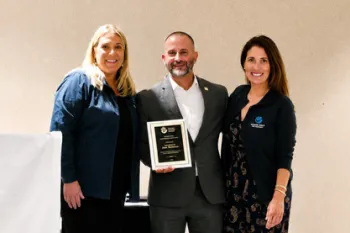
ATLANTA—Humane World for Animals, formerly called the Humane Society of the United States, is proud to honor Jose Ramirez with a 2026 Humane Law Enforcement Award for his steadfast commitment to protecting communities by cracking down on cockfighting. Ramirez serves as president of the Georgia Gang Investigators Association and the National Alliance of Gang Investigator Associates. He also works as a gang interventionist with Meriwether County Schools.
The link between cruelty to animals and violence against people is something Ramirez understands firsthand. A 26-year law enforcement veteran, he traces his mission to create safer communities back to childhood exposure to animal fighting—his family was involved in a cockfighting ring.
Ramirez describes cockfighting as a generational enterprise, passed down alongside domestic violence, child abuse and substance abuse. Rather than perpetuate that cycle, he chose a career in law enforcement, channeling his experiences into a commitment to mentoring and protecting others while helping break cycles of violence.
"Receiving the Humane Law Enforcement Award is incredibly meaningful to me. Cockfighting is a crime I know all too well, having been exposed to it growing up. I've dedicated my time and energy to ensure that future generations don't experience the violence and suffering that comes with animal fighting,” said Ramirez. “This recognition is not just about me; it's about the law enforcement officers, investigators and advocates who continue to stand together to combat animal fighting and the criminal activity that often surrounds it. While there is still work to be done in Georgia, I remain committed to educating, building partnerships, and advocating for stronger protections for animals and our communities."
Humane Law Enforcement Awards are presented annually to officers and agencies that have taken an exemplary stand in support of animal protection. Humane World for Animals works around the globe to enact laws that protect all animals and relies on the support of law enforcement agencies in this lifesaving work.
“We are proud to recognize Jose Ramirez for his steadfast commitment to creating safer, kinder communities for people and animals alike,” said Cindy Iacopella, Georgia state director, Humane World for Animals. "Cockfighting is not only a brutal form of animal cruelty; it is often part of a broader criminal ecosystem in which violence is normalized. Time and again, investigations have revealed links to drug trafficking, weapons offenses and money laundering. Jose has transformed his own experiences into a force for change, and his work exemplifies how law enforcement professionals can help break cycles of violence while protecting both animals and people."
Humane World for Animals collaborates with law enforcement agencies throughout the U.S. on a wide array of investigations, trainings and legislation.
Frequently asked questions
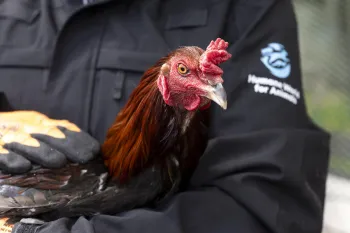
Cockfighting is a brutal spectacle that pits specially bred roosters against each other in a bloody fight to the death. Each year, thousands of roosters suffer in fighting pits in the United States. Razor-sharp gaffs tied to their legs, roosters suffer punctured lungs, broken bones and pierced eyes while fighting to the death.
Even birds who aren't killed during cockfights suffer terribly. Common injuries include punctured lungs, broken bones and pierced eyes, yet they are forced to continue to fight. The razor-sharp steel blades or "gaffs" (which resemble 3-inch-long, curved ice picks) tied to the birds' legs are so sharp and dangerous that cockfighters themselves have been killed when accidentally slashed by their own birds.
Most roosters on a gamefowl farm live tied to a stake, barrel or small wooden hut. They are often injected with steroids and adrenaline-boosting drugs and, for two to three weeks prior to a fight, are kept in a small dark box to isolate them from other animals, depriving them of stimuli and natural behavior.
As federal and state law enforcement agencies can attest, cockfights are often associated with other criminal activities such as illegal gambling, drug trafficking, gang activity and illegal weapon sales. Federal investigations have uncovered international drug cartels running sophisticated cockfighting operations as a means to distribute heroin, cocaine, methamphetamine and opioids across the United States.
Gambling is the norm at cockfights. Thousands of dollars can exchange hands as spectators wager on the fate of the birds. Cockfight derbies often attract hundreds of people engaging in a range of criminal activity which creates a dangerous situation for law enforcement officers, residents of the community and all involved.
The presence of children at these events is particularly disturbing—some parents make cockfights a family event, bringing picnic blankets and lunch which normalizes violence and teaches children to tolerate, and even celebrate, the suffering of animals.
While birds will fight over food, territory or mates, such fights are generally only to establish dominance within a group and seldom result in serious injury. This natural behavior is quite different from what happens in staged cockfights, where the animal’s will to survive is exploited. Winning gamebirds are a result of artificial selection—intentionally bred for maximum aggression.
Those who raise and sell roosters for fighting maintain hundreds, sometimes thousands, of birds—creating an ideal environment for the spread of disease. Birds are regularly sold and transported across state lines to fight in bloody cockfighting matches with no regulation or oversight. The fights themselves involve uniquely unsanitary practices such as cockfighters handling bloody, mutilated birds and putting their mouths over injured roosters’ beaks to suck fluids from their airways.