
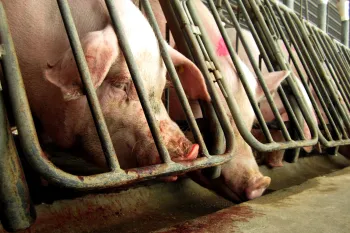
WASHINGTON—More than 720 veterinary professionals are asking Congress to stand up for the humane treatment of farm animals and ensure the Save Our Bacon Act stays out of the Farm Bill or any other legislative package. In a letter organized by Humane Veterinary Medical Alliance, the veterinary division of Humane World for Animals (formerly called Humane Society of the United States), they write of the need to maintain voter-approved state laws that ban the extreme confinement of female pigs:
“While much of the egg industry decided years ago to heed consumer demand and is rapidly transitioning to cage-free facilities, the pork industry’s lobby instead chose to fight California’s Proposition 12 in court and in Congress. While we note there is a split within the pork industry, some pork producers represented by industry lobbyists still use ‘gestation crates,’ metal cages so small the animals can’t turn around or take more than a step forward or backward.
“Gestation crates severely harm female pigs. As pigs grow during pregnancy, the crate bars press against their bodies, which can lead to sores, injuries, prolapse, and infections. Because the crates severely restrict movement, pigs can suffer muscle weakening and compromised cardiovascular health. The extreme confinement of pigs creates serious mental distress as well.”
Read the full letter signed by more than 720 veterinary professionals to members of Congress.
What is the connection between humane farm animal care and the Farm Bill?
- Veterinarians are uniquely qualified to evaluate farm animal welfare given their expertise and knowledge in understanding how housing and management practices affect an animal's health, behavior and overall well-being.
- They assess welfare by looking beyond productivity to whether animals can avoid unnecessary pain and chronic stress, express natural behaviors and thrive.
- Many farm animal veterinarians say modest group housing systems, like those that give breeding pigs the room to stand up, lie down and turn around, can improve individual welfare while supporting healthy herds and successful farming operations.
- Fifteen states have passed laws addressing the cruel confinement of pigs, chickens and/or calves in crates and cages so small they can barely move. Voters of all political stripes want animals to be treated humanely, and they support common sense laws that align food production with their values.
-
Congress is currently debating whether to preserve or overturn voter-approved state farm animal welfare laws through the Farm Bill. Having lost repeated legal challenges—including a 2023 U.S. Supreme Court decision upholding California's Proposition 12 and the Court's later decisions not to review challenges to both Proposition 12 and Massachusetts' Question 3—some pork industry interests are now asking Congress to accomplish legislatively what they could not achieve in the courts through the misleadingly named “Save Our Bacon Act.”
Additional resources for media:
- A timeline and explainer for California Proposition 12, Massachusetts Question 3 and the fight over state farm animal protection laws (HumaneWorld.org)
- Photos and videos of pigs in extreme confinement (media library)
- Responses to claims made by those seeking to block Prop 12 (myths/facts)
- List of farm animal protection laws across 15 states (pdf)
#