Cockfighting—the brutal spectacle that pits specially bred roosters against each other in a bloody fight to the death—makes the news occasionally. The cruelty behind the headlines is always the same.
In November, for example, law enforcement officers in Indiana, assisted by rescuers from the Humane Society of the United States, raided an alleged cockfighting operation near Fort Wayne and seized 139 roosters and hens. On site, rescuers found pieces of dozens of dead animals strewn about the property, an apparent bloodstained cockfighting pit in a dilapidated barn and a trench with the bodies of dead birds. The live birds were wandering around the yard or in makeshift enclosures, and some of them had abrasions and missing feathers. As is often the case with birds allegedly used in cockfighting, the seized animals had to be euthanized due to the threat of spreading such infectious diseases as avian flu, salmonella and virulent Newcastle disease.
Cockfights typically involve two roosters—known as gamefowl, often injected with steroids and adrenaline-boosting drugs, and equipped with sharp curved steel instruments (known as knives or gaffs) attached to their legs—facing off in a closed pit. Crowds, which often include children, watch the contests and bet on the outcomes. Other criminal activity common at cockfights includes drug trafficking, illegal weapons sales, assaults and thefts.
Cockfighting is a crime in every state and a felony in 42 states plus Washington, D.C., but it persists around the country, primarily in rural areas. The Southeast and Midwest are traditional hotbeds for cockfighting, but fights occur all over the country, says Janette Reever, Humane Society International program manager for animal crimes investigations. California, Texas, Arizona and Oklahoma are among the biggest cockfighting states, adds Leighann Lassiter, HSUS director of animal cruelty policy, but cockfights and arrests also occur in Northeastern states.
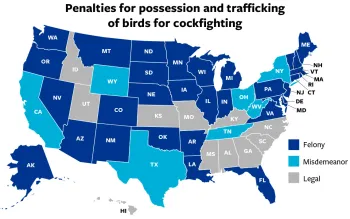
The HSUS, which has pushed for stronger cockfighting laws for decades, is now advocating for legislation in the 11 states (Alabama, Georgia, Hawai'i, Idaho, Kansas, Kentucky, Mississippi, Missouri, North Carolina, South Carolina and Utah) that don’t prohibit owning, breeding or selling birds for fighting.
Because cockfights take place under the radar, it’s difficult to gauge whether their numbers are increasing or decreasing, Lassiter says. Federal authorities have shuttered multiple large cockfighting operations in recent years in states including Georgia, Alabama and Kentucky. “Many people have left the industry because of the passage of stronger laws or because they’ve been caught at a fight and arrested and fear legal trouble,” Lassiter says. “A lot of progress has been made over the years, but it’s still a serious problem.”
Pete Marovich/For the HSUS
Find your legislators
Want to speak up for animals? Find your legislators and get involved in the fight to create a more humane world.
In the court of public opinion
Reever, who has participated in several cockfighting raids, finds the scenes disturbing on many levels. “When you go in and it’s a cockfight in progress,” she says, “you typically will pass by dead and dying birds—they’re just tossed.” The large number of children at the events is particularly upsetting, she says, and she believes they’re being desensitized to both the suffering of the birds and the illegality of the fights. “Sadly enough, it’s almost viewed as a family function.”
And yet, animal welfare advocates say public opinion has not turned against cockfighting the way it has against dogfighting. Reever notes that cockfighting participants often look down on people who fight dogs, believing that dogfights cause harm to “man’s best friends.” People who fight dogs are typically ashamed when they’re arrested, Reever says, because they know the community condemns their actions. People involved in cockfighting, in contrast, often strike a defiant tone, believing they’re carrying on a tradition and doing nothing wrong.
The different attitudes stem from the unfortunate reality that people simply don’t have as much empathy for roosters as for dogs, Lassiter says. And while many people believe animal fighting is wrong no matter the species, she adds, they often don’t realize how widespread cockfighting is, or how the birds endure long periods of extreme suffering.
Some legislators view cockfighting as a harmless part of the agriculture industry, and the fights can be seen as helping to fill hotels and boost the local economy. Some local sheriff’s departments are busy with other problems and choose not to prioritize cockfighting. “We sometimes have a hard time eliciting sympathy for these animals, and we have a hard time getting people to pay attention,” Lassiter says.
Although it’s illegal, cockfighting is also big business, and its participants aren’t shy about flexing their political muscle.
“We’re up against a very well-funded cockfighting industry,” Lassiter says, noting that in Oklahoma and Missouri, there are organized efforts to roll back the penalties for cockfighting and to make it legal to raise and sell birds for fighting. In Oklahoma, cockfighters formed a political action committee that raised $75,000 and donated about $40,000 to candidates in 2022. Multiple elected officials posed arm-in-arm with cockfighters at the state capitol before accepting endorsement checks.
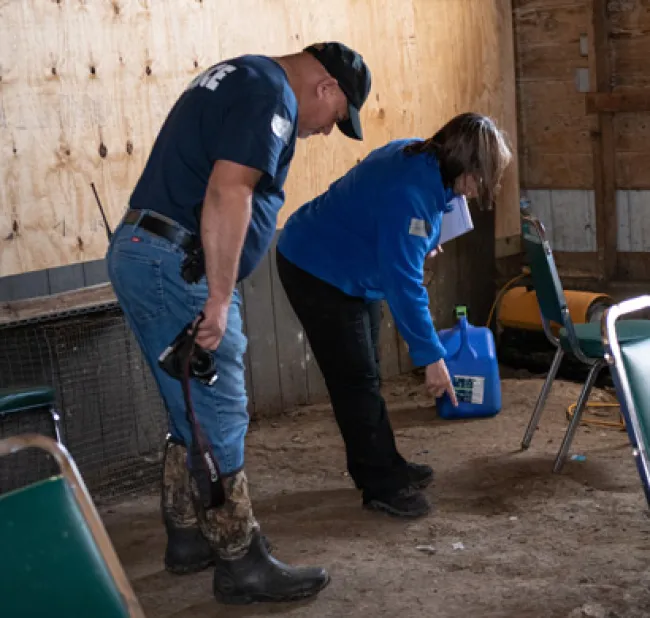
Meredith Lee/The HSUS
American fighting birds are highly prized around the world, creating a market for trafficking live birds to other countries, Lassiter says. Some U.S. gamefowl breeders sell thousands of animals a year, illegally using the U.S. Postal Service to mail them domestically and overseas—and not worrying about the consequences because enforcement is difficult. Lassiter recalls talking to one breeder who said he made $350,000 in a year, tax-free, selling fighting roosters for $2,000 apiece. “And this is just one guy in rural Tennessee,” she says. “We have no idea how much money is really in it, because, again, it’s all underground.”
The HSUS also combats cockfighting through the Law Enforcement Training Center, which offers courses in investigating and prosecuting animal crimes.
Trevor Whipple, a retired police chief from Vermont, has taught through the center for about five years and describes himself as an animal advocate. Whipple tries to raise his students’ awareness of the cruelty of cockfighting as well as its documented linkages to other crimes, such as illegal weapons sales. He notes that the FBI considers cockfighting a serious crime. In fact, it’s tracked in the National Incident-Based Reporting System as a “crime against society.”
“You might not be an animal advocate, you might not care about roosters,” Whipple tells his trainees, “but let me tell you what else is likely to be going on in these places, the linkages to human crimes.”
See our rescuers in action during the November 2022 rescue
Related stories
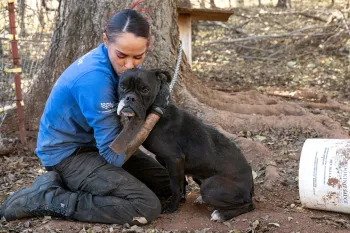
Meredith Lee/Humane World for Animals
Animal rescuers mobilize to free over 200 suffering animals and shut down an alleged cockfighting operation in Oklahoma.
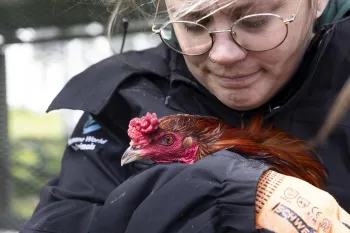
Jenn Ackerman/AP Content Services for Humane World for Animals
When our Animal Rescue Team arrived on the scene of an alleged cockfighting case, they found several chilling sights. See how our team assisted Clark County law enforcement officials after the sheriff’s office had served a search warrant.
Meredith Lee/Humane World for Animals
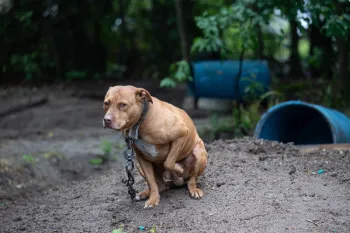
See one dog's story as he is rescued from dogfighting. Humane World for Animals assisted local law enforcement in removing him and 33 other dogs from alleged animal fighting in South Carolina.