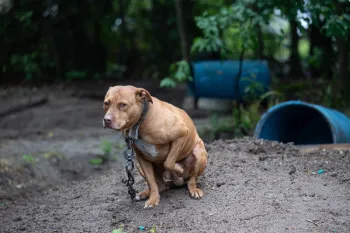
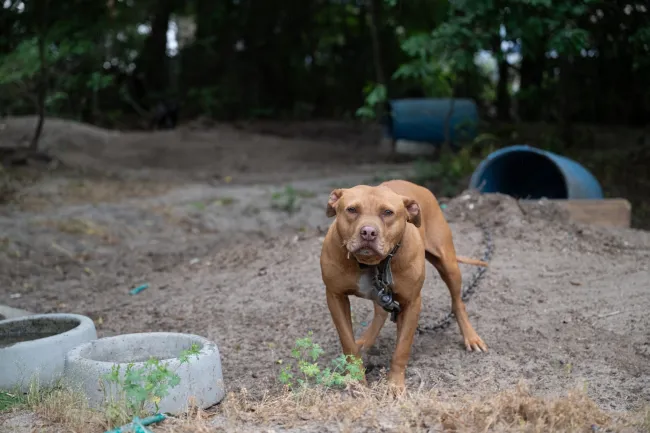
A brownish tan dog with white markings on his chest sits atop a mound of sandy dirt. The base of the mound starts where his thick metal chain ends. He has likely built this two-foot mountain by running in circles—over and over—as far as his chain will let him go. The dog has probably lived here a long time, although it’s almost impossible to know.
One thing is clear: Today will be his last day on this chain.
Rain starts to pour down. Rescuers with Humane World for Animals stand nearby. State law enforcement asked them to help remove this dog, and 33 others, from two South Carolina properties authorities allege were involved in dogfighting.
As the team huddles together to divide up the day’s work, the tan dog watches. He lifts one paw in the air. After a few seconds, he puts his paw down. The other paw comes up. He continues to lift alternating paws. When a rescuer looks in his direction, his tail thumps on the ground.
Rescuers walk to the edge of the tan dog’s mound to examine the scene. The dog runs to the end of his chain to greet them. As the team leads give instructions, the dog looks from rescuer to rescuer, wiggling his body. A few people kneel and pet him. A rescuer stands with his back turned to the dog and takes in the rest of the scene. The dog has other ideas—he rubs his body against the rescuer’s legs to get his attention.
Meredith Lee/Humane World for Animals
A state commits to stopping dogfighting
Rescues like the one occurring on this chilly April day used to be rare in South Carolina. The state is home to a lot of dogfighting activity, Humane World South Carolina state director Janell Gregory says, because police departments have historically struggled to go after these crimes. Until recently, animals rescued from alleged cruelty could not be considered for adoption until criminal cases were resolved.
This meant local governments had to pay for rescued animals’ care for months or years while their cases slowly crept through the criminal justice system. Costs could climb as high as $300,000, which happened to a South Carolina county after a 2019 dogfighting case where more than 30 dogs were rescued.
In 2024, the state passed a “cost of care” law to address this issue. Under the new legislation, if a judge determines the seizure was justified, the owner must either pay the cost of caring for the animals during proceedings or relinquish them so they can be assessed for adoption.
You are seeing the result of a perfect storm, where law enforcement identified dogfighting as a priority, and we passed cost of care legislation making it possible to police this crime.”
—Janell Gregory, South Carolina state director, Humane World for Animals
Around this same time, the government of South Carolina increased funding to help police agencies go after dogfighting. In 2023, the South Carolina Law Enforcement Division—a state agency that assists local police departments and conducts investigations as directed by the governor—created a dogfighting investigations unit. Since the unit’s creation, SLED has helped rescue over 900 dogs.
Humane World for Animals has been working with SLED for years to help rescue and care for dogfighting survivors. Over the past year alone, our Animal Rescue Team has deployed to South Carolina four times to remove animals from alleged dogfighting operations.
“You are seeing the result of a perfect storm, where law enforcement identified dogfighting as a priority, and we passed cost of care legislation making it possible to police this crime,” Gregory says.
This most recent case in Chesterfield County was the result of an extensive SLED investigation, which uncovered evidence including video footage authorities believe shows one of the defendants in the pit provoking an active dogfight.
All their work brought them to the two residential properties, search and seizure warrants in hand. Law enforcement arrested four suspects, including a Chesterfield County Sheriff’s deputy who was promptly fired from his job.
Meredith Lee/Humane World for Animals
Meredith Lee/Humane World for Animals
A rainy rescue
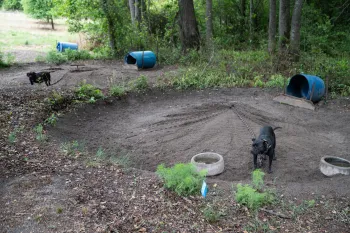
Like the tan dog, most of the canines are on thick chains. Some chains are so short the dogs can’t even access their meager plastic barrel shelters. The circles dogs have eroded into the ground almost interlap each other. At a briefing the night before, Adam Parascandola, our vice president of the Animal Rescue Team, had noted that dogfighters often house animals just out of reach of each other to keep them in an agitated state.
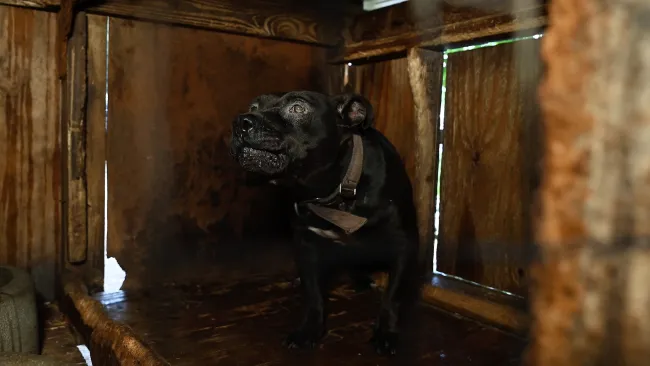
Dogs who aren’t chained live in small wooden hutches. Right next to the tan dog’s mound is a boarded-up hutch with a lock on the door. It looks deserted, but rescuers find a black dog inside. She is shrouded in near-complete darkness.
Kyra Hunsicker/Humane World for Animals
Like many of the other female dogs, she has swollen nipples, a sign she recently gave birth. No puppies are found on scene.
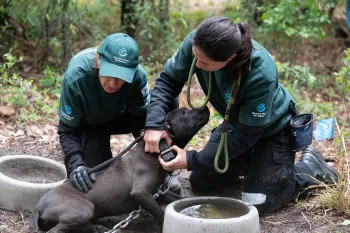
As rain continues to fall, rescuers begin removing and bringing the dogs to a pop-up veterinarian station for examinations. Many of the animals have scars in varying stages of healing. Though their bodies hint at a life of fear and pain, most of the dogs excitedly greet rescuers with tail wags and wiggles. The more nervous dogs stay on the top of their mounds or hide in their barrels, shrinking into themselves. They peer out at the commotion without leaving the safety of probably the only shelter they’ve ever known.
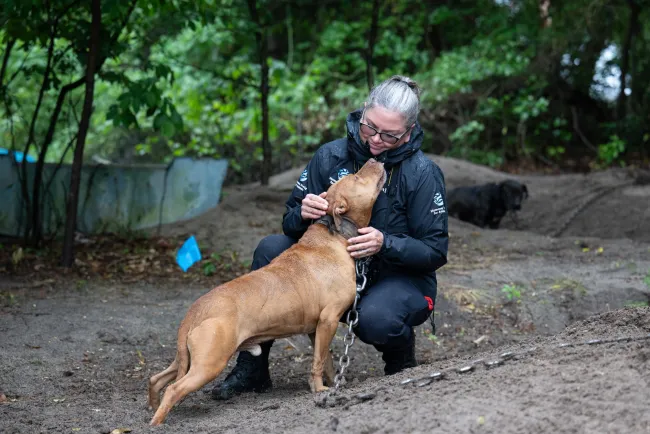
By mid-morning, a team of rescuers reaches the tan dog. A rescuer kneels down, camera strapped around her neck to document the scene. The dog pushes his body into her lap and licks her face. “Oh, your collar is on so tight,” she mutters to him.
When she stops petting him to talk with another rescuer, he taps her with his paw. Then he licks her camera lens.
Meredith Lee/Humane World for Animals
A second rescuer comes over and easily slips a leash around his neck. But she struggles to get his thick collar off. It’s secured so tightly that it takes the two rescuers a few minutes to remove it. The collar falls onto the ground with a resounding clack. The fur where it just was is tainted dark brown.
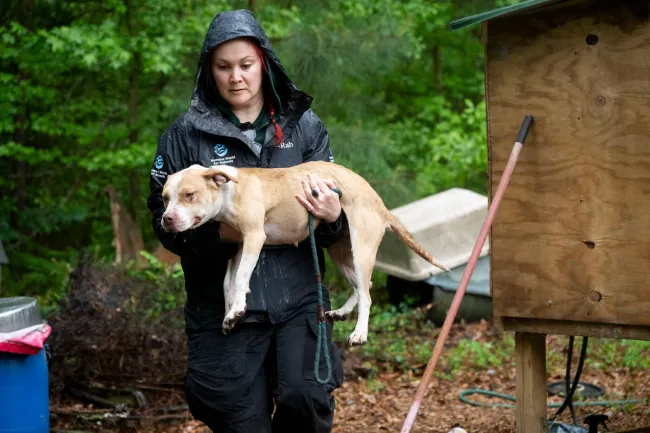
The second rescuer takes the dog into her arms and brings him to the veterinary station. Under the canopy tent, the tan dog is finally out of the rain. After he is done with his first exam, he is put into a crate and brought into a transport van. The rescue team puts a visual barrier between each dog’s crate to reduce their stress and gives them treats to eat.
The tan dog sits in the dry van while the rescue team removes the rest of the dogs. By late afternoon, the 34 survivors are ready to be driven to a confidential location to receive medical and behavioral care.
The rain has dissipated and the sun peeks out of the clouds. Rescuers leave, dogs in tow.
Kevin Wolf/AP Images for Humane World for Animals
Scarred bodies
The tan dog sits on pine shavings in a pen inside a facility. He stands up and wags his tail every time he notices a rescuer looking his way. He has been nicknamed “Fuji,” an ode to the highest mountain in Japan. Rescuers have named all the dogs after mountains as a reference to the mounds of dirt they were found on—and more abstractly, for the steep journeys they have endured.
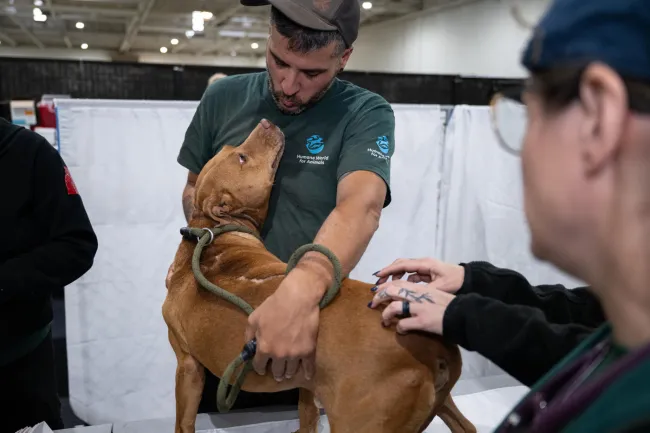
The 34 dogs are housed in this facility together, but they barely make a sound. One by one, the dogs are brought to a folding table to receive in-depth veterinarian examinations.
Many of the same findings keep popping up. Scarring is incredibly common. The majority of the dogs have inflamed, irritated skin on the front of their necks where collars sat just a day before. Multiple dogs are missing chunks of their ears or lips.
Meredith Lee/Humane World for Animals
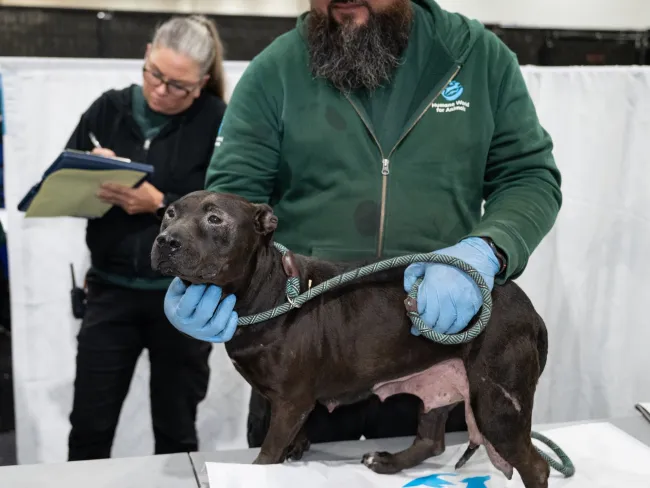
In the early afternoon, Fuji is brought onto the table. His tail is wagging, but he keeps it tucked low. He leans his boxy head into a rescuer. Forensic veterinarian Dr. Michelle Gonzalez gently touches the network of scars along Fuji’s back. He starts squirming around, twisting his head back to look at Gonzalez. He seems to think he is being pet.
The scars are most likely burn marks, she notes. She also finds healed scars on his leg and shoulder, infected wounds on both ears and callouses she calls “chain bumps” because they were probably caused by the heavy chains repeatedly hitting his wrists.
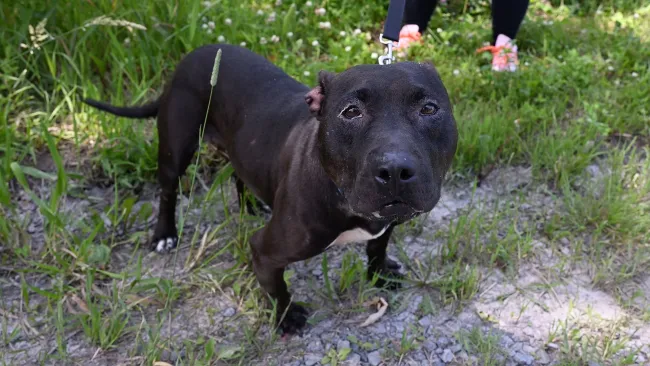
A little while later, the black dog found in the hutch next to Fuji’s mound—now named Pico after Mount Pico in Portugal—comes to the table. The first noticeable thing about her is her eyes, which are encrusted in dried mucus. On examination, Gonzalez finds she has scarring on her corneas.
Looking closer, two other things stand out. Pico has a large scar on the outside of her left rear leg and enlarged nipples running down the inside.
It appears Pico suffered a major injury to her leg, and someone surgically grafted the skin around her mammary glands onto the wound. After this grafting procedure, Pico appears to have had a litter of puppies, Gonzalez says. That should have never been allowed, she adds.
Meredith Lee/Humane World for Animals
Pico stays almost completely still throughout the exam, even as it extends almost twice as long as the others. Rescuer Kassi Bennett squirts canned cheese into a bowl for her. Pico is too nervous to eat. Bennett scoops some cheese onto her finger and brings it to the dog’s mouth. Pico gently licks it up.
It’s approaching late afternoon and everyone, human and animal, seems tired. Nearby, a volunteer is making snacks for the dogs. He smushes two dog bones together with peanut butter. “I’ve taste tested them myself,” he jokes.
The rescuers finish the day’s exams. Fuji sits in his enclosure, still his excitable self but more subdued. When he sees a rescuer looking at him, his face lights up but he doesn’t move. At the end of the day, rescuers turn off the lights. The dogs could use a good night’s sleep.
While it varies with each case, overall, the majority of dogs the team rescues from animal fighting operations pass their behavioral assessments and go on to find adoptive homes.
A beginning and an end
Over the next two weeks, the dogs are given time to decompress and recover. Once the dogs feel more comfortable, the behavioral team begins assessing their behavior. Rescuers start slowly. They introduce each animal to a realistic–looking model dog. If a dog does well, the team will slowly start introducing them to other canines.
During Fuji’s assessments, he attacks the model dog. The behavior team is highly attuned to the nuances of dog behavior and watch Fuji carefully for clues. When dogs are playing, they’ll often shake the model in their mouth a few times before moving on to something else. Dogs exhibiting dangerous behavior toward other dogs will frenetically go after body parts and will often refuse to let the model go even when the team tries to redirect their behavior. This behavior is different than “typical” dog-to-dog reactivity behaviors that can be worked through with a trainer, the rescue team’s director of operations Audra Houghton says. It’s much more extreme and puts people and other animals at risk.
Fuji’s behavior is deemed unsafe. It’s a somber discovery: Multiple behavior experts look over Fuji’s case and contribute to his assessment so the team can decide his outcome as thoroughly and thoughtfully as possible. These decisions weigh heavily on everyone.
The rescue team needs to prioritize public safety as well as Fuji’s own quality of life. When dogs leave the team’s care, they’ll go to shelter and rescue partners to find adoptive homes. Living in a shelter in close contact with other dogs would be highly distressing for Fuji and dangerous for the other dogs in the shelter. And sadly, large dogs—particularly those who have a pit bull-type look—are staying in shelters significantly longer than other animals.
While it varies with each case, overall, the majority of dogs the team rescues from animal fighting operations pass their behavioral assessments and go on to find adoptive homes.
Fuji will not. He is scheduled to be euthanized.
None of this is Fuji’s fault. Scarring on his body suggests he’s been involved with dogfighting activity before. His trust in humans has somehow remained strong despite what people have put him through, but he has likely grown to view other dogs as a threat.
Animal fighters often manipulate dogs’ innate loyalty to humans, a trait they’ve developed over thousands of years as our best friends. Dogs who are highly interested in pleasing humans and highly “game,” meaning they have an unwavering determination to persevere through pain and exhaustion, will sometimes be selectively bred in the hopes they’ll pass down those traits and produce young more willing to fight.
Meredith Lee/The HSUS
End organized dogfighting
Dogs trained or forced to fight suffer horrific injuries and suffering. Speak out against this cruelty to protect dogs and ensure dogfighters are held accountable.
Euthanasia is an outcome no rescuer wants, but it’s a reality of the work. Rescuers have only known Fuji for a few weeks, but they’ve grown very attached. It’s hard not to fall in love with him.
Team leads Jessica Johnson and Audra Houghton know this case has been particularly hard for rescuers. They offer to oversee the euthanasia procedure themselves to spare the team that’s cared for him.
Right before his procedure, Fuji is given simple comforts: spray cheese and pets. Sometimes all the team can do is make an animal’s last few moments full of warmth and love.
Many times, they’re able to do much more.
After a few weeks in the rescue team’s care, Pico has already transformed. She moves around with much more confidence. In the play area, she approaches rescuers with her tail wagging. She’ll sit for a few pets before continuing to explore her new surroundings.
All signs point to Pico being able to be adopted into a new home. Where Fuji’s story ends, Pico’s has just begun.
Kyra Hunsicker/Humane World for Animals
Related stories
Meredith Lee/Humane World for Animals
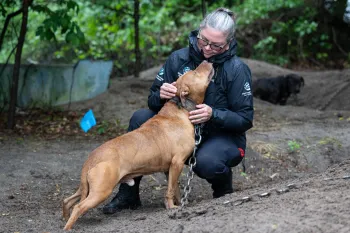
Rain poured as our Animal Rescue Team deployed the morning of April 28 with officers from the South Carolina Law Enforcement Division to help rescue dogs from a suspected dogfighting ring.
Meredith Lee/The HSUS
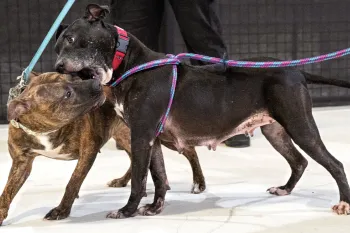
Less than a month after she first learned to go on leash, a brindle-and-white dog named Cameo completed a turn around the inside of a Maryland care and rehabilitation center and, keeping pace with her handler, moved calmly back into her kennel.
Phil Skinner/AP Images for Humane World for Animals
The suffering of animals in laboratories, animals in roadside zoos, and dogs subjected to the terrible cruelties of dogfighting have been persistent problems across the United States. But that may be changing now.