
Egg production transparency in the European Union
Oliver Strewe/Getty Images
The European Union requires the farming method to be indicated for shell eggs sold directly to consumers, allowing consumers to distinguish between organic, free-range, barn and caged production systems.
However, no equivalent requirement applies when eggs are used as ingredients in processed foods. This means that information routinely available when purchasing shell eggs is not necessarily provided on labelling when eggs are incorporated into products such as mayonnaise, dried egg pasta and biscuits. This is the hidden eggs transparency gap.
Why egg production systems matter
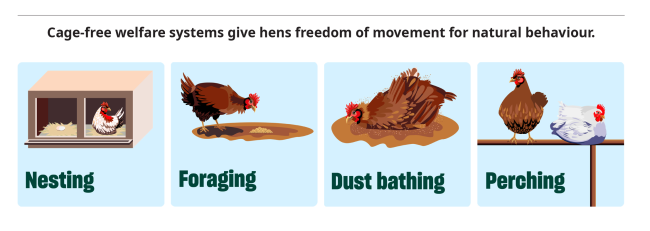
Approximately 399.8 million hens in the EU are kept for egg production, around 35.5% of whom are still confined to cages. Even enriched cages restrict movement and prevent hens from expressing important behaviour, such as nesting, foraging, dust bathing and perching. In contrast, cage-free systems generally provide greater freedom of movement and allow hens to engage in more natural behaviour.
Humane World for Animals
The cage-free transparency index
The Hidden Eggs research assessed mayonnaise, dried egg pasta and biscuit products across Austria, France, Germany, Italy, the Netherlands, Poland, Romania and Spain. It used a cage-free transparency index to measure how transparently egg production systems are communicated on food packaging across countries of sale, product categories and sales channels.
Hidden Eggs research in numbers
Read about the methodology and sample.
The voluntary approach produces uneven transparency
The research found that information about egg production systems remains inconsistent across the processed food industry. As a result, consumers and wholesale buyers may receive very different levels of information when purchasing similar products.
Transparency varies across the EU internal market
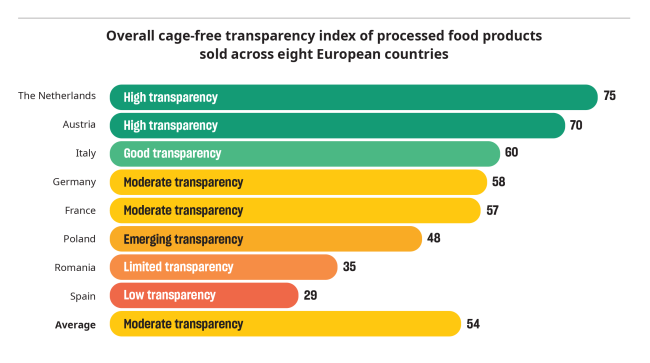
Across all eight countries, the combined cage-free transparency index was 54. The Netherlands and Austria achieved the highest cage-free transparency index scores, while Romania and Spain recorded the lowest.
Humane World for Animals
Transparency varies by product category
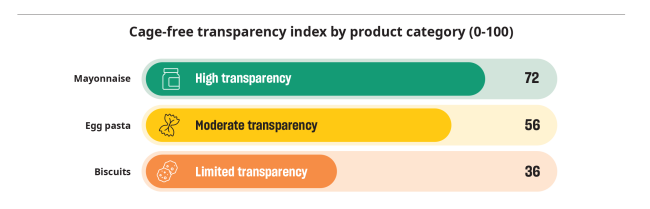
The highest cage-free transparency index was found among mayonnaise products, while the lowest was found among biscuit products.
Humane World for Animals
Transparency varies between sales channels
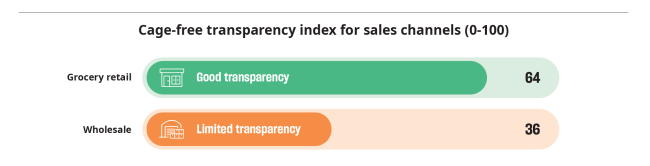
Across the sample of mayonnaise, dried egg pasta and biscuit products, products identified at grocery retail achieved a substantially higher cage-free transparency index than products sold at wholesale markets.
Humane World for Animals
Cage-free egg commitments do not ensure disclosure
Humane World for Animals
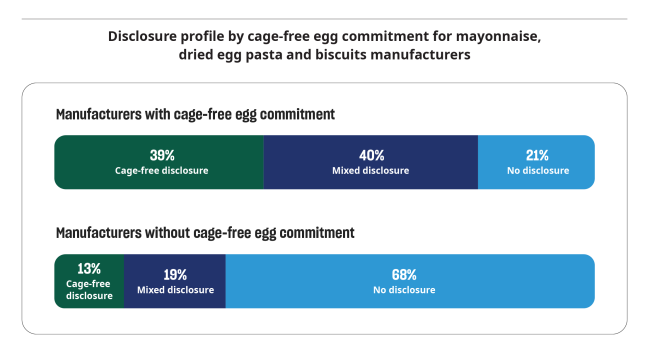
Food manufacturers with public cage-free commitments were generally more transparent than manufacturers without commitments. However, mixed disclosure remained common, showing that commitments do not consistently translate into information on product packaging.
Information is not always easy to identify
Humane World for Animals
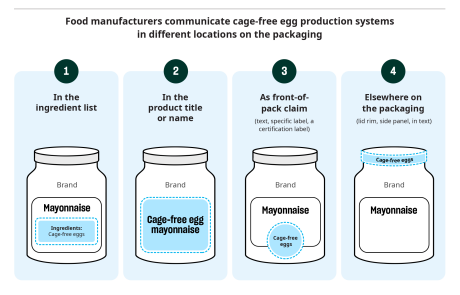
Where cage-free egg production system information was disclosed, food manufacturers communicated it in different ways and with varying levels of visibility on their product packaging.
Recommendations
Information should not disappear because eggs enter the processed food supply chain.
The European Union already requires the farming method to be indicated for shell eggs sold directly to consumers. Equivalent information should also be available when eggs are used as ingredients in processed foods.
In practice, an extended farming method disclosure framework should:
- Cover egg and egg ingredients used in processed foods
- Use harmonised farming method terminology
- Place information in a standard and readily visible location
- Apply equivalent requirements to relevant imported products
Extending harmonised farming method disclosure requirements to ingredient eggs would support informed purchasing decisions, create more consistent market recognition for producers investing in higher welfare systems, and help to close the hidden eggs transparency gap. Moreover, it could help complement broader efforts to transition to cage-free egg production systems.
Hidden Eggs report
Lukas Vincour / Zvířata Nejíme /We Animals Media
- Report: Hidden Eggs
- Methodology
- Assessed outlets, food manufacturers and brands
- Country factsheet: Poland
For the Hidden Eggs report in Polish, please visit humaneworld.org/nioski
Frequently asked questions
The hidden eggs transparency gap refers to the difference between the farming method information available when consumers buy shell eggs and the information available when eggs are used as ingredients in processed foods. EU rules require farming methods to be indicated for shell eggs sold directly to consumers, but there is no equivalent requirement for eggs used in products such as mayonnaise, dried egg pasta and biscuits.
The research assessed 476 food products from 99 food manufacturers across Austria, France, Germany, Italy, the Netherlands, Poland, Romania and Spain. It examined mayonnaise, dried egg pasta and biscuit products and measured how transparently egg production systems were communicated on packaging.
Approximately 399.8 million hens in the EU are kept for egg production, and around 35.5% are still confined to cages.
The report calls for eggs used in processed foods to follow the same farming method labelling used for shell eggs in the EU, so consumers have clearer, more consistent information.
You can help farm animals
Animals on factory farms never breathe fresh air or feel grass beneath their feet. Your generous gift will support our efforts to improve their lives and other animals in need.
S. Chakrabarti/