
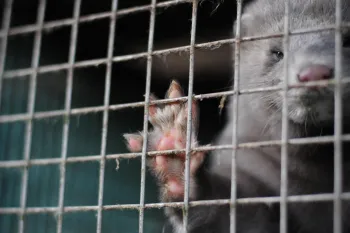
BRUSSELS – The Danish government has decided to pull the plug on its mink fur farming industry, putting animal welfare ahead of the commercial interests of the country’s seven remaining fur farms. Denmark was once the largest mink fur producer in the world. However, it will not seek the special permit from the European Commission required under the EU Regulation on Invasive Alien Species to allow mink farming to continue after the ban on keeping American mink takes effect in August 2027.
Dr Joanna Swabe, senior director of public affairs for Humane World for Animals Europe, says: “This is a momentous decision. We applaud the Danish coalition government for ending a cruel industry that confines mink to small wire cages solely for fur fashion. Once the world’s largest fur producer, Denmark is now consigning this industry to history and joining the EU Member States that have ended fur farming due to serious animal welfare concerns. The European Commission must take heed and deliver an EU-wide ban on fur farming, as demanded by more than 1.5 million citizens who signed the European Citizens’ Initiative for a Fur Free Europe.”
Alongside mink farming's limited societal and economic importance, the European Food Safety Authority’s scientific opinion on the welfare of animals on fur farms appears to have been pivotal to the Danish government’s decision. EFSA’s recommendations underline that meaningful improvements to animal welfare are impossible within the current cage-based production system.
Before the COVID-19 pandemic, Denmark had 1,147 mink farms. The country’s entire farmed mink population of 17 million animals was killed after SARS-CoV-2 outbreaks were identified on 290 farms, resulting in hundreds of human COVID-19 cases caused by mink variant strains. Mink farmers received more than €3 billion in compensation for their losses. Only a small number resumed mink farming after a temporary suspension on breeding was lifted.
Added to the EU’s List of Invasive Alien Species of Union Concern in 2025, American mink will be subject to a keeping and breeding ban from 7th August 2027. Under Article 9 of the IAS Regulation, Member States may exceptionally seek Commission authorisation for continued production on “compelling public-interest grounds, including social or economic reasons”. National permits require prior Commission approval and strict containment, escape-prevention and contingency measures. Finland has regrettably already submitted its application.
Humane World for Animals Europe congratulates its Fur Free Alliance partner Anima for decades of tireless campaigning to highlight the cruelty of fur farming and help shift public attitudes towards the industry in Denmark.
A handful of chinchilla fur farms remain in Denmark.
FAQs
- Fur farming is already banned in 24 European countries, including 18 Member States. However, more than 6 million mink, fox, raccoon dogs and other animals are still confined in small wire cages on almost 1,200 fur farms in the EU.
- According to the 2025 report A full-cost account of the EU fur industry, EU fur farming has seen a dramatic decline, mirroring a global downturn. The number of animals killed and pelted for their fur has declined by 86% in the last decade, to 6.3 million animals in 2024. The value of fur pelt sales has declined by 92% in the same period, to an estimated €183 million in 2024. As existing phase-out periods come to an end by 2028, production is expected to decline by a further 15-20%.
- Most leading designers have fur-free policies including Max Mara, Saint Laurent, Gucci, Alexander McQueen, Balenciaga, Valentino, Prada, Armani, Versace, Michael Kors, Jimmy Choo, DKNY, Burberry and Chanel. Fashion houses are choosing to innovate with sustainable, cruelty-free alternatives.
- Fashion Weeks including Copenhagen, London and New York have dropped the use of fur from their events, and publishers of titles including Vogue, Elle, GQ, Harper’s Bazaar, Glamour, Esquire and Vanity Fair have committed to fur exclusion policies.
ENDS