BRUSSELS ―The Icelandic government has formally confirmed it will introduce a legislative bill in February 2027 to amend the Whaling Act, giving “particular consideration” to a permanent ban on whaling, an announcement welcomed by Humane World for Animals (formerly called Humane Society International).
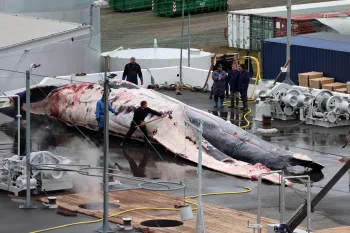
So far this hunt season, a total of 80 adult fin whales out of a quota of 150 have been killed in Iceland, plus at least seven unborn calves filmed being cut out of their mothers and dragged away at the whaling station, who are not counted as part of the quota.
The Parliamentary Agenda of the 158th Legislative Session 2026-2027, published on the government’s website, contains a list of bills to be introduced, including a “Bill to amend the Whaling Act, No. 26/1949 (Revision)”.
Wendy Higgins at Humane World for Animals says: "This is a really significant milestone in efforts to consign to history Iceland's cruel and needless whale hunts. There is considerable political and public support for this bill to ban commercial whaling, and compelling ethical, veterinary, legal and conservation reasons to hope it succeeds. Every whale killed by exploding harpoon in Icelandic waters, is a tragic loss of life needlessly taken for an industry that has no purpose. A law to stop the killing can't come soon enough."
The bill announcement reads (translated from Icelandic): “The bill proposes a comprehensive revision of the Whaling Act. The current Whaling Act dates from 1949 and has changed little since its enactment. The bill will be based on the 2024 report of a working group on the administration and legal framework of whaling. Particular consideration will be given to the views expressed therein regarding a permanent ban on whaling as well as the constitutional issues that would need to be considered in this regard, including with regard to freedom of employment and property rights. February.”
In July, a host of high-profile British stars including Dame Judi Dench, singer songwriter Leona Lewis OBE and renowned photographers Mary McCartney and Rankin, wrote a letter to Icelandic Minister of Industry Hanna Katrín Friðriksson expressing their "deep sadness" at the whale killing and urging Iceland to ban whale hunting.
Whaling facts
-
Fin whales are classified by the International Union for Conservation of Nature as globally vulnerable to extinction.
-
In 2023, an independent report released by the Icelandic Food and Veterinary Authority found that some whales killed in Icelandic hunts took up to two hours to die and that 41% of whales suffered immensely before dying, taking an average of 11.5 minutes to die.
-
Prior to this year’s whale hunt starting, Minister Friðriksson made a pledge to introduce a legislative bill to ban whaling in the autumn.
-
Iceland, Japan and Norway are the only countries in the world to continue commercial whaling, defying a global moratorium by the International Whaling Commission enacted in 1986. In the past two decades, Iceland has killed more than 1,000 fin whales.
-
Most Icelanders don’t eat whale meat. The vast majority of whale meat is consumed by foreign tourists in a handful of tourist restaurants. Around 2.3 million foreign tourists visit Iceland each year, including more than 240,000 from Britain who make up the second largest percentage of foreign visitors to Iceland after the United States.
-
Whale meat is misleadingly marketed to tourists as an Icelandic delicacy despite the fact that less than 2% of Icelanders eat it.
-
Japan was once the biggest consumer of Icelandic whale meat through importation, but this trade has ceased because Japan has a whale meat stockpile due to lack of local appetite. It has also expanded its own whaling. Most of the fin whale meat currently sold at Iceland’s tourist restaurants comes from whales who have been killed by Norwegian hunts.
ENDS
Download photos of Icelandic whaling 2026 credit Micah Garen: HERE