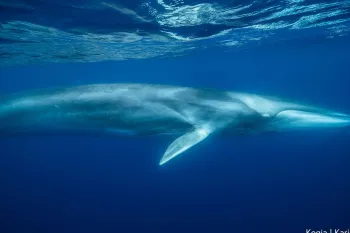
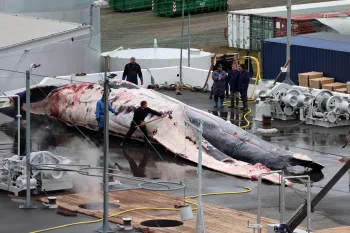
LONDON― Dame Judi Dench and a host of other high-profile British stars have written a letter urging Iceland to ban whale hunting, expressing their "deep sadness" that 18 fin whales have been slaughtered since this year’s hunt began last month.
The letter to Icelandic Minister Hanna Katrín Friðriksdóttir follows the resumption of commercial whaling after a two-year hiatus. Co-ordinated by Humane World for Animals (formerly called Humane Society International) the letter was signed by Dame Judi Dench, singer songwriter Leona Lewis OBE, renowned photographers Mary McCartney and Rankin, Round the World sailor Tracy Edwards MBE, comedian Ricky Gervais, poet and broadcaster Pam Ayres MBE and actor and playwright Sir Mark Rylance.
The celebrities wrote: “At our time of writing, we are distressed to learn from Humane World for Animals that 18 beautiful fin whales—including one pregnant female and her unborn baby—have been killed, and that one whale was shot four times with exploding harpoons and took an agonising 31 minutes to die.”
Fin whales are classified by the International Union for Conservation of Nature as globally vulnerable to extinction. In 2023, an independent report released by the Icelandic Food and Veterinary Authority found that some whales killed in Icelandic hunts took up to two hours to die and that 41% of whales suffered immensely before dying, taking an average of 11.5 minutes to die.
Prior to this year’s whale hunt starting, Minister Friðriksson made a pledge to introduce a legislative bill to ban whaling in the autumn.
The letter continues: “We stand with the very many people across Iceland who do not want to see this whale slaughter continue, who want to begin a new chapter in Iceland's relationship with whales, one built on respect, compassion and fealty for nature. When you recently pledged to introduce a bill to ban commercial whaling in Iceland, the world cheered you on. In doing so, you can turn the page on killing whales for a meat that has virtually no viable market, and instead make Iceland a world leading destination for peaceful, harmonious whale watching tourism. Please let these be the last whales to die in Iceland's hunt.”
Iceland, Japan and Norway are the only countries in the world to continue commercial whaling, defying a global moratorium by the International Whaling Commission enacted in 1986. In the past two decades, Iceland has killed more than 1,000 fin whales.
Dr Joanna Swabe, Humane World for Animals Europe’s senior public affairs director, said: “It is so disheartening to see Iceland’s whaling boats slaughter whales again despite overwhelming evidence that there is no humane way to kill a whale and that these ocean giants will very likely endure an agonising death for meat that virtually no one in Iceland wants to eat. This is not only the second largest animal on the planet but also a species classified as globally vulnerable to extinction. Such killing is cruel and indefensible. We urge the Minister to introduce a bill to ban whaling as soon as possible, but it is devastating that it will come too late to stop the killing this summer.”
Fast facts:
- Most Icelanders don’t eat whale meat. The vast majority of whale meat is consumed by foreign tourists in a handful of tourist restaurants. Around 2.3 million foreign tourists visit Iceland each year, including more than 240,000 from Britain who make up the second largest percentage of foreign visitors to Iceland after the United States.
- Whale meat is misleadingly marketed to tourists as an Icelandic delicacy despite the fact that less than 2% of Icelanders eat it.
-
Japan was once the biggest consumer of Icelandic whale meat through importation, but this trade has ceased because Japan has a whale meat stockpile due to lack of local appetite. It has also expanded its own whaling. Most of the fin whale meat currently sold at Iceland’s tourist restaurants comes from whales who have been killed by Norwegian hunts.
Download photos of Icelandic whaling 2026 credit Micah Garen: HERE