
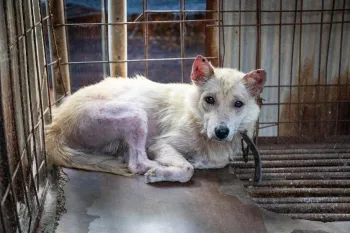
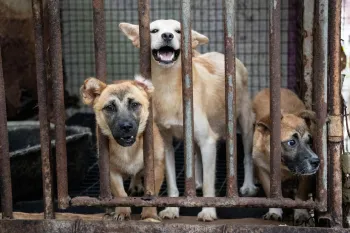
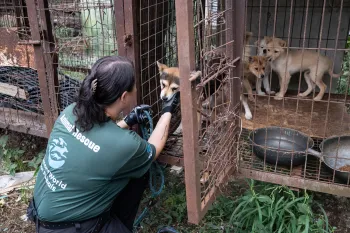
We have identified a dog meat farm in Gangjin, South Korea where approximately 70 dogs have been enduring terrible conditions.
A member of the public alerted a local group to the farm, who asked Humane World for Animals Korea for assistance. Together, our two groups reported the farm to the authorities, and it was officially confirmed to have violations of the Animal Protection Act relating to animal husbandry and management. The local authorities obtained a signed statement from the farmer relinquishing ownership of the dogs to us and his written commitment to no longer participate in the dog meat industry.
This will be Humane World for Animals’ final large-scale dog meat farm rescue in South Korea before the country's ban on the industry takes full effect in February 2027. It marks more than a decade of our commitment on the ground to successfully see an end to this cruelty.
Jean Chung/For Humane World for Animals
Jean Chung/For Humane World for Animals
Conditions on-scene
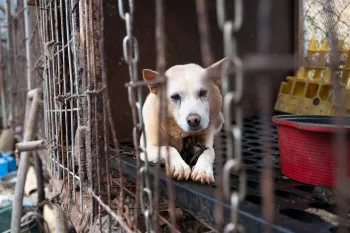
- The large farm had at one point held as many as 1,000 dogs who were held in cages or on chains, confined across the property.
- The farmer is in his 80s and took over the farm around three years ago after the original owner developed lung cancer. He never intended to run a large-scale dog farming business, and many cages are left empty as a stark reminder of the number of dogs that used to be bred and slaughtered on the farm.
- Like many of our previous farm rescues and closures, this farm has lots of mixed breeds and sizes of dogs. The farmer said he took unwanted small dogs from neighbors or locals which contributed to the mixture of breeds. Unwanted puppies often end up being given to dog meat farms like this one, either directly handed over to the farmer or simply abandoned at the farm gates.
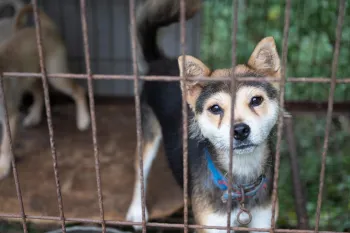
- Some of the dogs were found wearing collars and may have been relinquished by previous owners. On many of our previous farm rescues and closures, we have found abandoned pet dogs on meat farms.
- The dogs on the farm have undergone the legally required health checks and vaccinations required for travel overseas. Most will fly to the U.S. in September to start their adoption journey, whereas a number of the puppies will fly to the U.S. in February 2027 with their mothers, as they are currently too young to fly.
Meredith Lee/Humane World for Animals
Meredith Lee/Humane World for Animals
Meredith Lee/Humane World for Animals
Meredith Lee/Humane World for Animals
Updates
September 15, 2026: More than 70 dogs, including puppies, have been locked away here, destined to be killed for their meat. They’ve lived like this for far too long with no way out, stuck in barren cages in the relentless heat and witnessing cruelty repeatedly. Many of them are still wearing collars. They’re scared, neglected and in desperate need of immediate rescue.
September 28, 2026: Today our team returned to the farm to begin final preparations for rescue and transport day. Veterinarians and animal care staff are conducting final health checks, confirming paperwork and travel documentation, and making sure dogs are ready to be placed in their airline-approved travel crates. The team is also reviewing loading and transport procedures, identifying any dogs who may need additional support during handling, and making sure food, water, medications and equipment are ready for the journey ahead.
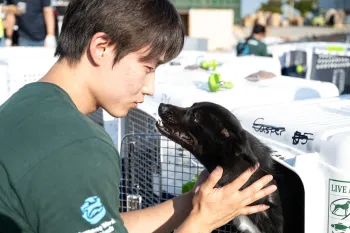
September 29, 2026: Rescue day has finally arrived. More than 70 dogs from the Gangjin dog meat farm are now safe. After years of deprivation and neglect, they have been given a chance of a future free from suffering. For the first time in their lives, these dogs are experiencing life outside their cages where many have spent years confined.
Our team carefully loaded the dogs for transport and will accompany them through the next stages of their rehabilitation so that they are ready for their journey to find loving homes. They will spend the evening at secure facilities at Incheon Airport in preparation for their flight tomorrow.
September 30, 2026: Today, the first group of rescued dogs departed South Korea and began their journey to the United States and Canada.
After spending the night in secure facilities at Incheon Airport, the dogs were prepared for their flight. Each underwent the health checks, vaccinations and documentation processes required for international travel, helping to ensure their journey is as safe and smooth as possible. For many of these dogs, this will be the longest journey they have ever taken, and the first step toward a completely different future.
The dogs will initially be cared for by Humane World for Animals at our rehabilitation center and then transferred to partner organizations to begin their search for adoptive families.
We will continue to urge the government to actively monitor and enforce the legislation after February 2027, ensuring that any more illegal farms are dealt with swiftly and decisively so that no more dogs will suffer on a dog meat farm in South Korea in the future.
Meredith Lee/Humane World for Animals
Your support is critical
You can help animals in need of urgent rescue and care by making a donation today. Please, give today if you can.
Despite the recent ban, thousands of dogs continue to suffer in the dog meat industry. Continued public support for implementing and enforcing the ban is needed.
-Julie Sanders, Humane World for Animals
FAQs
The legislation was passed in January 2024 and will go into full effect in early February 2027. As is standard practice when large-scale industries are dismantled for good, the time between the law passing and the ban being complete is a phase-out period, during which dog farmers, slaughterers and restaurant owners have been able to apply for government support to transition out of or close their businesses.
The majority of dog meat-related businesses in the country have now closed, with the final few required to close over the next several months. We continue to urge the government to use what remains of the phase-out period to work with animal protection groups like Humane World for Animals Korea to rescue as many dogs as possible in a state-sponsored, coordinated effort.
This rescue of more than 70 dogs will be our final large-scale dog farm rescue in South Korea. That is partly because the majority of dog farms have already closed—over 82% as of September 2026—so we are now very much in the sunset phase of the industry. However, even after the ban is in place, Humane World for Animals will remain fully engaged in South Korea to help ensure the dog meat industry is permanently eradicated and the ban is enforced.
Our commitment is unwavering: we will continue to monitor the ban's enforcement, collaborate with local authorities and partners to protect animal welfare, and intervene wherever our support can make a meaningful difference in ending the suffering of dogs.
The farm came to our attention after a member of the public reported it to a local partner group who asked for our help. Together, we reported the farm to the authorities, who officially identified it as having violations of the Animal Protection Act relating to animal husbandry and management. The authorities obtained a signed statement from the farmer relinquishing ownership of the dogs and his written commitment to no longer participate in the dog meat industry. Humane World for Animals stepped in to rescue the dogs and fly them to the USA where they will complete their veterinary care and rehabilitation before being made available for adoption via the Humane World for Animals Shelter and Rescue partner program.
As the dogs will be flown to the United States for overseas adoption, they must complete a quarantine and vaccination period in order to be granted all the health certificates legally required for transport. The farmer allowed our team access to do this, and while there, we were able to photograph the dogs and document the conditions in which they were kept. We also made improvements to the dogs’ living conditions while they remain quarantined in place for vaccinations, conducted random inspections to make sure the dogs are safe and well-fed, and treated any minor injuries or illnesses while we established a concrete plan to transport the dogs. Rescuing a large number of dogs and bringing them to safety in compliance with local and international law is a huge undertaking that requires substantial funding, planning and coordination. We are committed to the rescues we take on and the safety of the animals is our first priority.
The farmer is in his 80s and took over the farm around three years ago after the original owner became ill. As the farm has already been shut down by the authorities, considering his age, he is likely to retire.
There is no evidence that these dogs were stolen. Some of the dogs were found wearing collars and may have been relinquished by previous owners. On many of our previous farm rescues and closures, we have found abandoned pet dogs on meat farms.
We believe that all suffering matters and we campaign around the world on behalf of all animals who suffer for the food industry, not just dogs but pigs, cows, sheep, chickens and many more. We expose the cruelty of all forms of factory farming, campaign for that cruelty to end and encourage a global transition to more compassionate plant-based food choices promoting meat-free and dairy-free eating to protect animal welfare, human health and the planet.
Although we can’t stop the suffering of all animals for the food industry in the short-term, we shouldn’t use the suffering of pigs or chickens in one country as an excuse for inaction to stop the suffering of dogs and cats in another country. We recognise that humans have developed a particularly special bond with dogs and cats and as a result there is widespread support—including across Asia—for an end to killing of dogs and cats for meat. By working with that momentum for change, we can make a difference now to the lives of millions of dogs and cats, while at the same time advocating for compassion towards all animals.
When it comes to animal suffering, geography really should not matter. What matters is that these dogs desperately need help, and we are lucky to be in a position to help them, especially since there is insufficient widespread acceptance of dog adoption in South Korea currently.
Many of our Shelter and Rescue Partners who care for our South Korean dogs in the U.S and Canada report increases in public adoption enquires about all of their dogs. So, our Korean ambassador dogs are helping their canine cousins in other countries find homes, too. They also act as ambassadors to raise public awareness about the dog and cat meat trade, and their happy ending stories help build support for more bans on this cruel trade across Asia.
Most Koreans don’t view eating dog meat as part of Korean culture. It’s a habit of a small minority of society but it doesn’t define a whole nation. It is important not to misrepresent this as a West versus East issue because that does an enormous disservice to the extremely passionate campaign by South Koreans themselves for an end to the dog meat industry. It is local public and political opposition toward the dog meat industry that has created the opportunity for this legislation to ban it. Change has come from within South Korea and Humane World for Animals’ Korean team has been proud to have played a key part in that change.
The dogs from this farm rescue will be flown to the United States, where they will spend time at our care and rehabilitation center before being placed with U.S.- and Canada-based members of our Shelter and Rescue Partners Program, who will start their search for adoptive families. Humane World for Animals does not facilitate any adoptions, and our shelter and rescue partners each have their own adoption policies and criteria. At this point, we do not know at which shelter and rescue partners the dogs will be placed. As placement arrangements are confirmed, we will update this page with that information. Note: these dogs are for adoption within the United States and Canada only.
Please note that the dogs on this farm endured lives of almost total deprivation, confined in barren, metal cages, without adequate food or care. Many of them have required treatment for malnutrition and skin infections. Once they are in the U.S., they will need time to recover from their ordeal and have any health or behavioral issues addressed. Therefore, we cannot predict the length of time it may take before they are ready to be placed at shelter partner facilities.
Your donation will help us bring these 70 dogs to the U.S. and Canada, where they can find loving homes and serve as ambassadors to raise awareness of the dog and cat meat trade. Since 2015, Humane World for Animals has rescued almost 3,000 dogs from dog meat farms in South Korea. This work can only be done with the help of our supporters. Expenses of these rescues include Korean veterinary costs (vaccinations, health certificates, veterinary treatment etc.), transport in Korea, food and supplies for dogs, airline dog crates, flights for dogs, transport of our rescue team, boarding care for mums with young puppies too young to fly yet, truck transport of dogs in the U.S., care and rehabilitation in the U.S. and Canada, expert medical and behavioral treatment, and more.
Your donation will also help us continue our work around the world to help all animals, which includes monitoring enforcement of the dog meat ban in South Korea, as well as continue funding our work to bring an end to the dog and cat meat trade in Viet Nam, India, China and Indonesia. Our work includes political engagement, animal rescues, livelihood conversions, public awareness campaigns, and community engagement.
Related
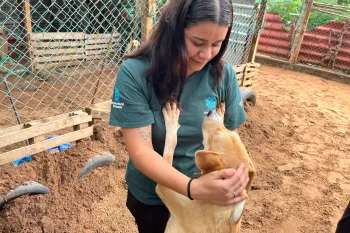
We rescue, transport and rehabilitate thousands of animals every year.
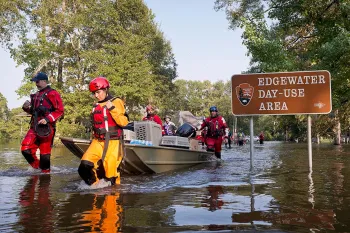
When disaster strikes, Humane World for Animals' Rescue Team leaps into action, working with local agencies.

From emergency rescue to months of recovery, every animal's second chance takes time, resources and compassion.
Your gift can do so much for animals in need
Start saving lives by making a one-time gift today. You can also help animals all year long with a monthly contribution.
Meredith Lee /Humane World for Animals