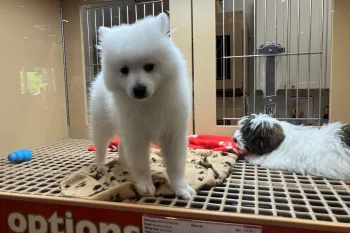
We're fighting to stop puppy mills from every angle—advancing legislation to end puppy mill sales from pet stores, conducting undercover investigations, promoting public awareness and education about the realities of commercial dog breeding facilities and assisting law enforcement officials when dogs from puppy mills need rescue. A couple of years ago, we assembled a team to deploy to Oklahoma to help more than two hundred dogs. It was one of the largest puppy mill rescues in recent Oklahoma history. Ashley Tucker, our program manager for outreach on our Stop Puppy Mills team at Humane World for Animals, joined. What she saw there has stayed with her and lent added meaning to her work. Here’s her story.
There are moments in animal welfare work that stay with you forever.
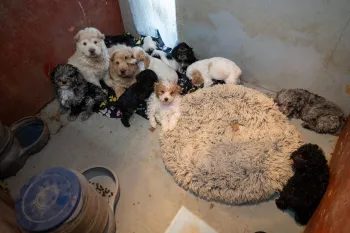
For me, one of those moments came in March 2024, when I deployed with our Animal Rescue Team to assist in the rescue of more than 200 dogs from two Oklahoma puppy mills. Law enforcement officials had requested assistance after allegations of animal cruelty surfaced, and our team was called in to help bring the dogs to safety.
People often ask what it's like to be part of a large-scale rescue operation. The truth is that one of the hardest parts isn't the rescue itself, it's the waiting beforehand.
These operations require extensive planning and coordination. There are legal considerations, veterinary preparations, transportation arrangements, and countless details that must be addressed before a team can deploy. All of that is necessary. But once you know a situation warrants a rescue, every hour feels painfully long.
I remember thinking about the dogs we hadn't yet reached and wondering if they were suffering. There was nothing I could do to help them in that moment except communicate with them in my heart:
“Try to hang on just a little longer. We’re coming.”
When we arrived, some of the things I saw reinforced exactly why these rescues matter.
Meredith Lee/Humane World for Animals
Some of the dogs were found outdoors with only partial protection from the weather. I remember seeing makeshift roofing over some of the enclosures, rusty, worn, and deteriorating. The dogs were living, breathing animals who depended entirely on human beings for their care. Yet they were being kept like mere objects in the yard.
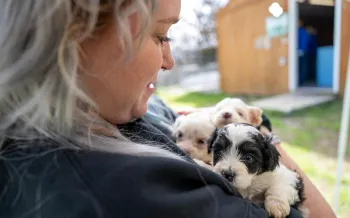
There is one dog I keep thinking about, a heavily pregnant basset hound who was lethargic, pale—and apparently also in labor. After the rescue, she was rushed for emergency veterinary care. She gave birth to a large litter of puppies. But veterinarians soon discovered that her condition was serious. Despite every effort to save her with emergency surgery, she did not survive. I think she hung on until she knew her twelve puppies were with caring people. Had our team arrived even one day later, she may have died without the dignity of care.
Whenever people ask why these rescues are so urgent, I think about that mother dog. Because her story reminds us that these situations are not theoretical. They are matters of life and death for animals whose suffering is often hidden from public view. It’s also what stayed with me long after the rescue, and what made what followed in Oklahoma so troubling.
Rather than addressing the cracks in the state’s commercial breeder law that allowed this suffering to persist at state-licensed facilities, state lawmakers pushed legislation (in 2019, 2025 and 2026) designed to protect Petland and other puppy mill retailers in the state. The bills would have stripped cities of their right to protect animals and consumers from the puppy mill pipeline by outlawing local regulation of puppy stores.
What made those efforts especially troubling was how disconnected they were from what we had seen firsthand. Puppy mill cruelty wasn’t an abstract issue or something happening far away; it was happening in Oklahoma’s own backyard. We had seen it, walked through it and carried those dogs to safety.
And yet after one of the largest puppy mill rescues in recent Oklahoma history, when Oklahomans were looking to their elected officials to address puppy mill cruelty, the response of many in the legislature wasn’t to try to support or strengthen state protections, but to try to take local protections away.
But in a win for animals, each time we were able to defeat these dangerous efforts. This year, Petland and their lobbyists got the bill through the House, but we prevailed in the Senate. Fortunately, a broad coalition of advocates, animal welfare organizations, businesses, local leaders and animal-friendly legislators came together and worked relentlessly to stop the bill and prevent it from receiving a vote on the Senate floor. That victory mattered because communities shouldn’t be forced to support a system that creates and perpetuates the kind of suffering we witnessed. It mattered because progress shouldn’t be reversed when animals are still languishing. And it mattered because change often starts closest to the problem.
Deployment with our Animal Rescue Team was one of the most meaningful experiences of my life. It was also one of the most heartbreaking. But it reminded me that rescue and advocacy go hand in hand. Rescuing animals from cruelty is essential, but every animal rescued from cruelty also deserves something else: A system that prevents the suffering we had to rescue them from in the first place.
Ashley Tucker is program manager for outreach on the Stop Puppy Mills team at Humane World for Animals.