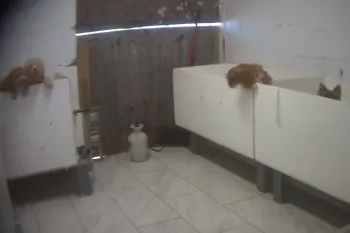
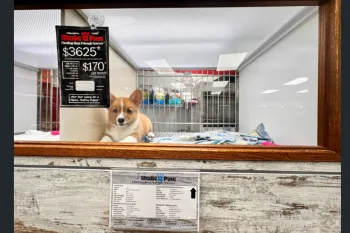
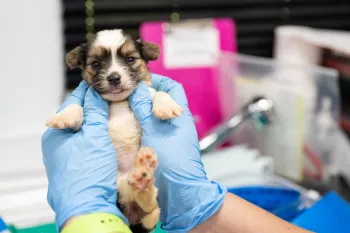
In December 2025, we released the findings of our undercover investigation of Sportsman’s Kennels, a dog breeding facility on Long Island in Suffolk County, New York. This breeder has appeared in Humane World for Animals’ annual Horrible Hundred report on known puppy mills five different times based on violations listed in state inspection reports. Undercover investigations are indispensable for exposing how animals are really treated. It is thanks to the people willing to go undercover that these findings can come to light. Here, our undercover investigator, who will remain unnamed, tells the story of the firsthand experience of going undercover for a month at that Suffolk County puppy mill.
When I first took on this case, I knew after day one it was going to be the most mentally taxing case I had ever received in my career as an investigator. I had no idea what horrid things I was going to witness yet, but I knew no place like this could exist without suffering.
My suspicions were confirmed when I saw how Sportsman’s Kennels’ dogs—both its puppies who were for sale and its breeding adults alike—were treated no differently from a poorly managed cash investment. Life-or-death medical emergencies were handled by unqualified employees to avoid expensive veterinary visits. But such cost-saving shortcuts risked costing the animals their lives. And this mistreatment was all concealed from the people who arrived, seeking to add a dog to their families.
Hiding the truth from customers
Customers thinking of purchasing a puppy could request viewing the parents. This was a ruse to earn their trust, but it was all an act: When a customer would request to view a puppy’s parents, there was a standard procedure for how to do this. First, the dog would need to be looked over by the employee. Nails would be trimmed, matting removed, fur brushed out, a quick bath not nearly thorough enough to really clean them, and a strongly scented citrus spray would be applied to the dogs to cover any leftover odor. Often, it was when a customer wanted to view them that they would ever get cared for like this. You can imagine how infrequently this would happen. If the employees couldn’t clean and care for the parents quickly enough, it was normal to do as much as possible with the time constraints and then simply show the parent dogs to the customers by carefully holding them in ways that hid any matting or problem areas that couldn’t be addressed in time, while the fragrant spray covered the stench.
After being viewed by the customer, they would be thrown back into their dark and damp kennels out of view. Customers who did take the time to look closer at the parents would comment on their appearance and promptly leave. Sadly, many would fall for this act.
The lies and deception didn’t end there. Customers are required to put down a substantial amount of deposit money if they want a specific puppy, marking that puppy as theirs until he or she is old enough to go home with them. Despite being the future new owners, customers would usually never be informed if their puppy suffered an illness, injury, or had to be taken to the veterinarian under Sportsman’s Kennels care.
The sick Yorkie
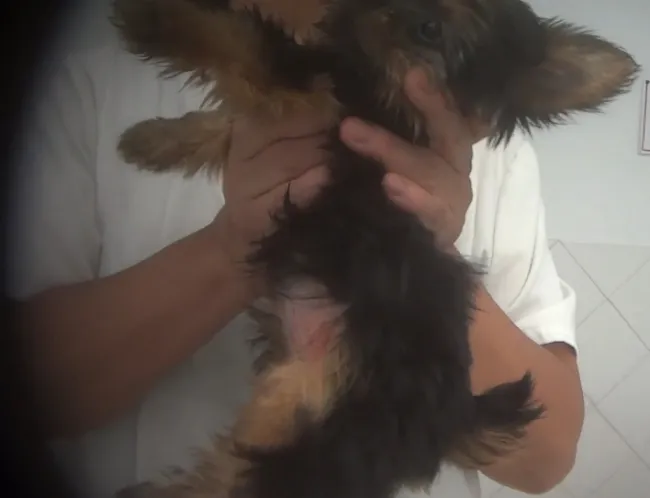
During my time there, there was a litter of tiny Yorkshire terrier puppies. Their own mother had mysteriously died around when they were born for reasons nobody was willing to admit to me, so these puppies had a surrogate mother, a Maltese. When they reached 8 weeks old, these puppies were removed from their surrogate mother. For puppies that small, the days following being taken from their surrogate mother are the hardest, and often scariest since their little bodies are still so sensitive. Within a few days, one little female from this litter crashed overnight. She had been lively and active the day before, and then, by around 7 a.m. the next morning, she was found barely responsive, unable to even move her little head.
Humane World For Animals
She was not taken to the veterinarian until 2 p.m. that day, when I arrived for my shift. I immediately rushed her to their local veterinarian, where they quickly assessed her situation as urgent and began lifesaving measures. She spent a couple days at the clinic, receiving emergency care. Thankfully, she survived. She was released back to Sportsman’s Kennels.
This little pup had a deposit on her from a family who wanted her to come home with them once she was old enough. They were never informed she had nearly died and had been at a veterinary clinic for round-the-clock care. When I suggested informing the owners of her status after the complication had resolved and she had returned to her normal, playful self, the owner of Sportsman’s Kennels insulted me, asking if I knew what my IQ was before promptly telling me my IQ was “not that good, I’m gonna tell you right now,” and adding that bringing up something like that to them “would be stupid.” As if they had no right to know about the condition of the seemingly healthy puppy they had bought.
Neglect as a way of doing business
The everyday work was also abysmal. Budget restrictions demanded a daily, constant battle of trying to find enough food around the facility for all the puppies and adult dogs on site. It was not unheard of for meals to be hours late or not given at all if there was no kibble left anywhere in the building, with the promise of “we’ll pick up more tomorrow.” Smaller-breed adult dogs and puppies would be moved from place to place by stressed employees who harshly grabbed the skin on the back of the dogs’ necks. Sometimes, even dogs weighing 30 pounds or more were lifted and dragged. The breeding facility was an operation that really needed dozens of employees to appropriately tend to the hundreds of dogs on site, but instead it was run by an average of three employees every day. Such understaffing was a recipe for rampant neglect.
Many of the breeding adult dogs were neglected beyond belief, even though they were the canine mothers and fathers upon whom the business solely relied. I saw patches of fur on their bodies that were matted down to the roots, irritating and pulling on their skin with each and every movement and causing hair loss. Ear infections were sometimes so severe you could smell them from several feet away. Ribs were visible, and hips noticeably jutted out. Nails were overgrown to the point of discomfort, if not pain, with each step. The feet of some dogs seemed to be permanently stained with a murky brown tinge up to their ankles. Some had dried feces between their toes and paw pads. Baths were a luxury for these dogs; there was no set schedule for bathing and never any spare time to devote the attention that bathing requires. The areas these adult dogs were housed in reeked of urine, feces and decay so strongly that I can still summon the scent in my memory.
Since our investigation came out, people have been raising their voices for the dogs at this puppy mill. Local groups have been demonstrating in front of the facility urging local authorities to take action.
Animals should never be treated like mere commodities. We must all come together to help stop puppy mills for good.
The author of this blog is an undercover investigator for Humane World for Animals whose name has been concealed.