In a historic stand against animal cruelty, Switzerland has become the first country in the world to ban both the import and sale of fur.
Last year, the Swiss Federal Council banned all imports of fur and fur products produced using “methods that involve cruelty to animals.”
Now, the country has taken the next logical step, banning the sale of fur products within its borders, and thus setting a hugely important example for other countries to follow.
As we highlighted last year, we are still waiting on some final details on the exact meaning of “methods that involve cruelty to animals.” What we do know is that this will be decided by the Swiss authorities, not the fur trade, and we strongly encourage them to ensure it includes all sources of fur production.
Given the recent scientific opinion from the European Food Safety Authority and testimony from veterinary associations around the world, anything less than a full ban on products from animals farmed or trapped for their fur would be a travesty.
That’s because there is no way to humanely raise or kill an animal for their fur.
Switzerland’s move should become a watershed moment to end the fur industry once and for all. It is high time for politicians in other countries to follow the lead.
Our team in the United Kingdom recently welcomed the publication of the Government’s Animal Welfare Committee’s opinion on fur sourcing. It made clear the brutal reality of farming and trapping animals for their fur but recognized that more needs to be done at a political level, stating that “consumer and market forces currently do not and cannot provide sufficient pressure to adequately safeguard animal welfare.”
Now the question becomes what can be done to finally put an end to fur.
The cruelty of fur is also a danger to everyone
It’s increasingly recognized that the factory farming of animals for fur is not only immensely cruel and unnecessary—it’s also a danger to public health.
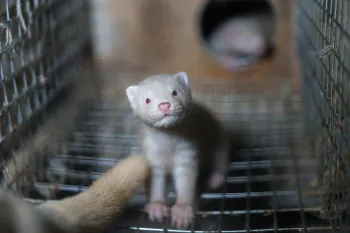
Fur farms pack animals closely together, making these hellish facilities the perfect place for viruses to spread. Because mink are vulnerable to both human and animal influenza viruses, keeping them in large numbers, in cages closely packed together, allows for the spread of COVID and other viruses to humans or other animals living on or near these facilities. In August, the first outbreak of avian flu (H5N1) on a U.S. mink fur farm underscores the urgent reality of these risks.
The cruelty and danger inherent in the fur industry is widely acknowledged. Now we need to harness political will to create permanent change for animals in this space.
The calls for a fur-free future are growing louder
This win for animals is also a reflection of just how weak the international fur industry has become. And it is also a testament to the steadfast work of campaigners on the ground there whose persistence has carried the issue forward, through the many legislative steps necessary for this historic outcome.
In this case, the fur trade had recently pushed hard to integrate its own industry-certification scheme into the process. Thankfully, this effort failed, as such scheme would have undoubtably watered down the effectiveness of banning fur imports and sales.
Meanwhile, in the UK, the FurFreeBritain campaign has the support of more than 200 Members of Parliament and Peers and the UK’s new Prime Minister, Andy Burnham, recently stated how he was “proud” of the action a previous Labour Government had taken in 2000 to ban fur farming. We urge him to follow Switzerland and move swiftly to introduce a ban on fur imports and sales. Such an initiative that would be as popular and as groundbreaking as that 2000 fur farming legislation. It would end the current double standard that allows the import of fur from animals from other countries who have been caged and killed in fur farms that would be illegal in the UK.
It is time, too, for the European Commission to publish its long-awaited proposal on the future of fur farming and trade in the European Union.
There is no reason for animals to suffer and die for the fur trade. The public knows it, and the calls for an end to the industry are getting louder. The evidence on animal welfare, public health, environmental damage and economic risk grounds is clear: the future must be fur-free.
Kristo Muurimaa/Oikeutta eläimille
End animal cruelty on the runway
Tens of millions of animals needlessly suffer and die every year for frivolous fur fashion.
Kitty Block is president and CEO of Humane World for Animals. Follow Kitty Block.