The U.S. Department of Agriculture’s announcement last week that it will suspend until December 31, 2026, the implementation of regulatory reforms designed to protect horses from soring conceals a bitter truth. In further stalling its enforcement of a final rule to prevent a stone-cold cruelty, the agency has abdicated its responsibility to protect horses under the Horse Protection Act, as directed by Congress. The announcement itself is proof.
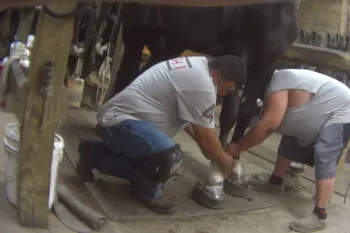
There is no need for additional evidence of the viciousness of horse soring (you can read more about it here and see it in the video below). Such evidence is abundant, from inspection reports, undercover investigations at Tennessee Walking Horse training barns and the prosecutions of several trainers. There is no reason—on any grounds—for the USDA to delay.
Progress for some animals, but not others
Just one month ago, USDA Secretary Brooke Rollins joined with two other cabinet secretaries—Attorney General Pam Bondi and Health and Human Services Secretary Robert F. Kennedy Jr.—to announce their joint commitment to stronger animal welfare policy and enforcement. Rollins concentrated her remarks on puppy mills and her determination to secure greater compliance with Animal Welfare Act regulations. “It’s a new day at USDA,” she said.
We were heartened by Secretary Rollins’ expressed support for better regulation and enforcement regarding puppy mill cruelty, just as we appreciated Attorney General Bondi’s comments on the topic of animal cruelty laws, and Secretary Kennedy’s vision for reducing the use of animals in testing. We would be thrilled to see the three of these leaders follow through on these commitments and surpass the efforts of their predecessors. But as of today, the contrast between these statements and the USDA’s slow-walking approach to horse soring is stark.
In fact, in areas such as horse soring and protecting farmed animals, there is active regression and opposition. In the case of horse soring, this includes rolling back longstanding enforcement tools as well as regulatory delays. And the nation’s strongest farmed animal protection law, Proposition 12, which has been upheld by the Supreme Court of the United States, is under federal attack, along with a dozen other similar laws to protect farm animal welfare and public health enacted in states red, purple and blue.
Acting as if some animals are more equal than others
We cannot lose focus on the fact that the Department of Justice is reinforcing those attacks with lawsuits intended to cripple some of the most important animal protection statutes ever enacted. Together, the USDA and the DOJ are taking the same short-sighted position against voter-supported animal protection reforms in the agricultural sector that the Biden administration did, but they’ve taken it up a notch by suing to block these laws in California and Michigan. They even suggest that high egg prices and pork industry problems are caused by these laws, instead of acknowledging true underlying causes such as industry price fixing and avian flu.
We were truly encouraged by Secretary Kennedy’s commitment to advancing alternatives to animal testing within the National Institutes of Health and the Food and Drug Administration. Even so, we can’t view the dietary guidelines he and Secretary Rollins recently announced without noting that these directives are clearly driven more by the priorities of Big Meat and Big Dairy than by our nation’s public health interests. They’re not just pushing an inverted food pyramid; they’re taking the nation in the wrong direction.
Secretary of the Interior Doug Burgum has just provided another striking example of this policymaking discordance—writing to U.K. politicians to tout the so-called benefits of trophy hunting. The Secretary’s outreach to the UK stands in direct contradiction to other efforts by the Trump administration—including Interior’s own U.S. Fish and Wildlife Service—and U.S. lawmakers to confront global wildlife trafficking in a serious way. Disjointed and compartmentalized laws and regulations controlling the legal trade of wildlife species will inevitably provide cover to wildlife traffickers, making it easier for them to disguise their illicit activities as legitimate and lawful.
Elected officials must listen to voters, not special interests
The selective application of animal welfare principles is not a new pattern of conduct, but in the current moment, at the federal level, it is a troubling and conspicuous challenge. There are too many appointed and elected officials kowtowing to industry groups attempting to distort the public debate over our responsibilities toward animals, and to pick and choose the animals to whom we have moral and practical obligations. Democrats do it, Republicans do it and Independents do it.
We think that’s wrong, and we are not alone. These officials represent millions of Americans who share our fundamental view that as individuals and as a nation, we have duties of care and concern for all animals and all species. The beliefs and convictions of countless Americans should not be excluded from public policy just because a few powerful interests are threatened.
To the contrary, the public’s views are precisely those that should shape the agenda and policies of our federal government. It’s the will of the people, not the economic drivers of the National Pork Producers Council, the horse sorers or the trophy hunting lobby, that should determine the fate of animals in this and other nations.
What you can do to help horses and other animals
All of this makes the soring rule a litmus test for the Trump administration. When it comes to soring, there are no questions of jurisdiction, morality, difficult trade-offs or practical necessity. There is just the wanton cruelty that has persisted for so long. The rule shelved by the USDA reflects years of investigation, public input and administrative review. It was specifically intended to end industry self-policing and stop the deliberate infliction of pain on horses to force extreme movement in competition.
We have repeatedly documented how industry self-policing has failed horses for decades, allowing widespread abuse to persist. This rule represents the most serious update to Horse Protection Act enforcement in decades. It enjoys bipartisan support, eliminates industry involvement in enforcement and establishes a federally supervised cadre of inspectors to prevent sored horses from entering competition. The USDA already has a statutory obligation to enforce the Horse Protection Act, and the agency should stop playing games and embrace its animal protection duties in this and every other area in its purview.
Tell the USDA to end horse soring now.
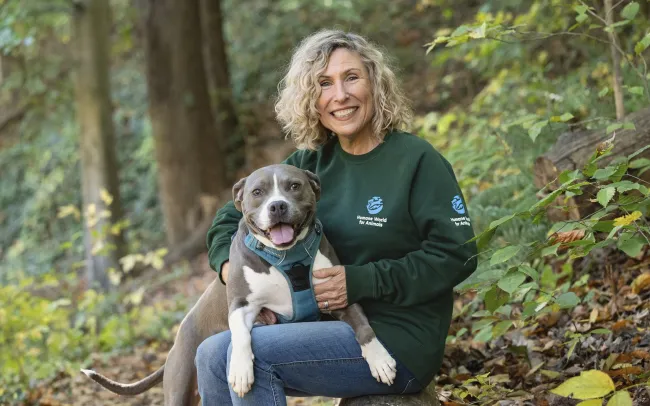
Kitty Block is president and CEO of Humane World for Animals. Follow Kitty Block on X. Sara Amundson is president of Humane World Action Fund.