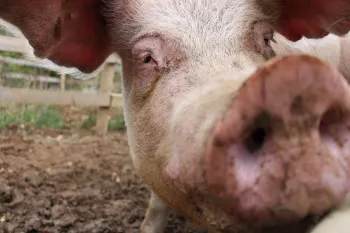
For many years, in the halls of power, and in public discourse, we’ve defended hard-earned progress for farmed animals. Most recently, this has meant holding the line against the Save Our Bacon Act in the Farm Bill and appropriations legislation to ensure there’s no undermining of California’s Proposition 12—widely considered the strongest law for the protection of farmed animals—and laws like it in other states.
Now, as the 119th Congress nears its close, we are determined to overcome any last-ditch attempts by the pork industry to wipe out Proposition 12 and other state-level laws that protect animals.
After the U.S. midterm elections, the CEO of the National Pork Producers Council conceded that it was unlikely a Farm Bill package would pass in the waning days of the 119th Congress. At the same time, he added that an attempt to destroy California’s Proposition 12 and other state-level animal welfare laws through other legislative means in the weeks ahead remains a possibility.
In gambling, that’s a tell, and we need to make sure it doesn’t become an eleventh-hour steal. To help prevent the dangerous Save Our Bacon Act from becoming law, you can take action now.
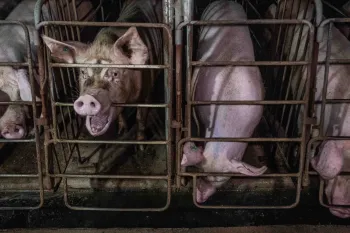
Konrad Lozinski/We Animals Media
Your voice is critical
The "Save Our Bacon Act" is bad for animals, consumers, and farmers. If it is enacted, hundreds of state laws protecting animals and addressing disease control, toxic materials, food labeling and more could be destroyed.
As a reminder: More than 7.5 million Californians (63%) voted for Proposition 12 in 2018; the Supreme Court upheld Proposition 12 in 2023; and it took full effect in January 2024. The law requires that mother pigs, hens used for eggs and calves kept for veal be given enough space to stand up, turn around and extend their limbs. It also bans the in-state sale of pork, eggs and veal produced via extreme confinement. Now, nearly a decade later, it’s clear that farmers are actively moving away from cage systems for farmed animals. And a total of 15 states across the U.S. spanning the political spectrum have now also enacted laws to address cruel confinement of farm animals.
We’re fighting to make the SOB Act the NPPC’s last sob story. And you can join us by calling your U.S. senators and representative and telling them right away to oppose the Save Our Bacon Act and its inclusion in any year-end legislative package.
As we work to kill this sweeping power grab of a bill, we can expect in the next Congress to see the pork lobby press for a vampire offshoot of the SOB Act, which was itself an offshoot of the EATS (Ending Agricultural Trade Suppression) Act in the prior Congress. And should such a bill be introduced or be appended to a future farm bill or other omnibus package, we will fight it as we’ve fought all other attempts to undermine the progress for animals voters have again and again advanced at the ballot box.
The National Pork Producers Council knows, as we do, and as most experienced legislators do, that with every year that passes, with every congressional session that begins and ends, with every additional state that enacts a comparable law on higher animal welfare standards, the prospects for gutting these voter-approved protections for animals grow dimmer.
Millions of voters in more than a dozen states have made their will clear, corporate supply and procurement chains have made their adjustments, and an ever-increasing number of pork producers and farmers have embraced the new standards.
At some point, the NPPC’s arrogance and indifference to public demand and the fundamental needs of animals will wear out the patience of the Congress, and the strength of better approaches will have taken too strong a hold in agriculture for the NPPC to overcome.
With a new Congress opening on January 3, we’re looking ahead to a new landscape of opportunities to do good for animals—all animals—and we are ready to get busy with a proactive agenda.
Some emerging priorities for farmed animals in the U.S.
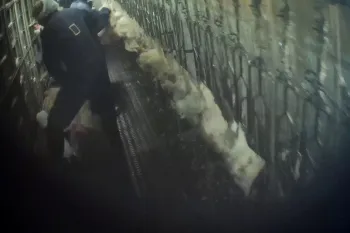
At least one of our priorities will be the neutralization of an abhorrent pair of rules concerning increasing slaughter line speeds for chickens, turkeys and pigs. That will put us right up against the NPPC, the American Farm Bureau Federation, the North American Meat Institute and a host of other factory farm trade associations that have never let concern for animals or human workers trouble their conscience.
To put it plainly, Big Pork and its allies want to intensify the suffering in industrial animal slaughter, making it still worse than it already is for the basic welfare of animals, the physical safety and psychological health of human workers, and food safety.
The rules that would increase slaughter line speeds are expected to be finalized soon, putting animals, workers and consumers at higher risk. For the sake of all of them and basic decency, we will challenge these and other merciless cruelties championed by Big Pork and its allies.
Looking ahead
The calls, letters and visits you made to your elected officials made this success possible in the 119th Congress. With over 100 newly elected legislators joining the 120th Congress in January, we will need your help to educate them on the importance of humane issues—and your help in giving a voice to the voiceless.
On the eve of a new Congress, it’s worth reflecting on the larger challenge that stands before us in our role as public policy advocates. It’s bigger than any particular fight.
It will involve building upon the power and influence we have already established. It will require cultivating even greater public support and unity around our message of concern for animals. It will demand that we do all we can to underscore for elected officials, corporate leaders and other constituencies the presence of a vast constituency for animals, a constituency that is determined to see higher standards of welfare and concern take hold everywhere in the world.
That’s who we are, and that’s what we’re about. We’ve shown it in the congressional session that’s coming to a close, and we’ll show it again in the one that’s about to begin.
Kitty Block is president and CEO of Humane World for Animals. Follow Kitty Block on X. Sara Amundson is president of Humane World Action Fund.