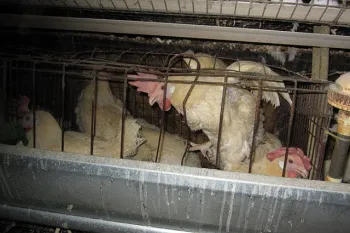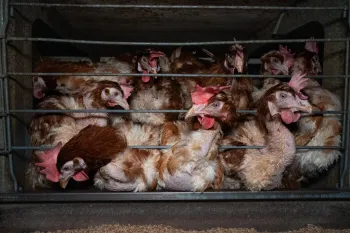
This week, a U.S. District Court in Michigan denied the U.S. Department of Justice’s lawsuit challenging Michigan’s cage-free egg law.
Michigan is one of 11 states that ban the use of cages for egg-laying hens and one of eight states that ban the sale of eggs from cage facilities. Michigan’s cage-free egg law, which improved upon its earlier law, passed with strong bipartisan support in 2019 and went into effect on Dec. 31, 2024.
The federal government’s lawsuit was utterly frivolous and disingenuous: It sought to blame high egg prices nationwide (which were actually caused by avian flu) on humane farm animal laws that have been upheld time and again by the courts, including the Supreme Court of the United States.
As creators, supporters and defenders of many of these state-level animal welfare laws addressing the cruelties and dangers of extreme confinement, we are pleased—but not surprised—by the District Court’s decision. We and our coalition of animal welfare organizations also intervened in this lawsuit. (Here is our statement at the time of our filing.)
The cracks in the argument against cage-free eggs
The District Court held that the U.S. government lacks standing to bring such a lawsuit, and it did not buy the DOJ’s claim that the law was responsible for higher egg prices, thus causing harm to consumers. In other words, the government failed to demonstrate a plausible injury to the United States.
That’s because there isn’t one. The Michigan suit is essentially a copycat of a case that the Trump administration filed in California, and both suits were filed long after many other suits filed by industry were rejected by the courts. These suits are about politics, not actual problems facing Americans. This is just one more instance in which the federal government has chosen to side with the backwards-facing segments of the factory farming industry, ignoring the millions of Americans who have signaled their desire for more compassionate and safer standards in agriculture.
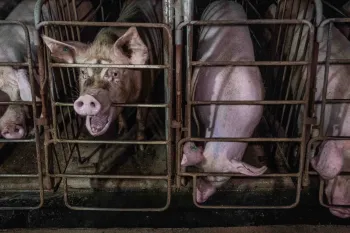
Against the tide of public opinion and the principles of good governance, certain Big Ag interests are determined to build a moat around the cruel and archaic production methods that cause animals so much misery and suffering. These intensive confinement systems are also the perfect environment in which zoonotic disease can spread, threatening the health of all of us.
The lawsuit was clearly part of the effort to resuscitate the failing cage-age for farmed animals. And once again, the backwards coalition of cruelty has lost its case.
Even egg farmers supported the Michigan cage-free law
Because the District Court held that the U.S. government lacks standing to sue in the matter, it did not address the merits of the DOJ’s preemption challenge. This challenge claimed that only the federal government can regulate eggs. This is similar to the argument that Big Pork and other special interests have made again and again. This argument is the basis for Big Pork’s ceaseless whining and bullying in the U.S. Congress and in every public forum in which they can get people to listen, whether that means having to lie about the source of price increases, pushing unsuccessful legal claims, or staunchly defending some of the most indefensible animal cruelty on earth.
What makes the Michigan case so plainly ridiculous is that the state’s egg farmers support the law that the suit would scrap and called the federal government out on it. Michigan Allied Poultry Industries filed briefs intervening in the case in support of the law. And nationwide, the egg industry is getting close to being comprised of 50% cage-free systems.
We won’t walk on eggshells to defend protections for farmed animals
Having lost in the District Court, the government can continue its challenge to Michigan’s law if it appeals to the Sixth Circuit within 60 days. The Trump administration should finally see that this kind of litigation has become a serious waste of time and resources. It is not helping voters, consumers, or egg farmers, especially those who have already made the more humane choice and investment to convert to cage-free systems.
The same can be said for the entire campaign by the National Pork Producers Council and other increasingly isolated groups to scuttle state-level laws through the Save Our Bacon Act and related maneuvers in the federal Farm Bill. (We’re fighting their SOB story there, too.)
The Trump administration, like the Biden administration before it, is on the wrong side of history when it comes to the ongoing legal and moral struggle over factory farming, and it really should find better ways to serve the public.
The lobbying groups and politicians trying to torpedo state-level farmed animal welfare and public health statutes are compulsive in their efforts to falsely blame California’s Proposition 12 and Californians for forcing their values on midwestern states. It’s easier to do that than it is to acknowledge the enactment of similar laws in midwestern states with strong agricultural sectors like Ohio and Michigan.
Every state law bearing on farmed animal welfare has made an enormous difference. These laws together have improved the treatment of countless millions of animals.
The federal government must stop debasing itself for those who want to keep farmed animals in cages and recognize the paradigm shift that has already begun. People all over the world are coming to the view that, if we use animals for food, we should care enough to ensure they live in conditions of higher welfare. And no matter where the coalition of cruelty goes next, we will be there, protecting progress for animals from these pathetic and groundless attacks.
Konrad Lozinski/We Animals Media
Your voice is critical
The "Save Our Bacon Act" is bad for animals, consumers, and farmers. If it is enacted, hundreds of state laws protecting animals and addressing disease control, toxic materials, food labeling and more could be destroyed.
Kitty Block is president and CEO of Humane World for Animals. Follow Kitty Block on X. Sara Amundson is president of Humane World Action Fund.