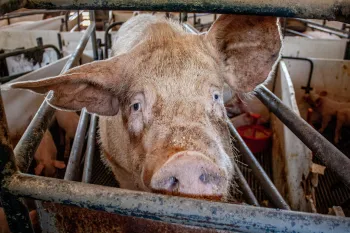
Update April 29, 2026: This week, an amendment to the proposed U.S. House Farm Bill that would have protected farm animals and preserved state animal welfare laws, including California's Proposition 12, was blocked from advancing for a vote before the full House of Representatives. In past Farm Bills, lawmakers on both sides of the aisle opposed attempts to override state animal protection and public health laws. More than 7.5 million Californians voted for Proposition 12 nearly a decade ago; the Supreme Court upheld Proposition 12 in 2023; and the market has already moved away from the extreme confinement of farm animals. You can urge your representative to oppose the Farm Bill that contains any language seeking to weaken or nullify any state animal protection laws.
--
The day of judgment has come for Big Pork’s last-ditch attempt to destroy the ability of states to enact farm animal protection laws. This week, the Save Our Bacon Act, the pork industry’s current vehicle for attacking these laws, will come to the House floor for a vote as part of the “skinny farm bill.” And that’s where we must stop it, in the U.S. Congress, as an act of true mercy for the suffering pigs who, by the millions, day after day and year after year, are the victims of Big Pork’s cruelty. If you’ve ever wanted to send a pointed message about bringing an end to intensive confinement in the pork industry, this is the moment.
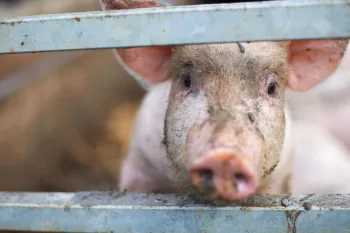
Konrad Lozinski/We Animals Media
Protect Prop 12
An upcoming Farm Bill is going to be used as a way to gut state animal welfare laws. Send a message to your U.S. Representative and urge them to preserve and protect Prop 12.
Big Pork’s wingman
If Big Pork had a wingman, it would be House Agriculture Committee chair Glenn Thompson, the man responsible for stitching the SOB Act into the “skinny farm bill.” Truth be told, this is not actually a Farm Bill at all. The key elements of traditional Farm Bills—substantial subsidies for American agriculture and rural communities—passed last year as part of a larger tax package, and the bill Thompson has sent to the full House is skinny on genuine benefits for real farmers and rural populations, because it’s not about them. As for the SOB Act, it’s a blatant stickup job for the factory farming interests that want to keep profits high and animal welfare standards low.
Of Thompson’s leadership in efforts to scuttle Proposition 12 and related state laws, the most important thing to say is this: It’s irresponsible—in the extreme. Inexplicably, he’s ignored the many farmers and producers, including some prominent and successful ones in his home state, who have embraced higher animal welfare standards. These parties have committed to practices that are in alignment with consumer demand and the growing shift in public attitudes about our responsibilities to animals. This is also the attitude of food service corporations, which, independently of the statutes enacted in state after state, have chosen to implement higher standards throughout their supply chains in the United States and abroad.
The pork titans do not recognize or admit that opposition to intensive confinement on animal welfare grounds is entirely justified. But it is. The whole fight over Prop 12 involves a dying business model that is out of step with American tastes and values, and no longer acceptable on moral or public health grounds. Prop 12, passed by California voters in 2018, simply bans the extreme confinement of mother pigs, egg-laying hens and calves used for veal in California, and outlaws the sale within the state of pork, eggs and veal sourced from extreme confinement.
The winds of change
More than a dozen states, red, blue and purple, have enacted bans on the extreme confinement of farm animals. An intelligent appraisal of the winds of change sweeping through the food production sector in recent years would have put Thompson and his Agriculture Committee colleagues in a position to champion a new path for pork production, one that is more sustainable, more humane and beneficial to smaller producers, and a whole lot better for the social, cultural, economic and environmental health of rural communities.
Instead, Thompson and other agricultural leaders have slavishly pandered to the National Pork Producers Council, the Iowa Pork Producers Association and the megadonor pork barons who stand up such tinhorn trade associations with their money. And now, amidst the obvious signs that there are many members of his own caucus who do not support the attack on state and local agricultural laws, Thompson has arrogantly forced this measure to a full vote.
The farm bill package Thompson has been pushing is under fire from many quarters, including a host of organizations that have decried the Agriculture Committee’s failure to restore cuts to the Supplemental Nutrition Insurance program, and a mix of Republicans and Democrats concerned about a provision that would create a uniform national pesticide label to preempt state and local mandates for stricter labeling of pesticides. The pesticide provision represents the same kind of backroom scale-tipping that has taken Big Pork’s campaign to overturn Prop 12 from serial losses in our court system (all the way up to the U.S. Supreme Court in May 2023) to its vampire-like resurrection by the congressional delegation from Iowa (Sens. Joni Ernst and Chuck Grassley, and Reps. Ashley Hinson, Mariannette Miller-Meeks, Zachary Nunn, and Randy Feenstra). With Chairman Thompson, they are determined to foist Big Pork’s bottom-of-the-barrel, zero-welfare pork production model on the rest of the nation. If Pork was a state, they would be its caucus members.
It’s time to settle this once and for all
We’ re grateful to Reps. Anna Paulina Luna (R-FL), Jim Costa (D-CA), Andrew Garbarino (R-NY), Brian Fitzpatrick (R-PA), Jeff Van Drew (R-NJ), Mike Lawler (R-NY), Jimmy Panetta (D-CA), Veronica Escobar (D-TX), Mark Takano (D-CA), Sarah McBride (D-DE), Lloyd Doggett (D-TX), Gabe Amo (D-RI), Nancy Mace (R-SC), Doris Matsui (D-CA), Kevin Mullin (D-CA), Nancy Pelosi (D-CA), Sara Jacobs (D-CA), and Vern Buchanan (R-FL) who have introduced a bipartisan amendment to remove the SOB Act from this package.
In the current environment, this is really stepping up, and it shows that these legislators believe, as we do, that it’s necessary to do so. The SOB Act is an unseemly bid to make a ghastly intensive confinement model for pork production, with its utter disregard for public health, animal welfare, water quality and environmental protection, the de facto standard of the United States.
We’re too good for that, and the citizens and legislatures of a host of states have made it clear that the dominance of this type of production will not be the future of the pork industry. That trend is certain to continue, and one day it will make intensive confinement of pigs a bad memory of a wrong turn taken in American agriculture.
The only useful thing about Big Pork’s underhanded ploy in forcing this provision in the Farm Bill is that it gives us a chance to mobilize the countless Americans, including farmers and producers who support and welcome higher animal welfare standards, to put these special interests in their place by sending their radical attack on the rule of law and animal welfare into oblivion, where it belongs.
Kitty Block is president and CEO of Humane World for Animals. Follow Kitty Block on X. Sara Amundson is president of Humane World Action Fund.