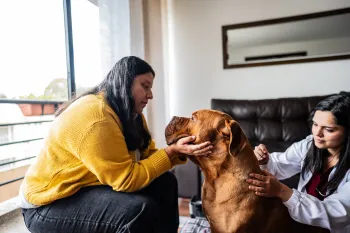
At 14 years old, Jack the corgi is struggling with aging. His back legs are wavering, spine is sagging, discs are bulging, and he has trouble standing. To address these challenges and improve his quality of life, Jack’s caregiver turned to veterinary acupuncture. Positive results followed, she told This Morning, a British talk show, “He walks a lot easier. When he’s had this, he goes home and lays down, and he just rolls upside down, legs akimbo; it’s more a relaxed sleep…He even actually plays with his toys a bit more.”
These effects dovetail with many seen in other animals undergoing acupuncture—and those results are helping drive the practice into the mainstream.
The science behind veterinary acupuncture
A growing body of scientific evidence—including the recent discovery of an interstitial system in the human body—backs the use of acupuncture for pain management and the treatment of certain neurological disorders. That goes for veterinary medicine, too. One 2023 study of acupuncture treatment for canine thoracolumbar intervertebral disc herniation showed a recovery rate of 80%. A 2026 meta-analysis of acupuncture for the treatment of intervertebral disc disease in dogs and humans found that “combining acupuncture with conventional treatment was significantly more effective than conventional treatment only.”
That complementary approach fits the methods of veterinary acupuncture practitioners like Dr. Barbara Hodges, program director of advocacy and outreach for Humane Veterinary Medical Alliance, and Dr. Bonnie Wright, a board-certified veterinary anesthesiologist and educator at Evidence-Based Veterinary Acupuncture. Both emphasize the integrative role of veterinary acupuncture in animal care, in concert with other therapies.
“A lot of medicine works better when we add something that’s not pharmacologic,” explains Wright. “Acupuncture is a great option for that, but so is exercise, physical rehabilitation, therapy and nutrition.”
FG Trade/Getty Images
Resources to help care for your pets
Find expert tips and trusted resources on pet care, animal behavior, humane wildlife management, and animal advocacy.
In veterinary medicine, acupuncture tends to address the chronic and acute pain associated with aging, including osteoarthritis, hip and elbow dysplasia, intervertebral disc disease and nerve damage. To a lesser degree, it may also help control seizure disorders, gastrointestinal issues, stress and anxiety, and disease impacts, especially in the kidney and liver.
Success is not guaranteed, of course, and not every animal responds equally, if at all.
“The things I think acupuncture works more than 90% of the time for are pain, some gastrointestinal conditions and neurologic dysfunction,” Wright says. “In the middle are things related to the immune system or an endocrine condition like diabetes. Those are more 60/40 or 50/50, depending on the condition.”
Ultimately, the goal is to nudge the body back into a state of homeostasis. Hodges defines this as, “The body is doing a good job on its own. It’s balanced. It doesn’t need too much tinkering.”
The more the body can achieve homeostasis, the less pharmacological treatment becomes necessary, or at least in large or prolonged degrees. This potentially saves the animal from suffering the negative long-term effects of some drugs, such as prednisone and other corticosteroids.
“Adding this nonpharmacologic side of medicine in, you aren’t trapped with just the drug,” Wright says.
That goes for acute pain, too. A 2026 study of the analgesic effects of acupuncture in cats undergoing ovariohysterectomy offers a case in point. It showed that acupuncture had similar effects to tramadol and meloxicam during the first 24 hours after surgery.
I take that as a compliment that they link me with a profound relaxation response.”
Dr. Barbara Hodges, veterinary acupuncturist and program director for HumaneVMA
How animals respond to acupuncture
All that said, not every animal will tolerate needles.
This is why Hodges and other practitioners start slow. “I might begin with five needles for the first treatment, including the calming points, and my first treatment might be 10-15 minutes,” she explains. “With long-term, older patients who are accepting of needle placement, the treatment can last 30-40 minutes.”
Most animals, however, do tolerate the needles remarkably well, Hodges and Wright say. That’s because the needles are very thin and bypass the skin’s sensitive pain fibers. Plus, most animals also realize that they feel very good during and after treatment, in part due to the endorphins acupuncture releases.
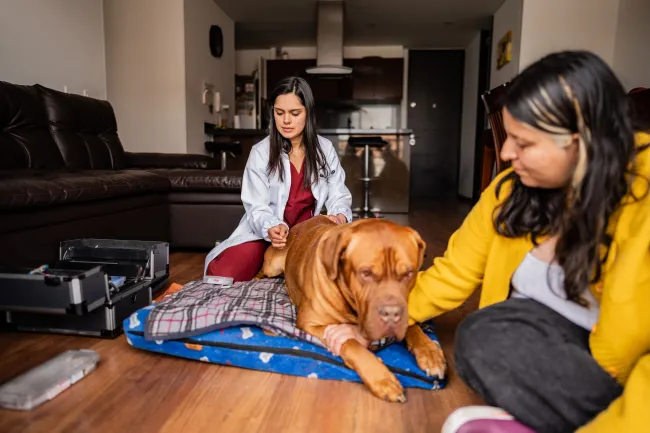
Some of Hodges’ patients actually yawn when she arrives. One dog she regularly treats walks slowly to the living room, lies down on the carpet and snores during the treatments. “I take that as a compliment,” she says, “that they link me with a profound relaxation response.”
For animals who don’t tolerate needles, other forms of acupuncture may be tried. One version targets acupuncture points with lasers. Another uses weighted tuning forks to create sound vibrations at these points. A third form is acupressure, which involves applying manual pressure to certain spots on the body.
Frazao Studio Latino/Getty Images
Common misconceptions about veterinary acupuncture
If these sorts of therapies sound strange to you, you are not alone.
For many people, acupuncture comes from a different culture and language, Wright says. “It uses language that feels very uncomfortable and [may not] sound logical, such as ‘Qi energy’ and ‘wind in the liver.’” Instead, she presents it to patients’ families in terms more familiar to them.
Another hurdle for caregivers considering acupuncture is that it takes longer for benefits to show. While a pharmacological approach typically provides quick, easily observable results, acupuncture is more cumulative and can take several weeks of sessions to manifest changes, making observation and calibration a key part of the process.
“When you give a drug, you can measure the effect during the time that drug is in the bloodstream,” Wright explains. “When you’re doing something like acupuncture or physical therapy, you’re looking at that stretched over a week, two weeks or a month.”
Both Wright and Hodges agree that about four weeks is enough time to determine whether acupuncture is working for your pet. This is also the time to establish ways of assessing your pet’s response, Wright says. “How do they seem in between sessions? Are they getting back to behaviors associated with a healthier time in their life?”
For caregivers interested in trying acupuncture for their pets, there are many resources. The American Holistic Veterinary Medical Association and Chi University have searchable directories. Caregivers may ask their veterinarian or trusted friend for a referral.
You can also simply seek out someone who’s employed acupuncture for their pet, Wright suggests. “Ask how they approached it. How did it feel? How did it go? What is the follow-up?”
The main takeaway Wright says: Don’t fear the unfamiliar or fall into myth narratives. “You hear people saying, ‘Oh, it seems so terrible that people are sticking needles in an animal, and it’s like witchcraft.’ There are hundreds of thousands of physiologic papers out there showing how acupuncture works, and it’s a scientific [tool] we’re bringing to the table.”
Related Stories
eclipse_images/Getty Images
Properly cleaning your pet's food and water bowls can help protect their health. Learn best practices from a veterinary expert.
Bigandt_Photography/iStock.com
Wearable tech for pets is becoming more and more popular, but are these products actually good for your animals? Before you buy the latest gadget, here's what you should consider.
Rachel Stern/Humane World for Animals
Learn why pet obesity is rising and get practical, vet-informed tips to help your dog or cat live a healthier, happier life.