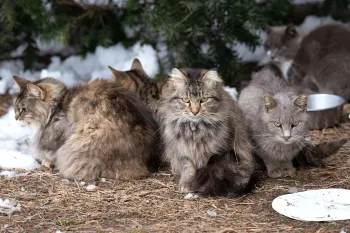
In February, on a road buried under nearly a foot of snow, our Animal Rescue Team approached a 17-acre Maryland property where the Wicomico County Sheriff’s Office had called for help: More than 100 cats needed to be removed from an alleged cruelty situation in freezing temperatures. When our team reached the fenced, wooded property—which contained many sheds, as well as a chicken house and enclosures used to shelter cats—they searched for signs of life. Immediately, they saw little ears and faces popping up from the snow inside and outside the fences. Cats had dug paths down to the dirt to relieve themselves.
As team members exited their vehicles, one friendly black-and-white cat approached Shalimar Oliver, Humane World case manager of animal crimes. The cat climbed up her leg and sat on her shoulder. “He was so excited; he was so happy,” Oliver says. Soon other cats came out—slipping out of doorways and crawling from beneath buildings. Inside the chicken house, where plastic insulation was stretched above the rafters, only the movement of cats’ paws was visible as they ran back and forth across the insulation.
By the end of the day, the team had rescued 111 cats. The number grew to more than 150 after other animals were humanely trapped later that week in partnership with local authorities. The team also found three recently deceased cats and the decomposed remains of many others who had died some time before.
The survivors were in poor condition, Oliver says.
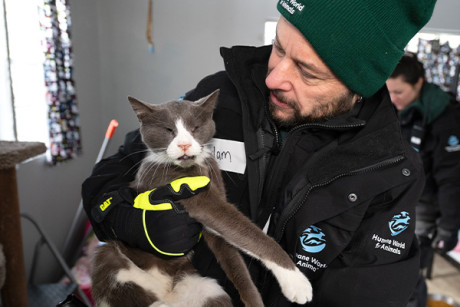
Meredith Lee/Humane World for Animals
Saved from the snow
It appeared the cats were not receiving adequate care or veterinary attention. “This situation has been unbelievably sad because of how sick they are.” Medical issues included upper respiratory infections with sneezing, wheezing and thick nasal discharge; dehydration, emaciation, abscesses; a scratched cornea and conjunctivitis; mites; dental disease; ring worm; overgrown nails and matted fur.
The property had been called a “sanctuary” with a board that filed tax returns as a nonprofit. Some people paid to leave healthy spayed and neutered cats there, likely assuming they would get adequate care, Oliver says. Many of the rescued cats were friendly. Some had microchips. Others seemed unsocialized and were likely feral.
The discovery of a rabies-positive dead raccoon on the property meant the rescued cats had to be quarantined for up to four months. As of press time, our team and partners were placing the cats in homes and in barn cat programs.
Related Stories
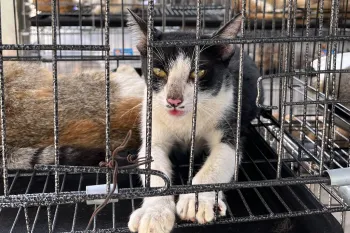
Phuong Tham/Humane World for Animals Viet Nam
Cats are, in many ways, the forgotten victims of Viet Nam’s illegal meat trade. That changed this week in Ho Chi Minh City. More than 400 cats were seized by police in what appears to be one of the largest single cat meat trade interceptions in Viet Nam's history.
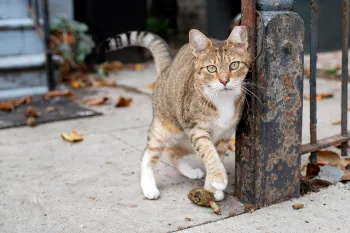
Shelby LaVigna/For Humane World for Animals
What should you do if you find a cat outside? The answer isn’t as simple as you may think. Research has changed our understanding about what cats need. Here's what you need to know.
Rachel Stern/Humane World for Animals
Volunteers share the rewards and challenges of fostering pets while finding ways to protect their own well-being.