

Frequently asked questions
- How many dogs are used in experiments every year?
- What kinds of experiments are dogs used in?
- Which companies and organizations use dogs in experiments?
- Which laboratories in the U.S. have the largest number of dogs in their possession?
- Where do laboratories get the dogs they use in experiments?
- Which dealers have large numbers of dogs in their possession?
- What is life like for dogs in laboratories?
- What happens to the dogs once the experiment is over?
- Aren’t there laws to protect dogs used in experiments?
- Why are dogs still used in experiments?
- What are the non-animal alternatives to using dogs in experiments?
- What are the disadvantages of dog experiments?
- What are the alternatives to experiments on dogs?
- What are you doing to end experiments on dogs?
- What can I do to help dogs and other animals in laboratories?
Meredith Lee/Humane World for Animals
End experiments on dogs
Sadly, dog testing is still legal everywhere in the world. No dog deserves to suffer in a barren laboratory. We need your help to end this. Demand an end to experiments on dogs today.
How many dogs are used in experiments every year?
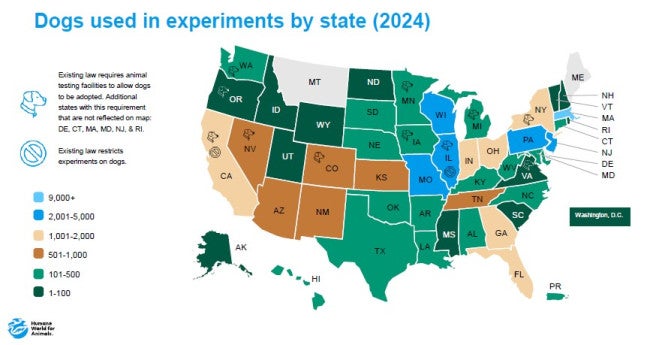
More than 40,000 dogs are used in experiments each year in the United States. In addition, tens of thousands of puppies destined for labs are born at breeding facilities every year. This number increases dramatically worldwide.
Use our Animal Laboratory Search Tool to find information about universities, hospitals, companies and other organizations that use dogs and other animals in experiments.
Humane World for Animals
What kinds of experiments are dogs used in?
Dogs are used to test drugs, medical devices and pesticides such as weed killer, insect repellent, and plant fungicide spray. This kind of testing tries to determine whether a substance, ingredient or device will affect human health. Dogs used for testing are fed quantities of the test substance—such as a weed killer or a new medicine under development—on a daily basis for months and observed for harmful effects. These substances can be given to the dogs in their food, as pills, or force-feeding (by forcing a tube down their throat). The dogs are sometimes injected with substances or forced to inhale them. Most dogs used in these kinds of tests are eventually killed after the experiment ends so that their tissues and organs can be examined. In order to test medical devices or other products, dogs are implanted with items such as pacemakers and typically killed after the test is over.
Dogs are also used in biomedical research, including cardiac, neurological, respiratory and dental experiments. Dogs may be specially bred to have a fatal disease.. In other cases, healthy dogs will be operated on to give them symptoms of serious conditions like heart disease or to remove or damage some of their organs and then be further experimented upon. They are also typically killed after the experiment is over.
Which companies and organizations use dogs in experiments?
Approximately 250 companies and other institutions in the U.S. report using dogs in experiments each year, including chemical, pesticide and drug companies (and the contract laboratories that carry out dog tests for these companies), public and private universities, community and technical schools, government-owned facilities, Veterans Affairs (VA) facilities and hospitals.
Use our Animal Laboratory Search Tool to find information about facilities that use dogs and other animals in experiments.
Which laboratories in the U.S. used the largest number of dogs in 2024?
| Research institution | # of dogs in 2024 | State where USDA annual report is filed* |
| Charles River Laboratories Inc | ~9,000 | Massachusetts |
| Labcorp Early Development Laboratories Inc | ~3,500 | Wisconsin |
| Zoetis LLC | ~1,300 | New Jersey |
| Summit Ridge Biosystems Inc. | ~1,100 | Pennsylvania |
| Altasciences Preclinical Columbia LLC | ~1,000 | Missouri |
- Some research institutions compile annual animal data from their facilities across the U.S. and report it in one USDA annual report. This makes it impossible to know exactly how many animals are being used in each state.
Where do laboratories get the dogs they use in experiments?
The majority of dogs in laboratories are purpose-bred, meaning that they are bred with the intent of selling them to laboratories that use dogs in harmful experiments. Tens of thousands of dogs destined for labs are born at breeding facilities every year. People who breed and sell purpose-bred animals (including dogs) are called Class A dealers and are licensed and inspected by the U.S. Department of Agriculture (USDA).
Historically, some cats and dogs were sold to laboratories by brokers known as random source Class B dealers, who acquired animals at auctions, from newspaper ads and various other sources, including animal shelters. Thankfully, random source Class B dealers have not been allowed to operate since 2015 when Congress first passed legislation to prevent them from being licensed.
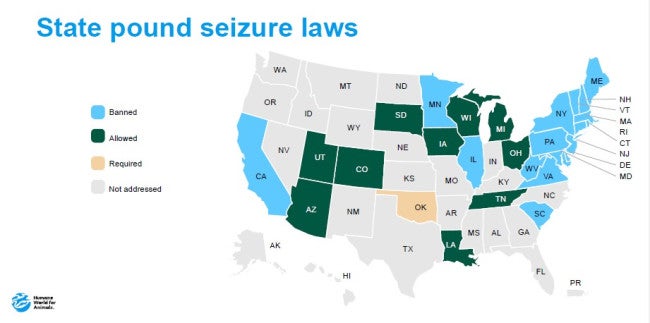
Some cats and dogs in laboratories are still obtained directly from animal shelters, a practice known as “pound seizure.” Pound seizure laws vary from state to state with one state (Oklahoma) requiring shelters to give cats and dogs to laboratories when requested rather than euthanizing them, and other states allowing or prohibiting laboratories from taking animals from animal shelters. Some states have no laws at all, leaving it up to the individual shelter or locality.
Humane World for Animals
Which dealers have large numbers of dogs in their possession?
Breeders of purpose-bred dogs (dogs bred specifically to be used in experiments) are called Class A dealers and are licensed and inspected by the U.S. Department of Agriculture (USDA). Of the Class A dealers selling to laboratories in 2024, the following dealers had some of the largest numbers of dogs in their possession:
| Dealer | Approximate # of dogs | Location |
| Marshall Farms Group | 18,000 | North Rose, NY |
| Ridglan Farms | 2,500 | Mount Horeb, WI |
| Oak Hill Genetics | 1,200 | Ewing, IL |
What is life like for dogs in laboratories?
Dogs in laboratories suffer immensely. In addition to the painful experiments that the vast majority of dogs in laboratories experience over days, months, years or even decades, life in a laboratory is typically a miserable and terrifying experience.
Typically kept alone in barren steel cages with little room to move around and few, if any, comforts, such as toys or soft bedding, dogs often become unbearably lonely and anxious, often devoid of the companionship of other dogs or the loving touch of a human. The painful—often excruciating—procedures that they experience include being intentionally injured, implanted with medical devices, infected with diseases, subjected to repeated surgeries, force-fed drugs, pesticides or other substances and observed for harmful effects such as heart failure, liver disease, signs of cancer or even death. They typically also watch (or hear) other animals suffering, including their own parents, siblings or babies.
Dogs in laboratories may also be mistreated by inexperienced or careless staff. Although there are penalties for laboratories when animals are injured or killed due to negligence or when they fail to meet minimum standards of animal care, in reality, the fines are typically either very small or waived entirely.
- Read about our 2022 undercover investigation at Indiana laboratory Inotiv, one of America’s largest animal testing labs. We documented hundreds of dogs, monkeys, rats and pigs undergoing experiments, including terrified beagle puppies being force-fed potentially toxic drugs in cruel and ineffective months-long tests paid for by Crinetics, a pharmaceutical company in San Diego.
- Read about our 2019 undercover investigation at a Michigan laboratory where thousands of dogs are killed every year. After weeks of pressure from the public, the pesticide company that had commissioned a year-long fungicide test on 32 dogs agreed that the test was unnecessary and released the dogs to one of our shelter partners to be adopted.
What happens to the dogs once the experiment is over?
Dogs are typically killed once an experiment is over, particularly dogs used in chemical/drug testing. However, more and more states are passing laws that require laboratories, when possible, to offer dogs to shelters and other rescue organizations so they can be adopted into loving homes after the experiments they were used in have ended. As of December 2023, 16 states have such laws.
Do laws like the Animal Welfare Act really protect dogs used in experiments?
The Animal Welfare Act (AWA) is supposed to protect certain animals, including dogs, used in experiments, but this law only offers minimum standards for housing, food and exercise. The law also stipulates that the proposed experiments be reviewed by an Institutional Animal Care and Use Committee, which is appointed by the laboratory and largely made up of employees of the institution. A 2014 audit report reviewing AWA oversight of animal laboratories found that “animals are not always receiving basic humane care and treatment and, in some cases, pain and distress are not minimized during and after experimental procedures.” Although there are penalties for laboratories when animals are injured or killed due to negligence or when they fail to meet the minimum standards of animal care stipulated by the Animal Welfare Act, in reality, the fines are typically either very small or waived entirely.
Why are dogs still used in experiments?
The vast majority of experiments on dogs are not required by government law or regulations; however, the federal government plays a significant role in most of the experiments carried out on dogs in the U.S.
- The Food and Drug Administration (FDA), through its approval processes to evaluate the safety of drugs, devices and other products, often requests that companies provide data gathered from multiple animal tests, including tests that are often carried out on dogs.
- The Environmental Protection Agency (EPA) requires that new pesticides be tested on dogs for 90 days before they can be registered.
- The National Institutes of Health (NIH), the Department of Veterans Affairs (VA), the Centers for Disease Control and Prevention (CDC) and other federal agencies either carry out experiments on dogs themselves or provide funding to other facilities to conduct experiments on dogs.
These types of tests on dogs have been performed for decades, regardless of whether they provide valuable information.
U.S. agencies are taking steps to phase out animal experiments in favor of of non-animal methods. In 2025, FDA released a plan to reduce animal testing and NIH closed the last remaining dog laboratory on its campus, made a statement prioritizing non-animal research and invested more than $150 million in sophisticated research that doesn’t use animals.
Swapping animal experiments for non-animal alternative methods seems like a straightforward process, given that using animals has so many limitations and new technologies offer countless possibilities for creating methods that are more humane and that more accurately mimic how the human body will respond to drugs, chemicals or treatments. Unfortunately, developing these alternatives is a complex process facing many obstacles, including inadequate funding. In some cases, a non-animal alternative must be formally “validated”—an expensive and lengthy process—in order to be accepted by government agencies, both in the U.S. and globally. In contrast, animal experiments have never been subjected to the same level of scrutiny and validation. Despite these challenges, many scientists are increasingly committed to developing and using non-animal methods.
What are the non-animal alternatives to using dogs in experiments?
The world is moving toward a future where scientists use cutting-edge testing methods that use human cells, tissues and organs, 3D bioprinting, robotics, computational modeling and other technologies to create experiments that do not harm animals.
While animal tests have not significantly changed since they were developed decades ago and will always have severe limitations, these advanced non-animal methods represent the very latest techniques that science has to offer, provide countless possibilities to improve our understanding and treatment of the human body and will only continue to improve over time. Non-animal methods also have several advantages over outdated animal experiments: they more closely mimic how the human body responds to drugs, chemicals and treatments; they are more efficient and often less expensive; and they are more humane. Ultimately, moving away from antiquated animal experiments is better for both humans and animals.
We advocate for the immediate replacement of animal experiments with approved non-animal methods as soon as they are available, and for increased funding to develop new methods. A concerted effort to shift funding and technological development toward more non-animal alternatives will lead us toward a future where animal experiments will become a thing of the past.
Examples of non-animal alternative methods
- “Organs-on-chips” are tiny 3D chips created from human cells that look and function like miniature human organs. The organs-on-chips are used to determine how human systems respond to different drugs or chemicals and to find out exactly what happens during infection or disease. Several organs, representing heart, liver, lungs or kidneys, for example, can be linked together through a “microfluidic” circulatory system to create an integrated “human-on-a-chip” model that lets researchers assess multi-organ responses.
- Sophisticated computer models use existing information (instead of carrying out more animal tests) to predict how a medicine or chemical, such as a cholesterol drug or lawn fertilizer, might affect a human.
- Cells from a cancer patient’s tumor are used to test different drugs and dosages to get exactly the right treatment for that specific individual, rather than testing the drugs on animals.
- Specialized computers use human cells to print 3D tissues that are used to test drugs.
- Skin cells from patients, such as those with Alzheimer’s disease, are turned into other types of cells (brain, heart, lung, etc.) in the laboratory and used to test new treatments.
- Sophisticated computer programming, combined with 3D imaging, is used to develop highly accurate 3D models of human organs, such as the heart. Researchers then input real-world data from healthy people and those with heart disease to make the model hearts “beat” and then test how they might respond to new drugs.
Learn more about non-animal alternative methods
What are the disadvantages of dog experiments?
- Animal experiments are time-consuming and expensive.
- Animal experiments don’t accurately mimic how the human body and human diseases respond to drugs, chemicals or treatments.
- Animals are very different from humans and, therefore, react differently.
- Increasing numbers of people find animal testing unethical.
- There are many diseases that humans get that animals do not.
What are you doing to end experiments on dogs?
There is no place for harmful experiments on dogs. We are committed to ending this practice. Ending dog experiments worldwide is a long, multi-layered process. We are working towards the day when dogs are no longer used in harmful experiments—and laboratories instead use artificial intelligence , or tests that utilize human cells and organs, 3-D bioprinting, robotics, computer modeling, and other sophisticated methods. Urging legislators, policy makers, government regulators, companies, scientists and other institutions to work with us to achieve this goal is a painstaking process, but we won't stop until dogs no longer suffer in the name of science.
While we work towards this goal, we also aim to reduce the numbers and suffering of the dogs in laboratories. This includes ending the most egregious practices related to dog experiments, pushing for alternatives that use fewer dogs, calling for measures that improve the quality of life for dogs in laboratories, and advocating to give dogs the opportunity to live out the rest of their lives in peace after they are no longer used in experiments.
Follow us on Facebook and X to learn what we are doing to end experiments on dogs and other animals around the world—and check out our 2025 year-end blog to learn about our biggest wins for animals in laboratories.
What can I do to help dogs and other animals in laboratories?
If helping dogs in laboratories is important to you, please know that speaking out to legislators, companies, government officials, and others is critical to our efforts to enact change. Here are some of the ways you can help right now:
- Stand with us to end experiments on dogs by signing our petition.
- Tell the U.S. Environmental Protection Agency to stop requiring the 90-day pesticide test on dogs—and end all experiments on animals.
- Swap out your personal care and household products for cruelty-free versions! Cosmetics (such as shampoo, deodorant and lipstick) and household products (such as dish soap, laundry detergent and glass cleaner) are typically tested on guinea pigs, rabbits, mice and rats.
- Tell the FDA to stop encouraging companies to test on animals and instead switch to sophisticated alternatives.
- Stand with us to end research and tests on dogs by signing our petition.
- Urge the USDA to do their job and help protect animals in laboratories.
- Ask your U.S. federal legislators to ban cosmetic tests on animals.
- Support efforts to replace animal experiments with advanced non-animal alternatives that are better for both human health and animal welfare.
- Follow us on Facebook and X for the most the up-to-date news and actions you can take to help animals used in experiments.
Beagles belong in loving homes, not labs
Teddy was never meant to have a name. When he was born, he was given only a number, just like the tens of thousands of dogs used in animal experiments each year.
End animal testing
No animal deserves to suffer in a laboratory. Join us in the fight to end experiments on dogs and other animals. Take action today.
Your gift can do so much for animals in need
Start saving lives today by making a one-time gift—or protect animals worldwide all year long with a monthly contribution.
Octavian Cantilli/For the HSUS