
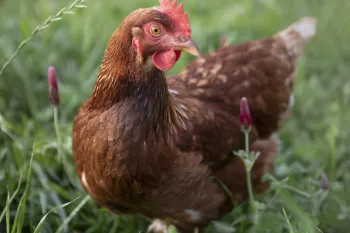
BRUSSELS―Walk into a supermarket in much of Europe today and you can see what many people want for farmed animals: more eggs from cage-free hens, more plant-based options and more higher-welfare choices. What people buy reflects the importance they place on animal welfare, and yet, for millions of farmed animals across the EU, those expectations are not being matched by political action. Five years after the European Commission promised to act, these animals remain trapped in cages.
On 30 June 2021, in response to the End the Cage Age European Citizens’ Initiative - backed by more than 1.4 million Europeans - the European Commission committed to deliver, by the end of 2023, a legislative proposal to phase out and put an end to intensively confining farmed animals in cages. That deadline passed without a proposal, but citizens’ expectations remain strong. According to the European Commission’s latest Eurobarometer, nine in ten Europeans consider it important to protect the welfare of farmed animals, and 84% want it to be better protected in their country.
Dr Joanna Swabe, senior director of public affairs at Humane World for Animals Europe, says:
“Five years ago, the European Commission promised millions of citizens it would deliver a legislative proposal to End the Cage Age. Today, that promise remains unfulfilled, and―in many Member States―millions of animals on farms continue to live miserable lives trapped in cruel and outdated confinement systems with no end in sight to their suffering. Citizens have waited long enough. Above all, the animals have waited far too long. The EU cannot credibly claim global leadership on animal welfare while failing to deliver on one of the most important promises it has ever made.”
That failure has real consequences for the animals the Commission promised to protect. Take hens kept for egg production, one of the largest categories of farmed animals in the EU. The latest European Commission data show that there are almost 448 million birds on EU farms, and more than a third of them are still confined in cage systems. In these cages, each hen has roughly the space of an A4 sheet of paper to live her entire life—unable to stretch her wings, dust‑bathe or move freely, and prevented from basic behaviour such as foraging or exploring.
The situation varies across the EU. The good news is that some Member States have started moving away from cages. Austria has already banned confining hens to cages, Luxembourg is fully cage-free and Germany is close to completing its transition. Czechia and Slovakia have also committed to phase-outs. By contrast, major producers such as Poland and Spain still house around 60% of hens in cages, while in Malta it is 99%. The result is a fragmented landscape across the EU.
Maria Noichl, MEP (S&D) says: “Confinement is torture. For humans but also for animals. Confining animals individually in small cages must come to an end. Immediately. Germany has already abolished cage rearing for laying hens. But I want this to apply to all animals, no matter where in Europe they are.”
The market is shifting in the right direction, but unevenly. More than 200 retailers have responded to consumer demand and committed to sell eggs from cage-free hens. In addition, leading supermarket groups such as REWE and LIDL are delivering on their cage-free commitments in key EU countries.
But voluntary progress remains partial and cannot replace a clear EU-wide legal framework. For that reason, Humane World for Animals Europe urges the Commission to deliver on its commitment to end cages for farmed animals. Anything less would fail not only the animals still trapped in cages, but also the farmers, and retailers who have already invested in better systems, and the citizens who used one of the EU’s most important democratic tools to call for change.
Humane World for Animals works globally to persuade corporations, financial institutions, food service companies, governments and farmers to eliminate the worst practices of industrial animal agriculture that subject the greatest number of animals to the longest duration and degree of suffering, including intensive cage confinement. The organization has farmed animal welfare teams in Australia, Brazil, Canada, the European Union, India, Malaysia, Mexico, South Africa, Thailand, the United Kingdom, the United States and Viet Nam. Humane World for Animals also promotes a shift toward a more plant-forward, climate-friendly global food system by providing culinary resources and training to institutions serving millions of meals daily and advocating for policy change at national and international levels.
#
Download photos here: Link