
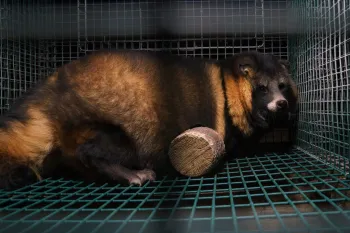
BRUSSELS/ROME—Olivér Várhelyi, European Commissioner for Animal Welfare, has responded to the 53 Members of the European Parliament who in February sent him a letter urging him to respect the will of more than 1.5 million supporters of the European Citizens’ Initiative “Fur Free Europe.”
Commissioner Várhelyi confirmed to the MEPs—led by Italian Members Cristina Guarda, Carolina Morace and Brando Benifei—that the information included in the letter “will be given full consideration as part of the decision-making process leading up to the adoption of the Commission’s communication, which is planned for April 2026.”
Humane World for Animals (formerly called Humane Society International), as the world’s leading organization campaigning to end the global fur trade, calls on the European Commission to stand on the right side of history by proposing a full ban on fur farming and the sale of farmed fur and fur products in the European Union.
MEP Cristina Guarda (Greens/EFA) says: “We await the Commission’s final proposal. Fur farming is no longer justifiable, given the suffering it causes to animals, as well as its environmental and public health costs.”
MEP Carolina Morace (The Left) says: “More than 1.5 million Europeans are calling for a fur-free EU. Should the Commission fail to propose a ban, we stand ready to fight for it in every forum—we owe it to both animals and citizens.”
MEP Brando Benifei (S&D) says: “The European Commission has informed us that April is the decisive month for a fur farming ban. Commissioner Várhelyi’s response is a signal, but what is now needed is the adoption of an EU-wide ban.”
In March, Humane World for Animals delivered a further 80,000 signatures to Commissioner Várhelyi from individuals supporting the introduction of a ban to end fur farming and the sale of farmed fur products in the EU. As of today, 9 April, anyone can post on social media to urge their government to publicly support the introduction of such a ban. Those posting in Italy can use the photo available at this link and tag @humaneworlditalia and Minister Francesco Lollobrigida.
Martina Pluda, country director at Humane World for Animals Italy, comments: “In a scientific opinion published in July 2025, the European Food Safety Authority concluded that fur farms in the EU are unable to meet the basic needs of mink, foxes, raccoon dogs and chinchillas. Experts also highlighted the impossibility of achieving significant animal welfare improvements within the cage systems in use, and noted that no alternative system has ever been assessed or implemented on a commercial scale. For this reason, we strongly oppose the introduction of ‘minimum animal welfare standards’ in this sector, and hope that the reports by POLITICO on this possibility will be contradicted by the European Commission’s official communication.”
Once the European Commission has presented its proposal, it will be jointly reviewed, amended and adopted by the European Parliament and the Council of the European Union.
Humane World for Animals works across the globe to end the fur trade. With a focus on the UK, Europe, North America and China, our work includes government, industry and corporate campaigns, collaborations with designers and fashion brands, undercover investigations and education campaigns, and has led to a steadily decreasing number of animals affected by this cruel trade.
Fur facts
-
Fur farming is already banned in 24 European countries, including 18 Member States. However, more than 6 million mink, fox, raccoon dogs and other animals are still confined in small wire cages on almost 1,200 fur farms in the EU.
-
Fur farming poses a zoonotic disease risk. Mink on almost 500 fur farms across 13 countries in Europe and North America have been found to be infected with COVID-19, with millions of animals killed on public health grounds. Highly Pathogenic Avian Influenza A (H5N1) has also been found on 72 fur farms in Europe to date. Around 500,000 mink, arctic fox, red fox, raccoon dogs and sable were killed on public health grounds.
-
Scientific evidence in the Fur’s Dirty Footprint report shows that the carbon footprint of 1kg of mink fur (309.91 kg CO2-eq) is 31 times higher than cotton, 26 times higher than acrylic, and 25 times higher than polyester. Raccoon dog fur and fox fur also have high carbon footprints, approximately 23 times worse for the climate than cotton, and 18 times worse for the climate than polyester.
-
Most leading designers have fur-free policies including Max Mara, Saint Laurent, Gucci, Alexander McQueen, Balenciaga, Valentino, Prada, Armani, Versace, Michael Kors, Jimmy Choo, DKNY, Burberry and Chanel. Over 1,600 fashion brands and retailers worldwide have committed to being fur-free and as fur becomes increasingly unmarketable and ethically indefensible, fashion houses are choosing to innovate with sustainable, cruelty-free alternatives.
-
Fashion Weeks including Copenhagen, London and New York have dropped the use of fur from their events, and publishers of titles including Vogue, Elle, GQ, Harper’s Bazaar, Glamour, Esquire and Vanity Fair have committed to fur exclusion policies.
#
Download photos and video of fur farms in Europe here.