
BRUSSELS - The European Commission published its EU Strategy on Livestock with the goal of helping the animal agriculture sector become more crisis-resilient, globally competitive and sustainable. Humane World for Animals cautiously welcomes this Strategy, with its express commitments to advancing farmed animal welfare, but emphasises that it is crucial that intensive animal production does not carry on with business as usual. Rather than merely optimising and carrying on with existing production models, however, the strategy must support a genuine shift toward a more humane and environmentally sustainable food system.
Dr Joanna Swabe, senior director of public affairs for Humane World for Animals Europe, says: “Deeds, not words, will ultimately determine whether the Commission’s strategy will lead to a genuinely sustainable and future-facing animal agricultural sector. Achieving higher animal welfare standards is a precondition for achieving this, especially the elimination of caged confinement for farmed animals. The Commission and Member States must ensure that both financial and practical support is available to help farmers swiftly move with confidence toward higher welfare production systems, which give farmed animals the chance of experiencing lives worth living.”
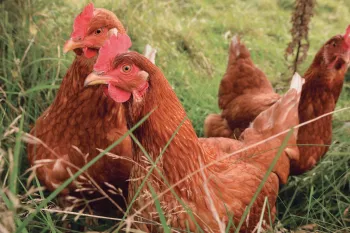
Humane World for Animals applauds the Commission’s announcement that it will present its long-awaited proposal to update welfare standards for hens kept for egg production and chickens kept for meat by the end of 2026. This legislative revision will focus on a phase-out of cages, an end to the systematic killing of male chicks, the adoption of practical on-farm welfare indicators, and import requirements in alignment with EU animal welfare standards. The EU will also advance a proposal on pig welfare in 2027, which will include the transition from crates to pen systems.
Humane World for Animals notes that the Common Agricultural Policy and other financial tools need to be used more effectively to fund and incentivise the rapid transition of farm infrastructures to higher-welfare systems. Humane World for Animals welcomes that the Commission is considering the option of introducing a dedicated financial instrument to bridge the financing gap for the investments needed to transition to more sustainable and higher animal welfare systems.
It is also vital that EU farmers are not disadvantaged by this necessary transition from intensive confinement systems. The playing field within the Union, particularly in the egg sector, already needs levelling up through legislative action to ban enriched cages, since some Member States have already gone completely or are nearly cage-free. However, as the strategy acknowledges, equivalent standards for animal products imported from outside the EU will also be needed, to prevent EU producers from being undercut by lower-standard imports, and give consumers reassurance that all animal products on the EU market meet the same animal welfare standards.
Lastly, to achieve a more sustainable animal farming sector and reduce the environmental footprint of animal agriculture, Humane World for Animals maintains that it is also vital not only to reduce stocking densities, but to reduce the number of animals kept for food production and to rebalance toward more plant-based diets. It is notable that the European Commission also adopted its Action Plan for resilience, strategic autonomy and sustainability of the EU protein system, which primarily seeks to address the EU’s chronic dependence on imported plant proteins, particularly for animal feed. The increase and diversification of plant protein production for human consumption is, however, also essential to encourage a transition to more sustainable diets.
#