
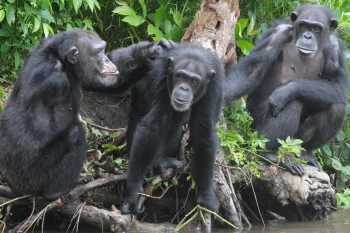
GLOBAL—Ahead of the global release of “Michael”, the biographical film on the life of Michael Jackson, Humane World for Animals (formerly called the Humane Society of the United States and Humane Society International) says the film’s benign portrayal of wild animals kept as pets — particularly a chimpanzee called Bubbles — could lead to a worrying increase in demand.
Bubbles was a significant part of Michael Jackson’s life and it is understandable that the film includes him. However, Bubbles is shown in the film as a manageable and affectionate companion living in a domestic setting. This portrayal glosses over the sad reality: the cruelty, danger and unsuitability of keeping primates as pets, given their complex welfare needs as wild animals, as well as the serious safety risks of their interaction with humans.
Even if the animals were created using CGI (computer-generated imagery), these depictions remain problematic. Presenting wild animals as thriving in private homes can reinforce the misleading notion that such environments are suitable for them. Movie portrayals of animal characters can trigger sudden spikes in demand for those species as pets as audiences seek to replicate the companion relationship depicted on screen. For example, the 2003 film Finding Nemo led to a global surge in demand for clownfish, and the Teenage Mutant Ninja Turtles franchise similarly led to increased demand for turtles as pets.
Ahead of the release of “Michael,” Audrey Delsink, senior director, Wildlife, at Humane World for Animals, says: “Wild animals like chimpanzees have complex physical, social and behavioral needs that cannot be met in private homes, no matter how well-intentioned the owner. Although these animals can survive in domestic captivity, survival must not be confused with well-being. We urge the public to recognize that wild animals belong in their natural habitats. Romanticized portrayals of wild animals as companions in movies can fuel demand for these species as pets and put more animals at risk of capture from the wild or lifelong suffering in private homes. Chimpanzees like Bubbles are also incredibly strong animals who can pose a real danger to the public once they reach maturity. Like all wild animals kept in close contact with humans, Bubbles retained his natural instincts, despite being held in captivity. As is so often the case, once he grew larger, stronger and more dangerous to manage, he was eventually given to a California animal trainer and in 2005 transferred to a Florida accredited sanctuary. Keeping primates as pets and dumping or rehoming them once they are no longer cute and manageable results in physical and mental stress, with long-term harmful effects on the animal’s welfare.”
Bubbles was born in a biomedical laboratory in Texas in the 1980s before being obtained by Jackson. Kathleen Conlee, vice president, animal research issues, at Humane World for Animals, says: “Having worked directly with chimpanzees from laboratory settings, I know firsthand how intelligent and social these animals are and what they need as they heal from such traumatic conditions. Portraying chimpanzees as manageable companions ignores their complex needs and the lasting harm that can result when they are kept in human‑controlled environments, while also shaping public perceptions in ways that normalize keeping wild animals for entertainment or private use.”
This issue is particularly relevant in Europe, one of the world’s major markets and transit hubs for wild animals kept as pets, with millions estimated to be currently living in private households. Cultural normalization through films and entertainment continues to fuel this trade without showing the long‑term consequences for animal welfare.
Humane World for Animals encourages viewers and the wider public to look beyond on-screen portrayals and understand the reality behind keeping wild animals as pets. Greater awareness can help prevent romanticized perceptions from taking hold and ensure wild animals are recognized not as companions or entertainment, but as complex and sentient beings whose needs cannot be met in private homes.
Humane World for Animals provides lifelong refuge for hundreds of animals who live at our sanctuaries, many of whom were held captive for the pet trade or for laboratory research. In Liberia, at our Second Chance Chimpanzee Refuge, we care for dozens of chimpanzees formerly used in research. In the United States, our Black Beauty Ranch provides a permanent home to over 600 animals including former pets and animals used in laboratories, such as primates. We also fund wildlife rescue, rehabilitation and release facilities in Costa Rica and Guatemala, caring for multiple wild species captured and kept as pets.
#