
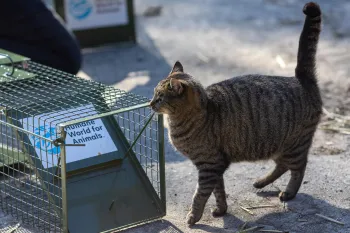
BERLIN – According to a new online survey conducted by Humane World for Animals Germany among 207 licensed veterinarians in 14 federal states, veterinarians overwhelmingly support trap-neuter-return (TNR) programs but say inadequate funding and inconsistent policies are hindering efforts to reduce street cat populations. The responses of the 80 veterinarians actively involved in TNR work, together with those of the 127 veterinarians who do not currently perform TNR, provide the most detailed picture to date of the clinical, financial and structural conditions under which TNR occurs in Germany.
The complete results of the online survey are available here (in German only).
An estimated two million street cats live in Germany out of sight on farms, industrial sites or in allotment gardens. These cats are often descendants of owned, lost or abandoned cats. They don’t have a guardian, as opposed to free-roaming owned cats. Street cats are fearful of people, sick, injured, unvaccinated, malnourished and underfed, and they reproduce uncontrollably. Which is why the suffering of street cats is considered Germany’s hidden animal welfare problem.
“Street cats are an animal welfare problem for society and for municipalities, yet their care and efforts to curb population growth continue to fall mainly to volunteers and animal welfare organizations. This must fundamentally change,” says Sylvie Kremerskothen Gleason, country director of Humane World for Animals Germany. Our survey findings show that municipalities and federal states are failing to take responsibility. Only 8% of veterinarians frequently work with their municipality, while 41% never work with their municipality.”
Veterinarians consider TNR effective
The survey shows remarkably strong support for the TNR method:
-
More than three-quarters of respondents (76%) rate TNR as highly effective for reducing street cat populations.
-
Almost one in five respondents (18%) rate TNR as moderately effective. Not a single respondent rated TNR as ineffective.
Respondents also identified one central problem: Not enough cats are being sterilized:
-
Almost eight in 10 respondents (78%) say that insufficient sterilization rates limit the effectiveness of TNR in their area.
Funding is the biggest barrier
What prevents the veterinarians surveyed from carrying out more sterilizations? Lack of funding was identified much more frequently than any other barrier assessed. Seven in 10 respondents (68%) rate a lack of funding as a significant problem. On a scale of 1 to 5 (1 = not significant; 5 = very significant) funding received an average rating of 3.83, the highest of any barrier in the survey. Particularly frustrating is that the willingness to participate in TNR programs is there, but the resources are not. More than two-thirds of respondents (65%) say government or NGO subsidies would “definitely” or “probably” increase their participation in TNR work.
Public opposition was the lowest-rated barrier to TNR programs among veterinarians surveyed, receiving an average score of just 1.45 out of 5. This finding indicates that public resistance is not generally perceived by veterinarians as a significant obstacle to implementing TNR programs.
Additional findings from the online survey also identified the following solutions:
-
Dependable public funding for TNR programs
-
More training opportunities and targeted professional development for veterinarians
-
Better coordination among the veterinary profession, animal welfare organizations and municipalities
-
Standardized national clinical guidance for TNR
Veterinarians want policy solutions
Many veterinarians surveyed want policy measures that address the problem in the long term. The most frequently repeated request was a nationwide cat protection ordinance that would introduce uniform requirements across Germany for the sterilization, identification and registration of free-roaming owned cats.
This call reflects the findings of the latest Humane World for Animals Animal Welfare Barometer 2026 (German-language only). According to the results, 71.3% of people in Germany support nationwide mandatory sterilization for free-roaming owned cats. To urge the German government to take action, Humane World for Animals Germany launched its “Mandate for Animals” petition and campaign in early July.
“The findings from our survey show why the cycle of street cat suffering is so difficult to break: Veterinarians want to help, but funding, local infrastructure and clear responsibilities are lacking. At the same time, unsterilized free-roaming owned cats continue to contribute to the growth of street cat populations,” said Kremerskothen Gleason.
Background: Helping street cats in Germany
Humane World for Animals Germany has been working since 2024 to support the sustainable management of street cat populations through TNR. Since 2024, the organization has supported efforts in Schleswig-Holstein and, together with local partner organizations, expanded the program to several federal states in 2025. Almost 200 humane live cat traps were provided and targeted grants awarded to strengthen local capacity.
The findings of this new online survey will help further develop future work with policymakers, municipalities, the veterinary profession and animal welfare organizations, and advance effective solutions to Germany’s street cat problem.
Images and video footage are available here:
- High-resolution video footage and images of the TNR programs on the ground
- Infographics accompanying the TNR report
#