
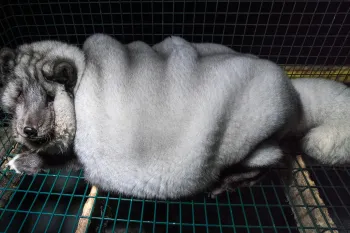
BRUSSELS―Previously unpublished footage from Finnish fur farms shows that so-called "monster foxes"―animals selectively bred to grow unnaturally large for larger pelts―continue to be bred despite years of fur industry promises of reform and legislation intended to prevent animal suffering.
The photos and videos, recorded between November 2025 and April 2026 on fur farms in Lapua, Veteli and Kauhava, were provided to the animal advocacy organization Project 1882 by an anonymous source. They document foxes with extreme skin folds, severe eye infections, untreated injuries and impaired mobility, housed in barren wire-mesh cages.
The footage comes at a critical moment for the future of fur farming in the European Union. Pressure is mounting on the European Commission to act following the Fur Free Europe ECI petition, which attracted more than 1.5 million signatures calling for an EU-wide ban on fur farming. While the Commission had been expected to present its response to the ECI in March, a decision has been delayed until after summer.
Public attention was drawn to so-called "monster foxes" in 2017, when images from Finnish fur farms revealed animals bred to grow unnaturally large in order to produce bigger, more valuable pelts. In response, the Finnish Fur Breeders’ Association adopted an action plan, stating that size 60 would be the maximum permitted blue fox skin size, that Saga Furs would return larger pelts to producers and that trading in pelts above size 60 could result in loss of certification. Despite this, the new material shows that breeding of monster foxes continues today. This year, Finnish auction house Saga Furs even introduced a new, larger size category for fox pelts, further rewarding the breeding of oversized animals. At its March 2026 auction, Saga Furs offered 12,769 blue fox pelts in a size 70 category, larger than the maximum established by the industry following the 2017 scandal.
Dr Joanna Swabe, senior director of public affairs for Humane World for Animals Europe, says: “The sheer monstrosity of the fur farming industry is laid bare by the continued selective breeding of foxes to be so unnaturally large that producers can extract ever greater profit from each pelt. This practice compounds the severe suffering already inflicted on animals confined for life in barren wire cages that cannot come close to meeting their complex behavioural and welfare needs. It is indefensible that the European Commission is even contemplating so-called ‘welfare standards’ for an industry built on such systemic cruelty, particularly in response to the clear democratic mandate delivered by the European Citizens’ Initiative for a Fur Free Europe. We therefore reiterate our unequivocal call for a full EU ban on fur farming. The College of Commissioners must heed Europe’s citizens, reject half-measures and take decisive action to consign fur farming to history.”
Benny Andersson, CEO of Project 1882, said: "This footage shows that serious animal welfare problems remain embedded in the fur industry. As the EU considers the future of fur farming, policymakers must decide what level of animal suffering Europe is willing to accept for luxury products. "
The European Food Safety Authority published its scientific opinion on the welfare of animals kept for fur production on 30 July 2025, finding that farmed Arctic foxes, also known as blue foxes, have been genetically selected for traits including rapid growth and greater body size in order to obtain larger pelts. EFSA identified medical conditions that impair the bones, joints, muscles or nervous system, making it hard to move or walk normally, as one of the most relevant welfare consequences for farmed Arctic foxes. EFSA concluded that, for the species assessed, in the majority of cases the welfare consequences could neither be prevented nor substantially mitigated within the current fur farming system.
Joh Vinding, chair of the Fur Free Alliance, said: “Nearly a decade ago, the fur industry was exposed for breeding grotesquely oversized foxes and claimed that this would stop. Despite the breeding of these oversized foxes being condemned by EFSA for serious welfare violations, the fur industry's broken promise is exposed by these new images. In 2026, in the European Union, these suffering animals continue to be bred for their fur, and the biggest pelts are still being sold and rewarded. The European Commission should draw the obvious conclusion: a fur industry that cannot keep its own welfare promises cannot be trusted to regulate itself. Europe needs a Fur Free Europe, not another system of industry standards.”
Notes to editors
Video and photos: Video footage and photographs from Finnish fur farms, GPS and timestamp verification as well as ddditional background information and expert commentary, are available to media on request.
#