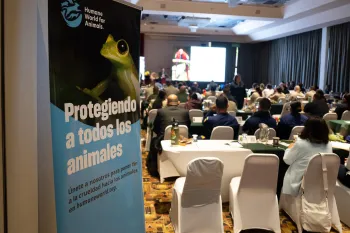
SAN JOSE, Costa Rica — To better meet the increasingly complex challenges of wildlife trafficking in the Central American region, animal protection organization Humane World for Animals and Costa Rica’s Public Prosecutor’s Office recently organized a training seminar titled “New trends in organized crime in environmental offenses, with an emphasis on wildlife trafficking and illegal mining.” The seminar, which brought together 85 justice officials and law enforcement personnel, focused on the technical and strategic capacities needed to investigate and prosecute environmental crimes, particularly those involving wildlife, through an organized crime lens.
The seminar is part of the “Enhancing Costa Rica’s capacity to combat wildlife trafficking” initiative, funded by the U.S. Department of State’s Bureau of International Narcotics and Law Enforcement Affairs (INL). The initiative is managed by Humane World for Animals in coordination with Costa Rica’s National Environmental Security Commission, of which the Public Prosecutor’s Office is a member.
Andrea Borel, executive director at Humane World for Animals Costa Rica, says: “Wildlife trafficking is one of the greatest threats to biodiversity and animal welfare, driven by criminal networks that operate across borders. Addressing this challenge requires a stronger institutional response through coordinated and comprehensive action. At Humane World for Animals, we reaffirm our commitment to working alongside authorities to protect wildlife and our communities.”
National and international experts led presentations on trends in organized environmental crime, specialized investigative techniques, the gathering of financial intelligence, interagency coordination and practical experience in the criminal prosecution of environmental offenses, among other topics.
Attorney General Carlo Díaz says: “Environmental crime has evolved and now represents a threat that extends beyond damage to natural resources. Many of these activities are carried out by criminal organizations that generate substantial illicit profits and require a coordinated, specialized and decisive response from law enforcement institutions. The Public Prosecutor’s Office remains committed to strengthening the investigation and prosecution of these crimes by promoting training opportunities and exchanges of experience that improve our ability to combat these manifestations of organized crime.”
Participants included representatives from the Ministry of Public Security — including the Public Force, Border Police, National Coast Guard Service and Air Surveillance Service — as well as the Ministry of Environment and Energy, including the Water Directorate, Legal Directorate, Environmental Comptroller’s Office, National Commission for Biodiversity Management and the National System of Conservation Areas. Representatives from the Judicial Branch, including the Public Prosecutor’s Office and the Judicial Investigation Agency, also attended, along with the Office of the Attorney General, the U.S. Embassy, Correos de Costa Rica and the General Customs Directorate.
#