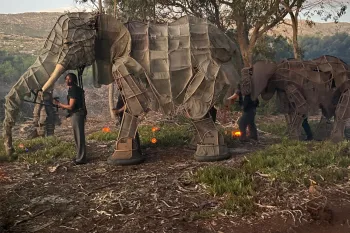
CAPE TOWN, South Africa—A herd of giant, life-size elephant puppets lumber through Cape Point’s shrubland. Above two adult elephant puppets and their young calf. The scene is part of a moving new short film aimed at raising awareness of the urgent need to protect South Africa’s iconic elephants from the imminent threat of mass culling, which is being actively discussed by provincial and national governments.
Despite the availability of proven, non-lethal methods to manage elephant populations, more than 2,000 elephants across the North West Park’s Madikwe and various KwaZulu-Natal game reserves face potential slaughter due to claims by provincial management authorities of over-population.
The giant puppets bringing the shocking reality of such killings to life were designed by Adrian Kohler from Handspring Puppet Company and built by Ukwanda Puppets (Sipho Ngxola, Luyanda Nogodlwana, Siphokazi Mpofu and late Ncedile Daki). The company is a South African puppetry collective best known for their contributions to internationally acclaimed productions like ‘War Horse’ and ‘The Herds’, a climate-awareness project featuring 600 life-size animal puppets.
Humane World for Animals South Africa, which commissioned and funded the short film, strongly opposes elephant culling and instead advocates for humane methods such as immunocontraception to reduce elephant births, opening wildlife corridors for natural dispersal, and expanding reserves to give these iconic animals with the space they need.
For 25 years, elephant biologist Dr Audrey Delsink, senior wildlife director for Humane World for Animals South Africa, has led the charity’s elephant immunocontraception program with University of Pretoria’s Veterinary Population Management Laboratory and partner reserves. To date, it has safely vaccinated over 1,800 wild female elephants across 50 South African reserves.
Dr Delsink says: "We are calling for a complete halt on the idea that elephants need to be mass culled in South Africa. Elephant numbers do need to be managed because their natural range has been vastly limited by humans, but the least we can do is approach this challenge with compassion and respect for their welfare especially when humane alternatives exist. Through these giant puppets, we hope audiences will feel an emotional connection with these magnificent sentient beings who have their own intrinsic value. They are not simply numbers in a population management debate, but individuals whose lives have intrinsic value all their own.”
Fast facts:
- Historical precedent: Large-scale culling officially ended in South Africa with a 1995 moratorium. Prior to that, over 14,500 elephants were systematically killed in Kruger National Park using lethal injections and large calibre weapons, resulting in international outcry and condemnation.
- The current threat: As wildlife becomes more commodified and monetized, political discussions have put mass killing back on the table. Commodification reduces living, sentient beings into goods to be bought, sold and traded for human profit.
- Total population: There are approximately 44,000 elephants in South Africa, with approximately 35,000 within the Kruger National Park and the balance living in fenced reserves.
- Conservation status: The African savanna elephant is listed as endangered globally on the IUCN Red List.
- Human-wildlife conflict: Poor fence maintenance or sabotage fails to keep elephants contained in reserves and elephant bulls’ natural migration instinct can cause conflict with humans.
- Humane solutions: A suite of highly effective, non-lethal strategies already exists to foster human-elephant coexistence.
Humane World for Animals says lethal options should always be an absolute last resort, with current scientific data pointing to non-lethal methods being more effective. The charity argues parliament must address provincial government delays in implementing humane strategies rather than resorting to slaughtering elephants.
Dr Delsink says: “Non-lethal methods have existed for decades, but many provincial governments have stalled for years. It is these same governments now advocating for a cull as a quick, cruel fix to their own inertia and as revenue streams for failing budgets. South Africa must not turn back the clock on decades of elephant protection by returning to an archaic, wholescale massacre of its elephants.”
Humane World for Animals hopes its storytelling initiative will shift national narratives away from commodifying elephants as hunting trophies or for population control and instead re-establish public and spiritual connections to them.
Dr Matthew Schurch, senior wildlife specialist for Humane World for Animals South Africa, witnessed the filming and said: “Watching the puppet elephants felt amazingly reminiscent of seeing elephants in the wild. Witnessing the puppeteers evocatively recreate the panic of elephants caught in the crosshairs was incredibly moving. When the puppets fell to the ground, the powerful stillness impacted us all. We must prevent a real-life tragedy from happening to our wild elephants. We hope that our short film will encourage people to engage with elephant conservation in a unique way, inspiring greater empathy, compassion and support for the protection of one of the world's most iconic mammals.”
Seven puppeteers were needed to bring the elephant puppets to life for the filming of this short film. Siphokazi Mpofu from the company said: “Being part of raising awareness for the endangered elephants was incredibly meaningful for us. It gave us the opportunity to be a voice for those who cannot speak for themselves. The puppets have the unique power to make people stop, look, and connect emotionally. They are magical, spark conversations, inspire empathy and remind us why protecting these magnificent animal matters.”
Humane World for Animals works in countries across the globe to foster humane co-existence between people and wildlife. Around the world, we promote and support effective, science-driven and community-focused solutions to mitigate negative human-wildlife interactions. Our efforts span a wide range of species and contexts, including elephants in South Africa, dingoes in Australia, urban wildlife in North and Central America, rodents in the United Kingdom, jaguars in Costa Rica, snakes in India, coyotes in the United States and many more, reflecting our commitment to context-led, species-appropriate solutions that help both human and wildlife communities thrive together.
Download behind-the-scenes photos and video of the puppet filming HERE.
Watch the short film HERE.
#
About Ukwanda Puppets
The Ukwanda members are permanent artists in residence/fellows at the Centre for Humanities Research at the University of Western Cape. The elephant puppets were created in 2016 for a production called “Olifantland”, which aimed to bring awareness to elephant poaching. All of the elephants are named after characters from the book ‘The Elephant Whisperer’; Nana, the matriarch of the herd requires four puppeteers (not present in the short video), Mnumzane, a bull, requires three puppeteers (Sipho Ngxola, Siphokazi Mpofu and Luyanda Nogodlwana), Mandla, the young bull, requires three puppeteers (Marty Kintu, Thabo Mkenene and Tshiamo Moretlwe), and baby elephant Nandi is performed solo (Lindokuhle Melaphi).