WASHINGTON—As warmer weather marks the beginning of “baby season” for wildlife, Humane World for Animals, formerly called the Humane Society of the United States, has recommendations on how to appropriately respond when encountering young deer, rabbits, foxes and other wildlife.
During the spring and summer, it is common to come across baby wild animals as a new generation enters the world. These young animals may appear to be alone, but their parent could still be nearby. While it is natural to want to help in these situations, intervention is usually unnecessary unless there is confirmation that the animal is truly orphaned or injured.
“This time of year, animal shelters and wildlife rehabilitators often see an increase in baby wild animals brought in by compassionate members of the public who mistaken these animals as abandoned,” says John Griffin, senior managing director of urban wildlife for Humane World for Animals. “While it is critical to provide care for animals in need of help, it is equally as important to assess the situation to determine whether intervention is truly necessary, as wild animals typically do best when they’re raised by their parents.”
Signs that a wild animal needs help:
- A bird is featherless or nearly featherless and on the ground.
- The animal is shivering.
- The animal is covered in parasites.
- The animal is crying and wandering all day long, and there’s a dead adult nearby who appears to be one of the parents.
- The animal shows signs of injury.
If any of these signs are observed or if a wild animal has been in a cat or dog’s mouth, it is important to contact a local wildlife center or wildlife rehabilitator for guidance. If necessary—and following the rehabilitator’s instructions—safely capture and transport the animal to the appropriate place for treatment.
Whether an animal is orphaned and needs your help depends on their age, species and behavior. Babies of some species are left alone all day and rely on camouflage for protection, while others are tightly supervised by their parent or parents.
Baby deer
People often mistakenly assume that a fawn (baby deer) found alone is orphaned. If the fawn is lying down calmly and quietly, their mother is likely nearby, and they are not in need of help. A doe only visits and nurses their fawn a few times a day to avoid attracting predators. Unless there is confirmation that the mother is dead, leave the fawn alone.
Although mother deer are wary of human smells, they still want their babies back. If the fawn has already been handled, return the fawn to the exact location where they were found and leave the area; the mother deer is unlikely to return while humans remain nearby.
If the fawn is lying on their side or wandering and crying incessantly, they probably need help. If this is the case, contact a licensed wildlife rehabilitator.
Baby rabbits
Rabbits at least 4 inches long with open eyes and erect ears and who hop well are independent from their mother and should be allowed to fend for themselves. Uninjured baby rabbits in an intact nest should also be left alone. Although they might look abandoned because their mom isn’t around, they’re probably fine: Mother rabbits visit their dependent young only a few times a day to avoid attracting predators. If the nest has been disturbed, lightly cover it with natural materials found nearby—such as grass, fur or leaves—and follow these steps:
- Keep all pets out of the area.
- Avoid touching the babies and wear gloves if possible while handling the nesting material.
- Use yarn, sticks or string to make a tic-tac-toe pattern over the nest to assess whether the mother is returning to nurse their young. Check back 24 hours later.
- If the yarn, sticks or string were moved aside, but the nest is still covered with fur, grass or leaves, the mother has returned to nurse the babies.
- Or better yet, monitor the nest with an outdoor video camera placed near the nest.
- If the pattern remains undisturbed for 24 hours, contact a licensed wildlife rehabilitator.
Baby foxes
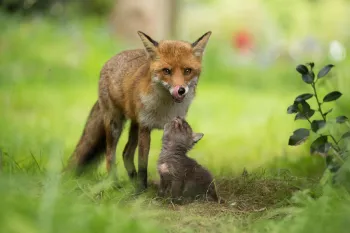
Fox kits will often appear unsupervised for long periods while their parents are out hunting for food. They will play like puppies around the den site until the parents decide they’re old enough to go on hunting trips. Observe the kits from a distance; if they seem energetic and healthy, leave them alone. If they appear sickly or weak, or if there is reason to believe both parents are dead, contact a licensed wildlife rehabilitator.
Humane World for Animals offers additional guidance for helping birds, raccoons, squirrels and other baby wild animals here.