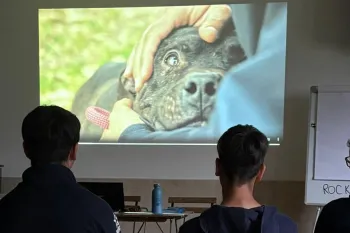
ROME—Fourteen students from a private school in Rome, Zaveria Cassia Institute, recently took part in a training session on dogfighting. This educational event was organized by Humane World for Animals Italy (formerly called Humane Society International) and Fondazione Cave Canem as part of the “Io non combatto” project.
The project’s aim is to prevent and combat the criminal phenomenon of dogfighting, by raising public awareness and educating younger generations about the importance of respect for the welfare of animals.
Students and teachers received the “Io non combatto” project’s brochure created for children. In addition to explaining dogfighting in age-appropriate language, this tool encourages young people to reflect on their relationship with animals, and their contribution to promoting a culture of compassion toward all sentient beings. The brochure, which includes a series of questions designed to stimulate classroom discussion, can be downloaded free of charge from the “Io non combatto” website, along with the Citizen’s Guide, designed to help people recognize and report instances of dogfighting.
Martina Pluda, country director of Humane World for Animals Italy, states: “Educating younger generations is essential for countering dogfighting and, more broadly, crimes against animals. In Italy, the law recognizes the particular seriousness of involving minors in these offenses.”
Federica Faiella, president of Fondazione Cave Canem, says: “With the ‘Io non combatto’ project, we promote empathy and responsibility, help to prevent juvenile delinquency, counter the normalization of violence, and build a more attentive and respectful society toward animals.”
The Zaveria Cassia Institute, managed by Kairos Social Cooperative Onlus, is located on the northeastern outskirts of Rome, in the San Basilio district. The students who took part in the session divided into small groups, and created posters aimed at raising awareness among their peers about dogfighting. They used the stories of Shrek and Michi, two dogs rescued as part of the “Io non combatto” project who, after undergoing behavioral rehabilitation at the Valle Grande municipal shelter in Rome, are now ready to be adopted by loving families.
Tiziana Portone, vice principal of the Zaveria Cassia Institute, says: “Raising awareness among young people on these issues is essential, because we are not only talking about dogfighting, but about values that can be applied in everyday life: respect for animals, for others, for classmates. Promoting respect is a mission of our time—first and foremost for schools, but also for all the environments young people encounter. It is our duty to do our part.”
Dr. Roberta Costagliola, a child development psychologist who participated in the program, comments: “Addressing the issue of dogfighting through workshop-based activities in schools at all levels promotes sensitivity and empathy in students, making them active participants through the emotions that inevitably arise from the stories of the terrible incidents involving dogs. Our intention is not to shock them, but rather to reflect with them on the role of humans who act cruelly and on the experiences that dogs carry with them in terms of emotions and physical and psychological wounds.”
In Italy, the law provides for increased penalties if the offense is committed with the involvement of minors. The presence of children or young people is particularly serious, as it can lead them to develop insensitivity toward animal suffering, enthusiasm for violence, and a lack of respect for the law. This can result in deviance and delinquency, meaning behaviors that diverge from—and ultimately violate—social norms.