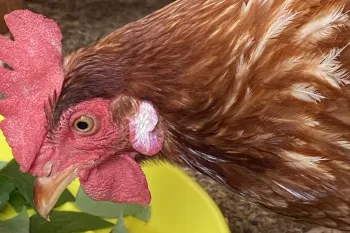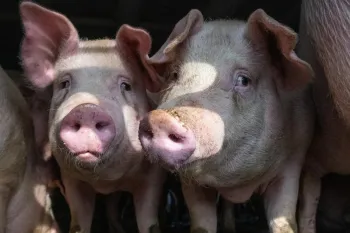
OTTAWA—Today, four leading animal protection organizations released Towards a National Framework for Farmed Animal Protection, a comprehensive report outlining critical gaps in Canada’s current approach to farmed animal welfare and proposing a clear pathway towards legislative reform. The report highlights a deeply flawed system in which the role of government in regulating the treatment of animals on farms is largely absent, and the fact that, without laws to set standards for the care of animals on farms, industry self-regulation has been allowed to fill the gap.
The report, jointly released by Animal Justice, Humane World for Animals, Mercy For Animals, and the Montreal SPCA, demonstrates how Canada's laissez-faire, industry-driven approach to farmed animal welfare permits and normalizes cruel practices that most Canadians find deeply troubling—including the widespread, extended use of small cages for hens, pigs, and calves—and that fail to meet global animal welfare norms.
At the same time, Towards a National Framework for Farmed Animal Protection offers a clear vision for how Canada can transition to a modern national legislative framework for farmed animal protection that better aligns with public expectations, closing the gap between Canada and the many peer nations that have already established comprehensive farmed animal welfare legislation and independent government oversight structures.
While 94% of Canadians believe it’s important that animals’ physical and psychological needs are met, Canada's current hands-off approach does little to achieve this. In the absence of government-led, enforceable standards, welfare standards are largely set by Codes of Practice developed by the National Farm Animal Care Council (NFACC), a private industry-dominated body.
NFACC’s Codes of Practice are voluntary in almost every province and territory, carry no legal penalties for non-compliance, and readily permit practices banned in many comparable jurisdictions, including extreme confinement, painful procedures without pain relief, and brutal methods of killing. As global markets increasingly link animal welfare to ethical governance and market access, Canada’s failure to modernize its framework presents growing economic and reputational risks.
Towards a National Framework for Farmed Animal Protection charts a long-term path forward, proposing concrete solutions to help solve Canada’s farmed animal protection crisis, including:
- Calling on Parliament to enact a federal Animal Welfare Act establishing enforceable standards of care for animals on farms.
- Reforming NFACC into a legislated, independent, science-based standard-setting body with public accountability.
- Establishing an independent governance structure by appointing a Minister and a Commissioner of Animal Welfare.
- Strengthening enforcement and compliance mechanisms and ensuring meaningful penalties and transparency.
“Most people are shocked when they learn Canada has effectively no laws to protect the welfare of animals on farms. It’s time for our government to step up to the plate and do what should have been done decades ago—pass comprehensive laws to protect the hundreds of millions of farmed animals in Canada,” said Camille Labchuk, lawyer and executive director of Animal Justice. “Canadians care deeply about the well-being of all animals and don’t want them to suffer. But without legal oversight, practices on Canadian farms are still stuck in the dark ages because the system prioritizes profit instead of basic respect for animals.”
“Despite significant public concern for the welfare of farmed animals, chickens, pigs, cows and others in Canada are commonly treated little better than inanimate objects under the law, valued for their productivity rather than their capacity to suffer or feel joy,” said Riana Topan, program director for farmed animal protection with Humane World for Animals Canada. “The legal landscape governing their treatment is largely comprised of weak and voluntary guidelines, legal loopholes and industry self-regulation that leave animals highly vulnerable to neglect, abuse, and systemic cruelty. This report outlines a path forward to reduce suffering for the hundreds of millions of animals whose lives rest in our hands. The time for meaningful change is now.”
"For too long, Canada has left the welfare of millions of animals in the hands of the very industries that profit from their exploitation,” said Maha Bazzi, Director of Animal Welfare Initiatives at Mercy For Animals. “We cannot continue to ignore the systemic cruelty baked into Canada's current regulatory vacuum. Mercy For Animals is proud to support this vision for a modern, legislated framework that prioritizes animal well-being over industry's bottom line. It is time for Canada to treat animal welfare as a matter of public interest, not private industry preference.”
"Canada has allowed a system of self-regulation to develop that leaves animals and producers behind," said Sophie Gaillard, Director of Animal Advocacy and Legal and Government Affairs at the Montreal SPCA. "Our current system still allows practices that have long been banned elsewhere, such as keeping breeding sows in crates barely larger than their bodies, confining laying hens in small cages, or performing painful procedures without adequate pain relief. Enacting legislation would create a level playing field for producers while also allowing for transparency and accountability. It’s time to begin this process of reform so Canada does not fall further behind."
The full text of Towards a National Framework for Farmed Animal Protection can be found here.