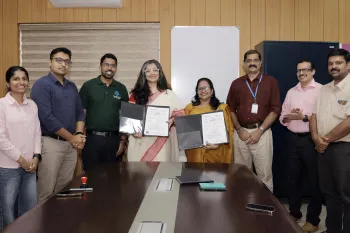
WAYANAD, KERALA—Animal protection organization Humane World for Animals India (formerly called Humane Society International/India), in collaboration with Kerala Veterinary and Animal Sciences University (KVASU), Pookode, today signed a Memorandum of Understanding (MoU) to launch a Massive Open Online Course (MOOC) on "Emergency Care and Response for Animals during Disasters." The initiative has been implemented with the philanthropic support of the Tata Trusts.
With climate change contributing to more frequent and severe disasters, animals face increasing risks of injury, displacement, disease and/or death during emergencies. This has created a growing need for trained veterinary practitioners who can support animal rescue with immediate emergency care. This first-of-its-kind MOOC on animal-related disaster response, is a pioneering initiative to address this requirement by building a professional cadre of disaster responders for animals across India. This program represents a strategic shift toward institutionalizing disaster management within the veterinary sector, with a goal of training 1,500 participants over the next three years.
The MoU signing ceremony, held at Pookode, Wayanad, was attended by Dr. Sabin George, registrar, KVASU; Alokparna Sengupta, managing director, Humane World for Animals India; Dr. C. Latha, director of academics and research; Dr. T. S. Rajeev, director of entrepreneurship; Dr. Muhammed Afreed, course coordinator; and other parties.
The MOOC curriculum is structured around a "Foundation to Specialization" model that progresses from essential disaster response concepts to advanced technical modules for field-level emergency care and recovery. The five-module course begins with a module focused on India’s disaster management systems, personal safety, and communication, followed by specialized technical training in areas such as animal handling and emergency medical relief, along with critical topics including the responsible use of antibiotics and minimizing zoonotic risks. Ultimately, the purpose of the MOOC is to ensure that when disaster strikes, India’s animal care responders are technically prepared, operationally sound, and equipped to safeguard animal lives and shore up human response.
Veterinary education in India has traditionally focused on clinical practice, with limited emphasis on emergency preparedness and disaster management. As a result, many veterinarians enter the field with limited specialized knowledge and operational skills for effective response to animal-related disasters and emergencies.
Alokparna Sengupta, managing director, Humane World for Animals India, said, "Disasters do not distinguish between human and animal lives, yet our preparedness systems often do. Every year, thousands of animals are affected by floods, cyclones and other emergencies, and are left injured, displaced, separated from their families, or stranded without access to food, water or medical care. In those critical first hours, every decision a veterinarian makes can mean the difference between life and death. With this collaboration, we are taking an important step towards building that preparedness. Our aim is to build the capacity of all veterinarians in the country with the specialized skills they need to deliver timely, compassionate care when animals need it the most. Building this capacity today will help ensure that more animals receive timely, lifesaving care during disasters tomorrow.”
Dr. T. S. Rajeev, Director of Entrepreneurship, Kerala Veterinary and Animal Sciences University, said: "The role of veterinarians is rapidly expanding beyond clinics and farms. Today, veterinarians are increasingly called upon to respond in complex emergencies where animal health, public health, livelihoods, and disaster management intersect. Educational institutions have a responsibility to anticipate these realities and prepare graduates accordingly. Through this collaboration, we are helping shape a new generation of veterinary professionals equipped not only to treat animals but also to lead during times of crisis. We are happy to partner with institutions like Humane World for Animals India and Tata Trusts in advancing this important area of veterinary education and strengthening India's disaster preparedness."
Dr. C. Latha, Director of Academics and Research, Kerala Veterinary and Animal Sciences University, said: “Strengthening the knowledge and practical skills of veterinary professionals is essential to ensure effective response during animal emergencies and disasters. Integrating disaster management and emergency animal care competencies into veterinary education will help prepare future professionals to respond with greater confidence and capability. Through this collaboration with Humane World for Animals India, KVASU is committed to advancing quality learning, capacity building, and training opportunities to develop a skilled and resilient veterinary workforce equipped to support animals and communities during times of crisis."
Dr. Afreed Muhammed N. V., Assistant Professor, Department of Veterinary Physiology, College of Veterinary and Animal Sciences, Pookode, said: "Disasters demand immediate specialized action. This pioneering MOOC bridges a critical gap in veterinary education by empowering practitioners across India with the operational skills and technical expertise needed to save animal lives on the ground during crises."
Ravinderjit Singh, Head, Rural Upliftment Portfolio, Tata Trusts, said, “At the Tata Trusts, we believe that community resilience cannot be achieved without recognizing how deeply intertwined animal welfare is with rural livelihoods and our environment. Our support for this initiative stems from the belief that lasting disaster preparedness requires strong institutions and trained professionals, not just emergency response when crises occur. As climate-related disasters become more frequent and complex, strengthening veterinary preparedness is an important part of building resilient communities and safeguarding livelihoods. With this initiative, our objective is to build veterinary preparedness by strengthening and institutionalizing disaster response. Building a skilled cadre of professionals capable of delivering specialized care is a critical part of this journey. This can help us lay the foundation to create long-term, sustainable solutions that benefit both people and the ecosystems they depend upon.”
Hosted on KVASU's Learning Management System, the MOOC will be offered as an online certificate course for registered veterinary practitioners across India. Enrollment has already begun, and the first cohort will start the program in September. The course will be conducted over a period of five-weeks and will be available free of cost . Additional details regarding registration and course access will be available through KVASU's Learning Management System.