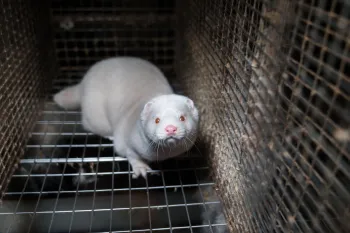
REYKJAVÍK ―A damning new economic study of Iceland’s fur farming shows that the industry has been operating at a financial loss for many years and had a net societal cost of 981million ISK (£6m/$8m) in 2025. Animal Welfare Iceland and Humane World for Animals are calling on the Icelandic government to use the upcoming revision of the Animal Welfare Act to ban fur farming at the earliest opportunity, for the sake of animal welfare, economic sustainability, biodiversity protection and public health.
“A full-cost account of the Icelandic fur industry”, authored by leading environmental economists and quantitative risk modellers Griffin Carpenter and Artūrs Kaņepājs, was launched on Friday 9 Oct. at an event attended by many politicians and veterinarians at The Nordic House in Reykjavík. It reveals a tenfold decline in Iceland’s fur farming revenue over the past decade, with the industry operating at a financial loss every year from 2014-2025, with the exception of 2021 but only due to state subsidies. The loss was estimated at 35million ISK (£215,000/$287,000) in 2025. When the gross value added of the fur farming industry is calculated, it is estimated that it contributes just 0.002% to the Icelandic economy.
The number of animals used by the industry has declined steeply in the last decade, from a peak of 200,000 animals killed in 2015 to approximately 40,000 killed in 2025, a fivefold decline.
For the economic account the study authors analysed publicly available government statistics and financial accounts. For the environmental account the study monetises sources of pollution and resources plus the impacts of mink as a non-native species and for public health it monetises the risk of mink as a vector for SARS-CoV-2. The authors then deducted these external costs from the gross value added (86 million ISK), showing the total societal impact of fur farming in Iceland is a net cost of 981 million ISK per year. The full report can be accessed here.
Report co-author, Artūrs Kaņepājs, said: "Iceland's mink farming industry has lost money in every year since 2014, with the single exception of 2021, when state support tipped the balance. Sustained losses have shrunk it to one farm and a few jobs. But despite the small size of the industry, the societal costs remain high: as long as mink are farmed, mink escape and Iceland is left with an invasive predator. Hunting bounties alone cost the public roughly 60 million ISK a year. Local pollution and the risk of zoonotic diseases add further costs. On these numbers, mink farming costs Iceland more than it contributes."
In the past year, the number of fur farms has reduced further from six farms to one, citing financial issues. It is therefore expected that the industry’s economic contribution has declined even further.
Shely Bryan, Fur-Free programme director at Humane World for Animals, said: “Allowing fur farming to continue makes no sense. It contributes virtually nothing to the economy, yet presents a danger to public health and native wildlife such as ground-nesting birds. Around the world, the fur trade is in steep economic decline due to falling demand and Iceland’s fur industry shares the same fate. The government must act, as more than 20 other European countries have, to end this cruel, risky and outdated business.”
Mink were introduced to Iceland for fur farming in 1931, subsequent concerns about their impact on native biodiversity led to fur farming being outlawed in 1951, however the industry was allowed to start again in 1969. The impact of non-native mink has been highlighted by the Icelandic Food and Veterinary Authority, or MAST, which has documented mink escape concerns, notably at Dalsbú in Mosfellsdalur – Iceland’s last fur farm – in recent years. Despite this, the same farmer recently stated his wish to import more mink to continue fur farming. In July 2025 the European Commission added the American mink to its formal list of Invasive Species of Union Concern, meaning that from July 2027, mink cannot be kept or bred without a specific permission. The government currently spends around 60million ISK of public money each year on ‘hunting bounties’ to control non-native species such as mink.
Dr. Rósa Líf Darradóttir, chairwoman at Animal Welfare Iceland, said: “Being kept their whole lives in tiny wire cages causes immense suffering to thousands of active, inquisitive mink and demand for fur is so low that their pelts are sold at a loss. With the industry at an historic low, it only makes sense for Iceland to bring this cruel and unnecessary practice to an end. In view of the animal welfare, biodiversity and public health threats posed by fur farming, we call on the Icelandic Government to use its recently announced bill to amend the Animal Welfare Act, to ban fur farming for good.”
A recent opinion poll shows more than twice as many Icelandic citizens support a ban on fur farming (42.8%) than oppose one (19.8%). Just over 54% of residents in the capital region support a ban. The Icelandic Veterinary Association also believes it is time to ban fur farming on the basis of science and animal welfare.
Shocking undercover footage of mink suffering on Icelandic fur farms was aired on primetime national television program, Kveikur, in March this year. In response, Þóra Jóhanna Jónasdóttir, chief veterinarian at MAST, stated "I believe that these animals cannot engage in their natural behavior" and called for the law to be reviewed. The Minister of Industry and Trade, Hanna Katrín Friðriksson, reacted that this was an "unacceptable treatment of animals" with progress needed in animal welfare legislation.
The Icelandic Government announced in September that a new bill to amend the Animal Welfare Act will be introduced in November (Ministry of Industry, bill 12.)
Key findings from the report:
-
Net cost to society: fur farming cost Iceland 981 million ISK in 2025, once environmental, wildlife, and public health costs are counted against its contribution to the economy.
-
Small economic footprint: 86 million ISK of value added (0.002% of the economy) and around ten full-time jobs in 2025.
-
Loss-making for over a decade: the industry lost money every year from 2014 to 2025, except 2021, when state subsidies covered the gap. A pelt costs about 8,000 ISK to produce and sells for around 5,000 ISK.
-
Steep decline: pelt production fell fivefold, from 200,000 in 2015 to 40,000 in 2025, and revenue fell more than tenfold.
Download photos and video from the investigation HERE
ENDS