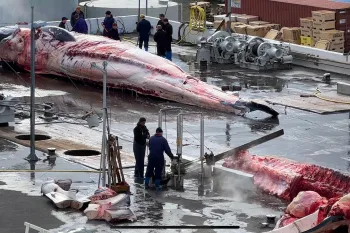
BRUSSELS―Campaigners at Humane World for Animals have today reacted in horror at the killing of the first two fin whales in Iceland’s 2026 hunt. Iceland’s whaling ships are allowed to kill up to 318 fin and minke whales in defiance of the global moratorium on commercial whaling. The killing comes just two months ahead of Iceland’s referendum on whether or not to join the European Union but Humane World for Animals (formerly called Humane Society International) says the resumption of whaling could not be in more stark contrast to the long held anti-whaling stance of the EU.
Dr Joanna Swabe, Humane World for Animals Europe’s senior public affairs director, said: “The first fin whale deaths in Iceland’s hunt this year are devastating. Iceland has killed more than 1,000 fin whales in the past two decades, not only the second largest animal on the planet but also a species classified as globally vulnerable to extinction. We know from Iceland’s own veterinary body that this poor whale will likely have endured immense and even prolonged suffering after being struck with an exploding harpoon, an agonising death for meat that virtually no one in Iceland wants to eat. A bill to end whaling is welcome and we urge the Minister to introduce it as soon as possible, but it is too late to stop this heart breaking killing this summer.”
Iceland’s hunt resumed despite a pledge by Iceland’s Minister of Industries, Hanna Katrín Friðriksson, that a legislative bill to ban whaling will be introduced this autumn. While Humane World for Animals welcomes such a bill, it says it has not come soon enough to stop the agonising and protracted deaths of whales in Icelandic waters this summer.
In 2024, whaling permits were issued allowing the killing of up to 2,130 whales in Iceland over five years—209 endangered fin whales and 217 minke whales each year for 2025-2029. While the 2026 kill quota published by the Marine Research Institute in April reduced the quota, it still allows the killing of 150 fin whales and 168 minke whales this year. Thankfully no minke whales have been hunted in recent years.
Humane World for Animals says that the resumption of whaling makes a mockery of Iceland’s discussions to join the European Union, a 27-nation bloc with a strongly anti-whaling, pro whale protection position.
Swabe said: “For the Icelandic government to allow the commercial killing of whales to proceed against the backdrop of a referendum to join the famously anti-whaling EU bloc, makes a mockery of those discussions. If those negotiations continue, the EU must take a firm and unwavering stance on this issue and insist that Iceland end whale killing once and for all.”
Iceland, Japan and Norway are the only countries in the world to continue commercial whaling, defying the global moratorium by the International Whaling Commission enacted in 1986.
Fast facts:
- Iceland left the IWC in 1992 but returned in 2002 with an exception to the moratorium, despite objections from multiple nations.
- Hunting fin whales in Iceland was suspended in 2016 due to a declining market for whale meat in Japan. Hunting resumed for the 2018 season when 146 fin whales were killed, including a pregnant female and a rare fin-blue hybrid whale, plus six minke whales. A single minke whale was killed from 2019-2021, 148 fin whales in 2022 and 24 in 2023. No whales were killed in 2024 and 2025.
- Fin whales are classified by the International Union for Conservation of Nature as globally vulnerable to extinction despite decades of recovery since the commercial whaling moratorium.
- In 2023 an independent report released by the Icelandic Food and Veterinary Authority found that some whales killed in Icelandic hunts took up to two hours to die and that 41% of whales suffered immensely before dying, taking an average of 11.5 minutes to die.
- Japan was once the biggest consumer of Icelandic whale meat through importation, but this trade has ceased because Japan has a whale meat stockpile due to lack of local appetite. It has also expanded its own whaling. Most of the fin whale meat currently sold at Iceland’s tourist restaurants comes from whales who have been killed by Norway.
Humane World for Animals works globally to protect wild animals by improving coexistence, reducing human-caused threats, and supporting recovery efforts. With active programs in Australia, Costa Rica, India, South Africa, the United States, Mexico and Viet Nam, our work addresses the root causes of wildlife harm including the exploitation of wild animals as pets, the trade in fur and body parts, wildlife killing contests, the use of animals in entertainment and the persecution of wild animals such as elephants, wolves, dingoes and marine species such as sharks. Humane World for Animals also supports the rescue and recovery of animals affected by trade, poisoning and other threats, while collaborating with policymakers and practitioners.
ENDS