ALAJUELA, Costa Rica — An estimated 1,000 wild animals are illegally removed from their natural habitats in Costa Rica each year, to be trafficked to international markets, sold as pets, or added to private collections.
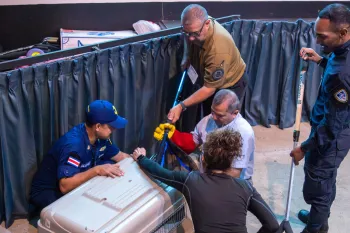
To address this issue, Humane World for Animals Costa Rica, in partnership with Costa Rica’s National Environmental Security Commission, conducted a series of training workshops for government authorities responsible for handling rescued or confiscated wildlife in illegal trafficking cases. The Commission includes the Public Prosecutor’s office, the Judicial Investigation Agency (OIJ), the Ministry of Public Security, and the Ministry of Environment and Energy.
Altogether, 150 officials took part in the workshops, which focused on safe and humane wildlife handling, protection of both animals and responders, use of specialized equipment, and basic first aid for wildlife.
“This is critical training for those of us working in the field, because we face these situations daily. It is essential to have the tools needed to rescue or confiscate a wild animal, and coordinate with the appropriate agencies to ensure that the animal is brought to safety. For example, in the Northern region where I work, we have had to respond to cases involving iguanas, toucans, and sloths, so it is vital to be prepared,” says Tatiana Hurtado, an officer with the Fuerza Pública de Costa Rica (Public Force).
Andrea Borel, executive director at Humane World for Animals Costa Rica, says: “Illegal wildlife trafficking represents not only a threat to ecosystems and biodiversity, but also cruelty and stress for animals removed from their habitats to be illegally sold. When authorities succeed in stopping these illegal acts, it is vital that they know how to properly handle confiscated animals in order to reduce suffering and increase the likelihood that they can be returned to the wild through proper rehabilitation at authorized rescue centers.”
Olman Mora-Navarro, environmental comptroller at the Ministry of Environment and Energy, emphasizes the broader impact of the training. “Strengthening technical knowledge among law enforcement and judicial authorities improves their ability to identify environmental crimes, gather appropriate evidence, and move cases through the justice system. It also ensures safer, more effective, and legally sound interventions when vulnerable wildlife is involved.”
Participants represented a wide range of agencies, including the Public Force, Border Police, Tourist Police, National Coast Guard Service, Air Surveillance Service, Ministry of Environment and Energy, National Animal Health Service (SENASA), the OIJ, the Public Prosecutor’s office, the General Directorate of Customs, and Costa Rica’s postal service.
The workshops were conducted with support from specialists at Rescate Wildlife Rescue Center (formerly ZooAve) and are part of the project “Strengthening Costa Rica’s capacity to combat wildlife trafficking”, an initiative funded by the U.S. Department of State’s Bureau of International Narcotics and Law Enforcement Affairs (INL) and implemented by Humane World for Animals in coordination with Costa Rica’s National Environmental Security Commission.
Humane World for Animals works in countries across the globe to foster humane co-existence between people and wildlife. Around the world, the organization promotes and supports effective, science-driven and community-focused solutions to mitigate negative human-wildlife interactions. The efforts span a wide range of species and contexts, including elephants in South Africa, dingoes in Australia, urban wildlife in North and Central America, rodents in the United Kingdom, jaguars in Costa Rica, snakes in India, coyotes in the United States and many more, reflecting Humane World for Animal’s commitment to context-led, species-appropriate solutions that help both human and wildlife communities thrive together.
#