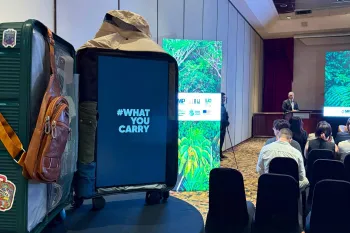
SAN JOSE, Costa Rica—Tourists arriving at Costa Rica's main international airport are being encouraged to leave wildlife and souvenirs made from animal parts out of their luggage through a new awareness campaign led by Humane World for Animals and Costa Rica's Judicial Branch.
The #WhatYouCarry campaign urges visitors to Costa Rica to take home memories, smiles and authentic experiences, rather than wildlife, plants or souvenirs made from animal parts. Such purchases can fuel illegal wildlife trafficking, cause animal suffering, and damage fragile ecosystems.
#WhatYouCarry is a joint initiative of Humane World for Animals, Costa Rica’s Judicial Branch (including the Public Prosecutor’s Office and the Judicial Investigation Agency) and airport operator AERIS. Launched in late July, it includes banners at the Juan Santamaría International Airport (SJO), as well as videos and digital content.
Andrea Borel, executive director of Humane World for Animals Costa Rica, said: “When a tourist buys a feather, a fang pendant or a tortoiseshell bracelet as a souvenir, it may seem like a harmless act. However, that object reveals a much more complex story: it was once part of a living animal who is no longer with us. At Humane World for Animals, we believe that an essential part of our mission is to make that animal visible: to see the cruelty within the wildlife trade and not just the final product. #WhatWeCarry helps visitors realize that behind a small object or a trafficked live animal, there can be a chain of capture, extraction, suffering and illegal trade.”
Between 2024 and 2025, Costa Rican authorities seized 4,366 wildlife and plant specimens at the country's main airports and border crossings, underscoring the scale of illegal extraction and trafficking affecting the nation's biodiversity. According to the Forensic Science Department of the Judicial Investigation Agency (OIJ), most of the seized specimens were reptiles such as boas and amphibians, as well as feline claws and bones, insects, mollusks and corals and plants such as orchids.
John Vargas, head of the Forensic Biology Section of the OIJ's Forensic Science Department, said: “When we talk about wildlife trafficking, we're not just referring to live animals. Our analyses reveal a vast diversity of species and samples that demonstrate the impact this activity has on the country's biodiversity. Since 2023, the number of cases referred for taxonomic and molecular identification of wildlife has increased by 330%. This increase shows that this is a persistent challenge that requires both scientific research and greater public awareness.”
#WhatYouCarry is part of an initiative, “Enhancing Costa Rica’s capacity to combat wildlife trafficking,” funded by the U.S. Department of State’s Bureau of International Narcotics and Law Enforcement Affairs (INL). The initiative is managed by Humane World for Animals in coordination with Costa Rica’s National Environmental Security Commission.
Travelers can learn more about the campaign and how to identify wildlife products that may be illegal to transport at www.whatyoucarrycr.com.