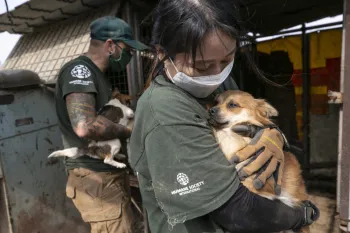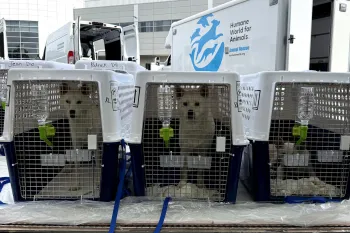
WASHINGTON―Nearly 30 dogs rescued by Humane World for Animals (formerly called the Humane Society of the United States and Humane Society International) from a dog meat farm in Gangjin, South Korea landed safely in New York and will soon start their search for loving homes.
After rescuing almost 3,000 dogs from South Korea’s dog meat farms since 2015, Humane World for Animals is marking its final large-scale dog meat farm rescue mission in South Korea before the country's historic ban on the dog meat industry comes into full effect in February 2027. After recovering at the organization’s care and rehabilitation center in Maryland, the dogs will be placed with shelter and rescue partners for adoption.
As government statistics show that only a tiny fraction of dogs—as little as 0.3%—on meat farms have been rescued since the ban was passed in 2024*, and as Humane World for Animals is the only international animal group to conduct large scale dog farm rescues and adoptions overseas, the Gangjin survivors are likely to be one of the last groups of lucky dogs to escape slaughter in South Korea.
The dogs—including Jindos, a husky mix and a range of small and medium dogs such as a spitz mix—were the final survivors on the farm, which once bred and slaughtered as many as 1,000 dogs a year. Surrounded by rows of rusting, empty cages that would once have been packed with dogs, and with the ground strewn with abandoned collars and skeletal jaw bones of dogs who died long before, this farm rescue symbolises the decline of the dog meat industry in South Korea. The industry is in its sunset phase with the majority of registered farms now closed.
In addition to the almost 30 dogs recovering in the United States, another 12 dogs from this rescue have been transferred to Humane World for Animals rehabilitation center in Montreal, Canada, while some mother dogs with their puppies who are too young to fly remain in South Korea and will make the trip to North America in early 2027. The Humane World for Animals team in South Korea is overseeing their care until they are old enough to safely make the trip. More than 70 dogs were rescued from this farm in total.
Sangkyung Lee, Humane World for Animals Korea campaign manager, said: "For more than a decade, our rescue teams have shone a spotlight inside these dog meat farms and faced the heartbreak of witnessing the suffering involved in this industry while saving the lives of thousands of dogs. To be conducting our final farm rescue is an incredibly profound moment. These dogs are among the very last few to suffer in this dying industry and sending them to the USA and Canada to start new lives in loving families feels like the perfect closing chapter to our 10-year mission as South Korea embarks on a new relationship with dogs in which they are friends not food.”
The farm was brought to Humane World for Animals’ attention earlier this year when a member of the public contacted a local animal protection group. Together, they and Humane World for Animals alerted local authorities who cited the farm for violations of the Animal Protection Act relating to animal husbandry and management. The 80-year-old farmer agreed to relinquish the remaining dogs to Humane World for Animals and to sign a written commitment to no longer participate in the dog meat industry, ensuring the dogs would be spared and rehomed rather than slaughtered and that no other dogs would be at risk.
With this being its last large-scale dog meat farm rescue operation in South Korea, and focus now shifting to monitoring compliance with and enforcement of the ban, Humane World for Animals’ work continues elsewhere across Asia to end the dog and cat meat trade through sustainable, locally led solutions across Viet Nam, Indonesia and India, and in China through a partnership with a China-based animal charity.
Fast facts:
- South Korea’s ban or Special Act on the dog meat industry was unanimously passed in the National Assembly in January 2024. It comes into full effect on Feb. 7, 2027, making it illegal to farm, kill, butcher or sell dogs or dog meat for human consumption, with penalties of up to two years in prison and a fine of up to ₩30 million (US$20,637).
- Ministry of Agriculture statistics estimate there were 5,898 dog meat businesses at the time of the Special Act passing, which include 1,537 farms, 221 slaughterhouses, 1,788 traders and 2,352 restaurants.
- In May 2026, the Ministry of Agriculture, Food and Rural Affairs confirmed that 82% of South Korea's registered dog meat farms (1,265) have already closed ahead of the complete ban, with 272 farms remaining.
- Latest opinion surveys show that most South Koreans (86%) don’t have any interest in eating dog meat.
- Dogs suffer immensely on dog meat farms, both physically and mentally. They spend their lives in small, barren, wire cages without proper food, water, stimulation, comfort, shelter or veterinary care. Death is by electrocution.
- Humane World for Animals’ rescues are conducted in compliance with national and local health and safety protocols including evaluation by a veterinarian and vaccination against rabies, distemper, hepatitis, parvo virus, parainfluenza, leptospira and canine influenza, as well as screening for respiratory illness as needed to ensure the health of each animal and to comply with international export and import requirements.
Notes:
* Of roughly 393,857 dogs counted on farms that have already shut down, an estimated 381,465—about 97%—were sent for slaughter or redistributed to other farms. A total of 9,358 dogs were transferred to other farms; only 623 dogs were adopted and 498 given to public shelters meaning only 1,121 of the 393,857 dogs (or 0.3%) made it out alive.
#
Download photos and video of: