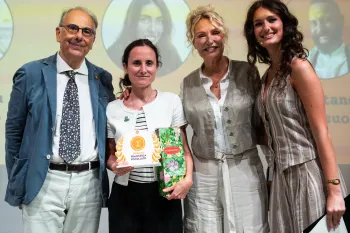
ROME, Italy—Francesca Pistollato, senior program director in biomedical science at Humane World for Animals (formerly called Humane Society International), has been honored with a LAV Animal Award in the “researchers and innovators” category for her commitment to promoting innovative and animal-free science with the aim of advancing more ethical, predictive, and humane biomedical research.
The LAV Animal Awards, now in their third year, recognize individuals who have distinguished themselves through courageous actions and choices that have had a significant and positive impact on animals. Winners in each category (researchers and innovators; media and influencers; institutions and justice; active citizenship) are selected by citizens in an online vote.
Acknowledging the award, Francesca Pistollato: “I would like to thank LAV for this recognition, which once again highlights the importance of transitioning to animal-free science in research, which is based on human biology. To accelerate the adoption of these methods, a cultural transformation is needed. This requires a shift in mindset and a redefinition of our values and frameworks, embracing advanced scientific approaches that are ethical and relevant to humans.”
The award ceremony took place on May 29 at the WeGil cultural space in Rome, with Gianluca Felicetti, president of LAV, and blogger and podcaster Liala Antonino (daughter of Italian TV presenter Licia Colò) also present.
Gianluca Felicetti, president of LAV, said: “With the Animal Awards ceremony, we have recognized those who, through their choices, have driven change in practices, production systems, and laws, working toward a better world for all, and especially for animals.”
It is estimated that, globally, around 190 million animals are used each year in research and testing, and nearly 8 million animals were used in the European Union alone in 2023. The most commonly used species include mice, fish, rats, rabbits, guinea pigs, hamsters and birds. Cats, dogs, and non-human primates are also used.
Beyond raising ethical concerns related to the suffering of large number of sentient beings, animal experiments require significant amounts of time and resources, provide limited understanding of how chemicals or drugs behave in the human body, and in many cases fail to accurately predict human responses or reliably replicate human diseases. Non-animal testing methods can be faster, less expensive, more relevant, and more reliable.
Humane World for Animals works around the globe to replace cruel, outdated animal experiments with innovative methods that don’t use animals. Our teams in Australia, Brazil, Canada, the European Union, India, South Africa, South Korea, the United States and other key economies help change laws, regulations and scientific practices to end testing and research on animals and promote the development, acceptance and use of advanced non-animal methods. We lead the Animal-Free Safety Assessment Collaboration as well as the Biomedical Research for the 21st Century Collaboration, multi-sector, multi-country partnerships advancing animal-free science as the gold standard.
#
Profile of Francesca Pistollato
Francesca Pistollato is a biologist from Treviso with over 15 years of experience in biomedical research, regulatory toxicology, and European research policy. She is an expert in the development of human-based approaches in the field of neurotoxicology and the transition toward human-relevant, non-animal methodologies (NAMs). Pistollato has experience in assessing the impact of EU-funded research and in coordinating multi-sector initiatives at European and international level. She has worked in academia, in institutional settings—at the Joint Research Centre (JRC) of the European Commission—and in the non-profit sector, contributing to the development of methodological approaches aimed at improving the translatability, quality and impact of research.