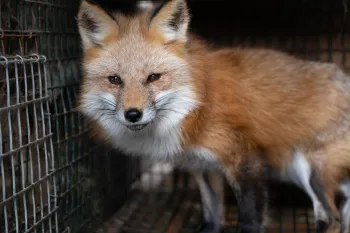
ROME—Ahead of Fur Free Friday, an initiative held every November that encourages consumers to refrain from buying clothing and accessories made with animal fur during Black Friday, Humane World for Animals Italy (formerly called Humane Society International) is urging the public to sign a petition calling on Rome Mayor Roberto Gualtieri to make the Italian capital the first city in Italy to ban fur displays in shop windows.
A motion before the Rome’s City Council calls on the mayor and the municipal executive to ban “the display of goods derived from unnecessary animal exploitation.”
The measure would build on Rome’s commitments to animal protection, the environment, public health and urban decorum. It would also respond to the more than 1.5 million people who backed the European Citizens’ Initiative Fur Free Europe.
The motion is the first of its kind in Italy. It has been signed by City Councillors Daniele Diaco, Linda Meleo, Paolo Ferrara and Virginia Raggi (of the national party Five Star Movement) and aims to reduce the visibility and normalization of fur products, thereby helping to discourage their purchase.
Martina Pluda, country director at Humane World for Animals Italy, says: “I would like to thank the city councillors for listening to civil society. However, a motion is only a first step, particularly until it has been debated and approved. For a ban on fur displays to become a reality, the mayor and the municipal executive must take the necessary measures to implement it. The longer this takes, the longer fur products remain on display. We therefore urge Mayor Gualtieri to respond to this call without delay and introduce the ban as soon as possible. Rome has the opportunity to become the first city in Italy to adopt such a measure and inspire many others to follow suit.”
Italy is one of 24 European countries, including 18 EU Member States, to have banned fur farming. Denmark has also recently taken steps to end its mink fur farming industry.
Despite this progress, more than 6 million minks, foxes, raccoon dogs and other animals remain confined in small wire cages on nearly 1,200 fur farms across the EU.
The European Commission is expected to respond to the European Citizens’ Initiative Fur Free Europe, which calls for an EU-wide ban on fur farming and the sale of fur products. A strong position from Rome would demonstrate leadership and reinforce growing momentum for a fur-free Europe.
Humane World for Animals works across the globe to end the fur trade. With a focus on the UK, Europe, North America, China and Australia, the organization’s work includes government, industry and corporate campaigns, collaborations with designers and fashion brands, undercover investigations and education campaigns, and has led to a steadily decreasing number of animals affected by this cruel trade.
Fur facts
- Most leading designers have fur-free policies including Max Mara, Saint Laurent, Gucci, Alexander McQueen, Balenciaga, Valentino, Prada, Armani, Versace, Michael Kors, Jimmy Choo, DKNY, Burberry and Chanel. Over 1,600 fashion brands and retailers worldwide have committed to being fur-free.
- Fashion Weeks including Copenhagen, London and New York have dropped the use of fur from their events. Camera Nazionale della Moda Italiana has decided to stop promoting fur in its events and communications, including on social media, and is urging brands not to present fur during Milan Fashion Week. Publishers of titles including Vogue, Elle, GQ, Harper’s Bazaar, Glamour, Esquire and Vanity Fair have committed to fur exclusion policies.
- EFSA’s scientific opinion, which was published in July 2025, concluded that the fundamental needs of minks, foxes, raccoon dogs and chinchillas cannot be met in EU fur-farming cages, and that this industry is incompatible with animal welfare.
- Fur farming poses a zoonotic disease risk. Mink on almost 500 fur farms across 13 countries in Europe and North America have been found to be infected with COVID-19, with millions of animals killed on public health grounds.
- Scientific evidence in the “Fur’s Dirty Footprint” report shows that the carbon footprint of 1kg of mink fur (309.91 kg CO2-eq) is 31 times higher than cotton, 26 times higher than acrylic, and 25 times higher than polyester. Raccoon dog fur and fox fur also have high carbon footprints, approximately 23 times worse for the climate than cotton, and 18 times worse for the climate than polyester.
- As shown by an analysis by economist Griffin Carpenter, the European fur farming industry generates a gross value added (GVA) of -€9.2 million, thus contributing negatively to the EU economy. Environmental costs (€226 million) and health costs (€211 million) exceed the sector’s total revenues (€183 million), meaning that its overall contribution to the economy—calculated by subtracting these costs from GVA—amounts to -€446 million.
#