It’s official: The last U.S. government-owned chimpanzees living in a laboratory will soon be leaving the Texas facility where they’ve been for decades. Today, the National Institutes of Health announced that the 33 chimpanzees will move to Chimp Haven, a lush 200-acre sanctuary in Louisiana, in 2027.
This is the latest in a series of positive actions signaling the willingness of the U.S. government to shift away from animal experiments.
The chimps—who range in age from the 30s to late 50s—currently live at the Keeling Center for Comparative Medicine and Research at The University of Texas MD Anderson Cancer Center.
It’s an absolutely incredible thing to see chimps who were locked in laboratories for most of their lives finally get to experience life in a sanctuary. We cannot wait for these chimps to see their new home.
Their stories
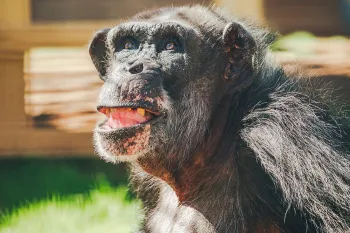
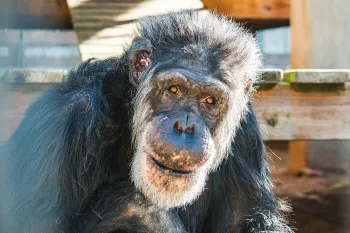
While public information about their pasts is limited, we know that many of them, like Bria, were born in a laboratory and have never known life outside of one. At 31 years old, this female chimp has endured so much. At a young age, Bria was loaned to another laboratory for two years, where she was used in a malaria study and had her spleen removed. It appears from her records that workers had difficulty sedating her before laboratory procedures, she had a miscarriage, and bit through the skin in her own arm to remove a birth control implant.
Other chimps like Tanya, a 57-year-old female, had their freedom stolen from them when they were captured in Africa and brought to U.S. laboratories as infants. In the wild, Tanya would have grown up with her mother, father and siblings. Instead, Tanya was separated from her entire family and spent the next 45 years of her life in a laboratory where she was used in biomedical research experiments. During that time, she gave birth to five babies as part of a breeding program to produce more chimpanzees who could be used in harmful research.
But Bria and Tanya will have renewed lives at Chimp Haven. The sanctuary’s mission is focused entirely on chimpanzee care and well-being and the sanctuary is specifically designed to cater to the unique needs of chimps formerly used in biomedical research. There, they’ll have the opportunity to explore Chimp Haven’s outdoor areas, make new best friends, and live out their lives on their own terms.
So many advocates helped make this moment possible
In 2000, we worked to help pass the Chimpanzee Health Improvement, Maintenance, and Protection (CHIMP) Act. While that law didn’t end biomedical research on chimps, it established a national sanctuary where federally owned chimpanzees would live after the experiments on them had ended. That federal sanctuary is run by Chimp Haven, which has done the incredible work of building its capacity to accept hundreds of federal chimpanzees from labs since the CHIMP Act was passed.
Then in 2010, we collaborated with other animal organizations to file a legal petition seeking to end the “split listing” of chimpanzees under the U.S. Endangered Species Act. This legal loophole allowed captive chimpanzees to be used in harmful biomedical research even though chimpanzees in the wild were fully protected under the Endangered Species Act. In 2015, the U.S. government granted our petition, and this decision effectively ended invasive chimpanzee research in the U.S. Shortly after, NIH announced that it would move all government-owned chimpanzees—including the chimps living at the Keeling laboratory as well as chimps at the Alamogordo Primate Facility in New Mexico—to Chimp Haven.
In the following years, more than 150 chimpanzees were successfully moved, but then NIH made the shocking announcement in 2019 that it would not transfer the remaining government-owned chimps living at the Alamogordo laboratory to Chimp Haven as promised. Instead, they would remain at the lab for the rest of their lives. At the time of this decision, there were 44 Alamogordo chimps, all of whom had been living there since at least 2001. NIH claimed that these chimps were too frail to be moved due to health concerns, even though sick and elderly chimpanzees are frequently relocated to sanctuaries without incident.
We fought for those chimps—and more than 150,000 of our supporters stood alongside us in demanding that the agency send the chimps at the Alamogordo laboratory to sanctuary.
In 2021, when NIH still refused to take positive action, we sued, arguing NIH’s refusal to move the chimps to Chimp Haven violated the CHIMP Act. Later that same year, NIH announced that nearly all remaining chimpanzees at the Keeling laboratory, including Bria and Tanya, would also remain in the lab instead of moving to sanctuary.
But, in response to our lawsuit, a federal judge ruled in December 2022 that NIH’s decision to deny sanctuary retirement to the Alamogordo chimpanzees because of their chronic health conditions violated the CHIMP Act.
At first, NIH still refused to move any chimps, but after 135,000 of our supporters contacted NIH, the agency changed course. In November 2024, NIH announced that the remaining chimps at the Alamogordo laboratory would finally be moved to Chimp Haven. By the spring of 2025, the chimpanzees had been relocated to their new sanctuary home where, today, they spend every day enjoying the freedom of sanctuary life.
While our lawsuit was focused on the Alamogordo chimps, the CHIMP Act’s requirements also apply to the Keeling chimps, and we are beyond pleased that NIH has chosen to follow the law and move them as well.
After years in a lab, Bria, Tanya and the rest of the chimps living at the Keeling laboratory will finally get their chance to experience the more natural environment that Chimp Haven provides.
What’s next for chimps in laboratories
Our work is not over. There are still as many as 100 privately owned chimps at three U.S. laboratories. This includes a laboratory in Louisiana with plans to move their chimpanzees to Project Chimps, a sanctuary in Georgia. We have committed $20 million to Project Chimps to help ensure that the sanctuary can accommodate as many of these chimps as possible. We are determined to stay the course until there are no more chimpanzees in laboratories.
And while invasive research on chimpanzees is thankfully a thing of the past, we continue to push to end harmful tests and research on dogs, monkeys, rats and other animal species. In a positive trend, NIH—along with other U.S. government agencies—has recently announced efforts to move away from using animals in experiments and instead focus on non-animal alternatives.
And while we celebrate this historic victory, we are also grieving for the chimps who passed away in the years since NIH reversed its initial decision to move the chimps to Chimp Haven. While heartbroken that those chimpanzees were never able to experience the freedom of sanctuary life, we are overjoyed that the 33 surviving animals from that cohort will soon have that chance.
After everything that Bria, Tanya and the other chimps have endured, we cannot wait for them to take their first steps at Chimp Haven.
Kitty Block is president and CEO of Humane World for Animals. Follow Kitty Block on X. Sara Amundson is president of Humane World Action Fund.