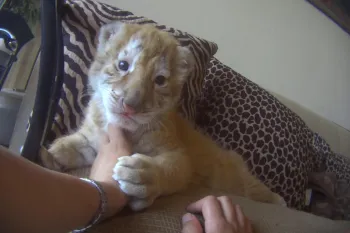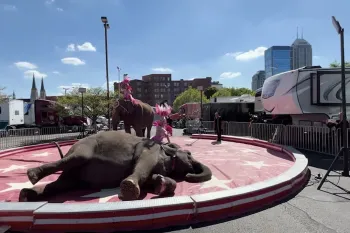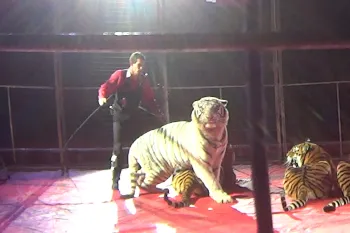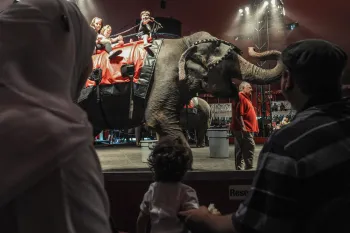
Across the U.S., 200 localities and a dozen states already restrict the use of some wild animals in traveling circuses and exhibits. As a result, circuses are using fewer wild animals, with some, such as Ringling Bros. and Barnum & Bailey and UniverSoul Circus, going entirely animal-free. But more needs to be done, and we can all play a part in our own communities to make a difference. Here, Olivia Lubig, a Michigan advocate and policy volunteer for Humane World for Animals, tells the story of her efforts to end the use of wild animals in traveling performances that visit her community.
My journey to banning traveling animal acts started by protesting Carden Circus, which visited my town of Marquette, Michigan, and towns and cities across the U.S., every year, with wild animals such elephants and often tigers in tow. In a local news article, Carden responded to our concerns by staunchly defending their “animal welfare” practices. This messaging irked me because Carden has received multiple citations for Animal Welfare Act violations from the U.S. Department of Agriculture, and has a history of hosting tiger exhibitors notorious for abusing animals. After reading Carden’s response to our protest, I thought, “There’s got to be something more I can do about this.”
Now, nearly four years after that protest, my town’s local government has updated the city code to prevent entities from bringing wild animals to perform there. I learned later that it was the 200th locality in the U.S. to do so—an incredible milestone in which I am proud to have helped lead. Here is the story of how I convinced my local policymakers to act on this issue.

Humane World for Animals
I started by reaching out to the Humane World for Animals team in my state, who helped me by providing information, strategy and resources. After some preparation, I scheduled a meeting with a local elected official and received a lukewarm response. I had all the facts down about animal cruelty and the public safety risks, but what they really wanted to know is why the local government should act on the circus issue. I had memorized talking points going into the meeting, but I hadn't prepared to explain the significance and broader context of why people specifically in my town should care.
After that meeting, I spent some time crafting my argument and focusing on the question: “So what?” That is, why does this matter and why should my community take action? For my “so what?” response, I connected my region’s cultural values of appreciating nature to the circus issue, arguing that hosting entities that abuse their animals does not align with our local values. I wrote about this disconnect in values in a letter to the editor of the Marquette newspaper The Mining Journal. It was this letter and the values-based arguments that captured the attention of policymakers, which really got the ball rolling. My letter was published in February 2025, and I used the same ideas as the basis for testimony at a public meeting in July.
Between my public testimony and meetings with policymakers, having my “so what?” prepared me to maintain clarity about the “why” behind my efforts, and to field questions regarding my motivations during these meetings with policymakers. This effort was not instant; it took a lot of follow-up, persistence and commitment. But, in January 2026, the local government officially updated the city code to ban entities from bringing wild animal acts to perform.
To be completely honest, I did not know if my efforts to ban traveling wild animal acts would be successful. I found my campaign to prevent these acts to be particularly challenging because I was not only learning how to lobby, but I was also figuring out how my local government operated. Local government processes can be confusing if you’re not already in the middle of it. Figuring out which part of the organizational structure you need to contact and which policymakers are most sympathetic to your cause is half the battle.
The real challenge that comes with being an animal advocate is communicating your “so what?” Articulating an argument as to why people should care about your cause is tremendously important. Animal advocates know so much about cruelty—whether inflicted upon circuses or in laboratories or in the wild, with wildlife killing contests. In theory, everyone may agree that stopping cruelty is important, but it’s not always enough to create an urgency to act. That’s why we must work to connect our cause to a wider issue. In my case, my “so what?” connected the circus to how my city/regional culture wants to be represented. As I learned throughout this process, your “so what?” can—and should—change with your audience. I found that different aspects of the circus issue resonated with different people. Figuring out which aspect matters most to someone—whether that be the animal cruelty inherent in the acts, zoonotic disease risks, the well-documented public safety risks or a values-based approach—and then focusing on those issues while in conversation with them is usually pretty effective because it acknowledges what matters to them.
I learned that we all can make a difference in our community. In many ways, there is even more power in being a local advocate than being a professional lobbyist. This is because, as a constituent, you are best equipped to connect the issue to your own community and the context in which you live. Your local elected officials are also more likely to consider your voice over a lobbyist who is not a constituent. But it can still require courage: I was honestly terrified to speak in front of my local government board. I found that practice and a bit of “fake it ‘til you make it” energy really helps.
There is always a risk that you’ll put your big heart for the animals out there and then strangers on the internet (or in real life) won’t respond in the way you’d expect or like. I found it helpful to keep in mind that I wasn’t auditioning to be a policymaker’s best friend. My goal was to foster mutual respect. Doing your best to hold that emotional boundary is really important.
While there might be challenges along the way, putting your heart out for animals matters. In fact, the caring, committed people who spoke up and engaged in their communities are exactly why 200 localities and 12 states have prohibited the use of certain wild animals in traveling acts. The collective momentum we’ve all built along the way will one day end these acts nationwide, for good.
The legislative and ordinance making process is accessible to anyone willing to engage in advocacy. For me, that meant having the guidance and support of Humane World for Animals through serving as a policy volunteer and by attending and speaking at Taking Action for Animals. Through those experiences, I could grow my confidence and sustain my enthusiasm. Channeling your big heart for the animals into effective action can make a real difference in your community, and I encourage everyone to step up to be a part of that change.
Olivia Lubig is an animal advocate based in Michigan and a policy volunteer for Humane World for Animals.