
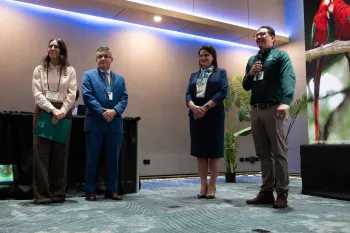
SAN JOSE, Costa Rica - Twenty-six members of the judiciary, including judges from the nation’s criminal, administrative litigation, constitutional, agrarian and labor courts, as well as legal scholars, gathered for a specialized workshop, "Environment and Justice in Costa Rica: Comprehensive Training for the Judiciary" in August.
The event, organized by Humane World for Animals alongside the Judicial Branch's Environmental Management Commission and the National Environmental Security Commission, was designed to strengthen judges' technical and legal capabilities in response to the growing complexity of environmental crimes, particularly illegal wildlife trafficking.
Participants examined the primary challenges facing environmental protection efforts, with a special emphasis on wildlife trafficking and its impacts in Costa Rica and globally. The training also addressed topics such as biodiversity and conservation, multilateral environmental agreements, environmental justice, climate litigation, the judiciary’s role in resolving environmental conflicts and practical tools for investigating and prosecuting environmental crimes.
Andrea Borel, executive director at Humane World for Animals Costa Rica, said: “In the face of the legal challenges posed by organized environmental crime and wildlife trafficking, having a robust judiciary is essential to protect not only our natural heritage, but also the wild animals who fall victim to this business and its cruel practices of capture, transport, captivity, or even death. At Humane World for Animals, we support, through training, the authorities who fight this scourge daily.”
The program featured insights from national and international experts, including technical support from the United Nations Office on Drugs and Crime, and included field visits to connect this knowledge with real-world conservation and environmental law enforcement efforts.
The workshop is part of the “Enhancing Costa Rica’s capacity to combat wildlife trafficking” initiative, funded by the U.S. Department of State’s Bureau of International Narcotics and Law Enforcement Affairs. The initiative is managed by Humane World for Animals in coordination with Costa Rica’s National Environmental Security Commission.
#