
Battery cages
Billions of hens worldwide are confined in cages. In the United States, for example, each caged laying hen is afforded only 67 square inches of cage space—each hen with less space than that of a single sheet of letter-sized paper. Unable even to spread their wings, caged hens are among the most intensively confined animals in agribusiness.
Caged hens also suffer from the denial of natural behavior such as nesting, perching, and dustbathing, all important for hen welfare. Numerous scientists and other experts have spoken clearly about the animal welfare problems with battery cages. One such scientist, Nobel Prize winner Dr. Konrad Lorenz, said:
"The worst torture to which a battery hen is exposed is the inability to retire somewhere for the laying act. For the person who knows something about animals it is truly heart-rending to watch how a chicken tries again and again to crawl beneath her fellow cage-mates to search there in vain for cover."
What are cage-free eggs and are cage-free eggs better?
Because of public opposition to battery cage confinement, many egg producers are switching to cage-free systems. These systems offer hens a significantly improved level of animal welfare compared to battery cage systems.
Cage-free systems benefit hens by allowing them to walk, spread their wings and lay their eggs in nests, and express other vital natural behavior. Our understanding of these behavioral needs has grown over several decades of scientific research, and the egg industry is beginning to embrace alternative, cage-free housing systems which allow the birds more freedom of movement.
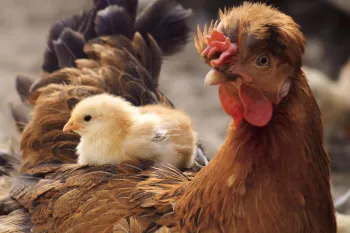
Some cage-free systems are also free range, which means the hens can go outside and feel the sun on their backs and the ground beneath their feet.
Dr. Michael Appleby, one of the world's leading poultry welfare experts, writes:
"Battery cages present inherent animal welfare problems, most notably by their small size and barren conditions. Hens are unable to engage in many of their natural behaviors and endure high levels of stress and frustration. Cage-free egg production, while not perfect, does not entail such inherent animal welfare disadvantages and is a very good step in the right direction for the egg industry."
Cage-free hens are spared several severe cruelties that are inherent to battery cage systems. But it would nevertheless be a mistake to consider cage-free facilities to necessarily be "cruelty-free." Welfare issues that remain to be solved include the killing of day-old male chicks (because they won’t grow to lay eggs) and partial beak amputation (where the tip of the beak is removed). However, these practices vary between countries and are beginning to be addressed where they are more widespread.
So, while cage-free does not necessarily mean cruelty-free, cage-free hens generally have significantly better lives than those confined in cages. If you buy eggs, look for cage-free or free range to support higher welfare housing systems for farm animals, or substitute eggs for a plant-based option.
Barry Lewis/Alamy Stock Photo/
Ask Loblaw to go cage-free
Loblaw has walked back its commitment to go 100% cage-free by 2025. Urge the company to eliminate cages entirely—not just battery cages—and stick to a truly cage-free future.
Modi Lajos/Getty Images
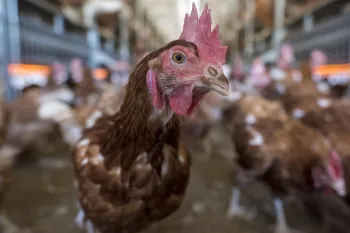
This week, as we come together with family and friends for Thanksgiving in the U.S., we honor our own tradition: Kicking off our year-end blog posts that celebrate progress for animals.
David Paul Morris/For Humane World for Animals
WASHINGTON—Animal protection charity Humane World for Animals (formerly called Humane Society International and the Humane Society of the United States) has launched a step-by-step guide to help food...
Gabriela Penela/We Animals Media
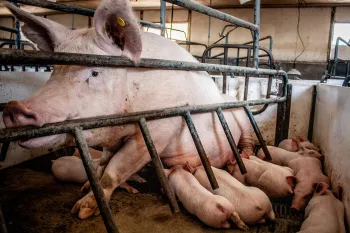
Barely larger than a pig’s body, these cages are where sows are locked away while they are pregnant, which happens repeatedly throughout their lives.
You can help farm animals
Animals on factory farms never breathe fresh air or feel grass beneath their feet. Your generous gift will support our efforts to improve their lives and other animals in need.
S. Chakrabarti/