Iceland Fashion Week has introduced a fur-free policy for participating local and international designers. The Icelandic fashion week, which takes place in Reykjavik in September, joins fashion weeks in Copenhagen, London and New York which have also dropped the use of fur.
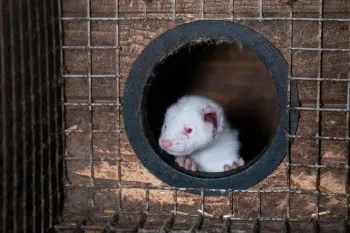
The Icelandic fashion event’s decision to go fur-free follows the broadcast on national TV of the first ever fur farm investigation in the country. Investigators, who supplied their undercover footage to global anti-fur campaigners Humane World for Animals and Icelandic partners Samtök um dýravelferð á Íslandi (Animal Welfare Iceland) showed mink with large wounds or infections, dead animals left in cages, mink covered in blood, others displaying stereotypical behavior indicative of mental breakdown and animals confined in small, filthy wire cages.
Humane World for Animals and Animal Welfare Iceland are now urging the Icelandic government to introduce a fur farming ban.
PJ Smith, director of fashion policy at Humane World for Animals, says: “Bravo to Erlendur Fashion Week Iceland for taking fur off its catwalks and event spaces and making compassion for animals an enduring fashion trend. Material innovation such as bio-based animal-free fur alternatives, are paving the way for a fur-free future of creativity and beauty without animal suffering.”
Asta Gudmundsdottir at Iceland Fashion Week confirmed the policy to campaigners via email, and said: “From the beginning, fashion, innovation and sustainability values have been at the core of Iceland Fashion Week. As the fur trade is at odds with all these principles, it’s time for us to take this stand and be proudly fur-free.”
Dr. Rósa Líf Darradóttir, chairwoman at Animal Welfare Iceland, said: “Fur farming exploits animals, damages the environment and is a relic of fashion’s past. We are delighted that Iceland’s fashion week is leaving fur where it belongs, in the past.”
The fur-free announcement comes as the European Commission is expected to publish its policy decision on an EU-wide fur farming ban. Fur farming is already banned in 24 European countries and restricted in many more. However, more than 6 million animals are still kept on almost 1,200 fur farms across the European Union in countries such as Finland, Denmark, Spain, Greece and Hungary.
Humane World for Animals recently unveiled a new thought-provoking campaign called Reality Projected exposing the cruelty hidden behind the glossy images promoted by the fur trade. Created with award-winning fashion photographer Fro Rojas of Kreative Kontent, the striking visual campaign uses light-projected photos and video of European fur farm cruelty onto the canvas of real fur coats.
Fur facts
- Most leading designers have fur-free policies including Max Mara, Saint Laurent, Gucci, Alexander McQueen, Balenciaga, Valentino, Prada, Armani, Versace, Michael Kors, Jimmy Choo, DKNY, Burberry and Chanel. Publishers of leading fashion titles including Vogue, Elle, GQ, Harper’s Bazaar, Glamour, Esquire and Vanity Fair have also gone fur-free. As fur becomes increasingly unmarketable and ethically indefensible, fashion houses are choosing to innovate with sustainable, cruelty-free alternatives.
- Greenwashing by the fur trade attempts to claim environmental credentials but the truth is farming, dressing and dying fur comes with a heavy environmental price tag. Research shows that the carbon footprint of 1kg of mink fur (309.91 kg CO2-eq) is 31 times higher than cotton, 26 times higher than acrylic, and 25 times higher than polyester.
- Fur farming is a public health risk. Mink on almost 500 fur farms across 13 countries in Europe and North America have been found to be infected with COVID-19, and Highly Pathogenic Avian Influenza A (H5N1) has also been found on 72 fur farms in Europe to date.
- Fur farming is undeniably cruel. In July 2025 European scientific experts concluded that fur farms across Europe fail to meet basic animal welfare needs for mink, foxes, raccoon dogs and chinchillas.
Humane World for Animals works across the globe to end the fur trade. With a focus on the UK, Europe, North America and China, our work includes government, industry and corporate campaigns, collaborations with designers and fashion brands, undercover investigations and education campaigns, and has led to a steadily decreasing number of animals affected by this cruel trade.