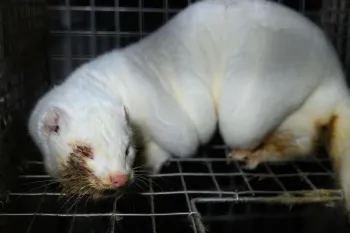
LONDON―Campaigners at Humane World for Animals UK (formerly called Humane Society International UK) are calling on the UK Government to act swiftly to end the import and sale of fur as the first ever undercover investigation at fur farms in Iceland reveals shocking levels of animal suffering. Investigators filmed animals with large wounds or infections, dead animals left in cages and mink covered in blood and confined in small, filthy wire cages. Despite having banned fur farming more than two decades ago, the UK continues to import fur from other countries, including Iceland.
Investigators filmed at three fur farms in November 2025, just one month before the farms closed down, reportedly due to financial collapse. Investigators handed their shocking evidence to Humane World for Animals as the world’s leading organisation campaigning to end the global fur trade. The footage was aired as part of an in-depth exposé on award-winning Icelandic investigative news program, Kveikur, which airs on the country's leading public-service broadcaster.
Images from the three farms investigated in the south of Iceland revealed thousands of mink being kept in dark sheds of small, filthy cages, mink with blood oozing from their nostrils, with one seen repeatedly sneezing. Other mink showed signs of infected eyes and had open or old wounds on their bodies and faces. Investigators also documented discarded bodies of dead mink. Mink at one farm were filmed displaying stereotypical behavior indicative of mental breakdown.
Although the three fur farms investigated have since closed down, reports obtained in February 2026 through a Freedom of Information request to Iceland’s veterinary authority suggest that conditions for animals at Iceland’s last remaining operating fur farm could be just as bad. Over the last 10 years, multiple inspections at Dalsbú fur farm in Mosfellsdalur by the Icelandic Food and Veterinary Authority known as MAST, report a catalogue of animal welfare concerns that may constitute breaches of the Animal Welfare Act such as animals with wounds, injuries, an abscess and signs of cannibalism. The Dalsbú fur farm houses many thousands of mink, kept in factory farm style caging.
Claire Bass, senior director of Campaigns and Public Affairs at Humane World for Animals UK, says: “These horrific images of blood-soaked mink trapped for their whole lives in tiny wire cages are as far removed from the fur trade’s fantasy of ‘luxury fur’ as it’s possible to get. That the fur from these tormented animals could be traded into the UK is completely at odds with the UK Government’s recent Animal Welfare Strategy commitment to ‘uphold high animal welfare standards as part of our approach to trade’, and it defies both public and political opinion. Fur farming is banned in the UK, now the government must uphold that standard and put the British fur trade where it belongs, in the past.”
At a UK Parliamentary debate last week, a ban on the import and sale of fur received strong cross-party support.
Unbelievably, the Icelandic Fur Farmers’ association website promotes links to Welfur and Saga Furs, both part of the fur trade’s own bogus animal welfare scheme that has been discredited by veterinarians. And export data shows almost all raw fur pelts are exported from Iceland to Finland, home of Saga Furs’ auction house, which boasts it only sells pelts from certified Welfur/Furmark farms. UK trade data shows that the UK has imported almost £800,000 worth of fur from Finland in the last decade. In correspondence with MAST in 2025, the Dalsbú farmer tells the veterinary authority that the reports from Welfur "give us a good rating". Correspondence received in March 2026 by AWI from a fur farming consultant at the Icelandic Agricultural Advisory Center also confirmed that all Iceland’s fur farms were and are certified by Welfur.
Dr. Rósa Líf Darradóttir, chairwoman at Animal Welfare Iceland, said: “Iceland’s Animal Welfare Act requires animals to be protected from fear, suffering, pain, injury, disease and that they be able to express their natural behaviours. Fur farming, by its very nature, is fundamentally incompatible with these statutory objectives. The documented conditions on the three fur farms were deeply disturbing and it is heartbreaking that fur farming is still taking place in my beautiful country. All Icelandic fur is sold outside of Iceland so for as long as countries like the UK keep their doors open to foreign fur imports, animals like these poor mink will continue to suffer. We urge the British government to say no to fur imports and say no to fur suffering.”
Iceland’s fur farming industry has been in steep decline for years, mirroring the decline of the fur trade globally due to rapidly decreasing consumer and designer demand for fur. There were 43 fur farms operational in Iceland in 2013, reduced to just six in 2024 and now one in 2026. Consumer demand for fur is so low that multiple reports show mink pelts from Iceland are being sold at a loss, below production costs.
Take action: urge the UK government to ban fur imports at humaneworld.org/furfreebritain
Humane World for Animals works across the globe to end the fur trade. With a focus on the UK, Europe, North America and China, our work includes government, industry and corporate campaigns, collaborations with designers and fashion brands, undercover investigations and education campaigns, and has led to a steadily decreasing number of animals affected by this cruel trade.
Fur facts
- A MAST report from the remaining Dalsbú fur farm in Iceland in August 2023 shows that multiple mink were found with bite wounds including many who veterinarians assessed should have been euthanized. Others were found with old wounds, a swollen jaw, an abscess, and evidence of cannibalism. Concerns were also raised about the barren cages lacking any environmental enrichment or sufficient insulation against the elements, as well as “repeated escapes” of mink in recent years.
- In July 2025 scientific experts from the European Food Safety Authority concluded that conditions on fur farms across Europe fail to meet basic animal welfare needs for mink as well as for foxes, raccoon dogs and chinchillas.Fur farming poses a zoonotic disease risk. Mink on almost 500 fur farms across 13 countries in Europe and North America have been found to be infected with COVID-19, with millions of animals killed on public health grounds. Highly Pathogenic Avian Influenza A (H5N1) has also been found on 72 fur farms in Europe to date. Around 500,000 mink, arctic fox, red fox, raccoon dogs and sable were killed on public health grounds.
- Research shows that the carbon footprint of 1kg of mink fur (309.91 kg CO2-eq) is 31 times higher than cotton, 26 times higher than acrylic, and 25 times higher than polyester. Compared to other environmentally harmful forms of animal agriculture, the farming of carnivorous animals is worse. The production of 1 kilogram of mink fur releases approximately seven times higher emissions than producing 1 kilogram of beef.
- Most leading designers have fur-free policies including Max Mara, Saint Laurent, Gucci, Alexander McQueen, Balenciaga, Valentino, Prada, Armani, Versace, Michael Kors, Jimmy Choo, DKNY, Burberry and Chanel. As fur becomes increasingly unmarketable and ethically indefensible, fashion houses are choosing to innovate with sustainable, cruelty-free alternatives.
Download photos and video from the investigation HERE.
ENDS