BRUSSELS – A letter signed by more than 80,000 EU citizens was submitted today in Brussels by Humane World for Animals Europe to Commissioner Olivér Várhelyi, calling for an EU-wide ban on fur farming and the sale of fur products across the European Union. The submission, with all signatures gathered in just 4 months, follows the historic European Citizens’ Initiative ‘Fur Free Europe’, with more than 1.5 million validated EU signatures.
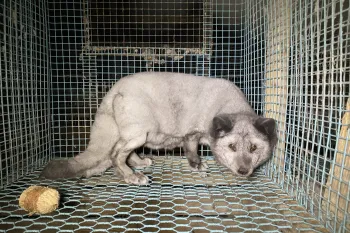
The letter, formally addressed to Mr. Várhelyi, European Commissioner for Health and Animal Welfare, calls on the European Commission to act in line with scientific evidence and public opinion by committing to introduce legislation. In July 2025, the European Food Safety Authority published its scientific opinion concluding that fur farming across the EU fails to meet basic animal welfare needs for mink, foxes, raccoon dogs and chinchillas. EFSA stated that keeping fur-bearing animals in cages of insufficient size and complexity with “barren conditions”, which “severely restrict movement”, causes serious chronic animal welfare problems, including suppression of key vital behaviours, stress, injuries and health disorders.
Dr. Joanna Swabe, senior director of public affairs for Humane World for Animals Europe, says: “Citizens across Europe have delivered a clear and united message: fur farming is outdated, unethical, and fundamentally at odds with modern EU values. With 80,000 additional signatures submitted today - alongside the 1.5 million from the European Citizens’ Initiative - the call for action could not be any clearer. This is a pivotal moment for Commissioner Várhelyi and his colleagues to drive real and lasting change. Humane World for Animals is ready to work constructively with the Commission to support a strong and effective legislative proposal that would bring an end to fur farming and fur trade in the EU.”
Across Europe, public opposition to fur farming continues to grow due to animal welfare concerns, public health risks linked to fur farms and related environmental considerations. Eighteen EU Member States have already introduced national bans on fur farming, while others have taken steps to curtail the practice. Despite this, more than 6 million mink, fox, raccoon dogs and other animals continue to be confined in small wire cages on almost 1,200 fur farms in EU countries such as Finland, Poland, Denmark, Spain and Greece.
Humane World for Animals works across the globe to end the fur trade. With a focus on the UK, Europe, North America and China, our work includes government, industry and corporate campaigns, collaborations with designers and fashion brands, undercover investigations and education campaigns, and has led to a steadily decreasing number of animals affected by this cruel trade.
Fur facts
- Fur farming poses a zoonotic disease risk. Mink on almost 500 fur farms across 13 countries in Europe and North America have been found to be infected with COVID-19, with millions of animals killed on public health grounds. Highly Pathogenic Avian Influenza A (H5N1) has also been found on 72 fur farms in Europe to date. Around 500,000 mink, arctic fox, red fox, raccoon dogs and sable were killed on public health grounds.
- Scientific evidence in the Fur’s Dirty Footprint report shows that the carbon footprint of 1kg of mink fur (309.91 kg CO2-eq) is 31 times higher than cotton, 26 times higher than acrylic, and 25 times higher than polyester. Raccoon dog fur and fox fur also have high carbon footprints, approximately 23 times worse for the climate than cotton, and 18 times worse for the climate than polyester. Compared to other environmentally harmful forms of animal agriculture, the farming of carnivorous animals is worse. The production of 1 kilogram of mink fur releases approximately seven times higher emissions than producing 1 kilogram of beef.
- Most leading designers have fur-free policies including Max Mara, Saint Laurent, Gucci, Alexander McQueen, Balenciaga, Valentino, Prada, Armani, Versace, Michael Kors, Jimmy Choo, DKNY, Burberry and Chanel. Over 1,600 fashion brands and retailers worldwide have committed to being fur-free and as fur becomes increasingly unmarketable and ethically indefensible, fashion houses are choosing to innovate with sustainable, cruelty-free alternatives.
- Fashion Weeks including Copenhagen, London and New York have dropped the use of fur from their events, and publishers of titles including Vogue, Elle, GQ, Harper’s Bazaar, Glamour, Esquire and Vanity Fair have committed to fur exclusion policies.
Download photos and video of fur farms in Europe here: Link
END