
By the numbers
We must rethink why Canada’s commercial seal hunt continues despite global bans and collapsing demand. At Humane World for Animals, we’re combining science, advocacy and public compassion to persuade governments, policymakers and markets to end this cruel, unnecessary hunt and protect seals threatened by climate‑driven ice loss—for good, worldwide together.
can be legally killed each year - even though the EU and dozens of countries ban commercial seal products because of animal cruelty.
followed the EU ban, collapsing global demand and leaving this cruel hunt alive only through government support—not public need.
Facts about the Canadian seal hunt
The cruelty of Canada's annual seal hunt
Facing harsh criticism the world over because of the hunt's cruelty and unsustainability, the Canadian government and fishing industry have spread misinformation. Here are the facts.
Which seals are targeted by Canada's seal hunt?
Harp seals are the primary target of Canada's commercial seal hunt, and to a much smaller extent, hooded seals and grey seals are also killed. Fully 97% of the harp seals killed are pups under just 3 months of age. This leaves Canadian seal populations especially vulnerable.
Where are the seals killed?
Canada's commercial seal hunt occurs on the ice floes off Canada's East Coast in two areas: the Gulf of St. Lawrence (west of Newfoundland and east of the Magdalen Islands) and the "Front" (northeast of Newfoundland).
Who kills seals and why?
Sealing is an off-season activity conducted by fishermen from Canada's East Coast. They make, on average, a small fraction of their annual incomes from sealing—and the rest from commercial fisheries. Even in Newfoundland, where most sealers live, the government estimates there are fewer than 6,000 fishermen who actively participate in the seal hunt each year—less than 1% of the provincial population.
Mark Glover/HSI
Protect baby seals
Thousands of seal pups are dying as climate change destroys their sea ice habitat and the Canadian sealing industry wants to slaughter the survivors.
Is the seal hunt cruel?
Experts agree: the seal hunt is inhumane
Yes. It is notable that in the 60 years Canada’s commercial seal hunt has been the subject of veterinary scrutiny, not one report has ever suggested the seal hunt is acceptably humane. A key review by Dr. Andrew Butterworth and Dr. Mary Richardson, two veterinary experts in humane slaughter methods, concluded that the commercial seal hunt is inherently inhumane because of the context in which it operates. A previous report by an international team of veterinary and zoology experts who studied the hunt concluded that both clubbing and shooting of seals in Canada are inhumane and should be prohibited. The report noted a general failure to comply with regulations by sealers and a failure to enforce the regulations by authorities.
Reports show regulations aren’t followed or enforced
Similarly, in 2001, a report by an independent team of veterinarians who studied the hunt concluded that governmental regulations regarding humane killing were neither being respected nor enforced, and that the seal hunt failed to comply with Canada's basic animal welfare standards. Shockingly, the veterinarians found that in 42% of the cases they studied, there was not enough evidence of cranial injury to even guarantee unconsciousness at the time of skinning.
Eyewitness reports of cruelty to seals
Parliamentarians, journalists, scientists and animal welfare experts who observe Canada's commercial seal hunt continue to report unacceptable levels of cruelty, including sealers dragging conscious seals across the ice floes with boat hooks, shooting seals and leaving them to suffer in agony, stockpiling dead and dying animals and cutting open live seals.
How the seals are killed
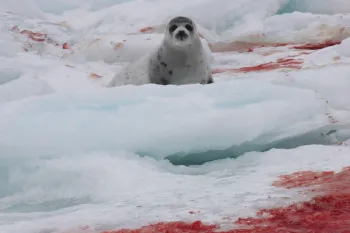
Humane World for Animals
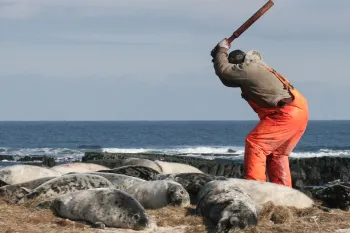
Rebecca Aldworth/HSI
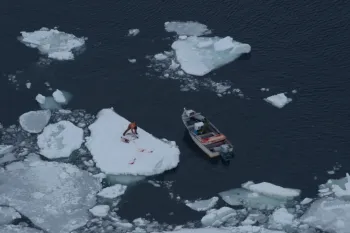
Frank Loftus/Humane World for Animals
Frequently asked questions
How many seals are killed annually in Canada’s commercial seal hunt?
While our work to close global markets for seal products has reduced the killing by 90% in some years, tens of thousands of baby seals continue to be brutally clubbed and shot to death for their fur annually. In fact, in the past two decades alone, more than 1.5 million baby seals have been slaughtered in the Canadian commercial seal hunt.
Moreover, the actual number of seals killed is likely higher than the number reported. Many seals are shot at and injured in the course of the hunt and studies suggest that a significant number of these animals slip beneath the surface of the water, where they die slowly and are never recovered.
When does the Canadian seal hunt take place?
Canada’s commercial seal hunt takes place each year as an offseason activity for fishermen on Canada’s East Coast, when they travel to the ice floes off Newfoundland, Labrador, and the Gulf of St. Lawrence. The hunt targets harp seal pups under just three months of age, with fully 98% of those killed being pups. Because sealers work from moving boats using clubs, hakapiks, and guns, the hunt happens during the period when pups are still on the ice and unable to escape into open water.
Are there any penalties when hunters exceed the government's quota?
No. In 2002, the Canadian government knowingly allowed sealers to exceed the quota by more than 37,000 animals. Sealers had already killed substantially more than the quota allowed by May 15 (the regulated closing date of the seal hunt) and yet the Minister of Fisheries and Oceans chose to extend the sealing season until June. In 2004, sealers killed close to 16,000 seals more than the permitted quota. Again, the Minister of Fisheries and Oceans extended the sealing season until well into June.
What products are made from seals?
Seals are killed primarily for their fur, which is used to produce fashion garments and other items. There is a small market for seal oil (both for industrial purposes and for human consumption) and seal penises have been sold in Asian markets as an aphrodisiac. There is little market for the meat, so seal carcasses are normally left to rot on the ice or disposed of in the ocean. Senior Canadian government representatives define the seal slaughter as “primarily a fur hunt.”
In Canada's commercial seal slaughter, wounded baby seals are routinely impaled on metal hooks, dragged across the ice floes, hoisted onto bloody boat decks and beaten to death. Humane World for Animals is stopping this cruelty forever by closing markets for commercial seal products and advocating for humane economic alternatives.
Rebecca Aldworth, Humane World for Animals
Is the seal hunt economically important?
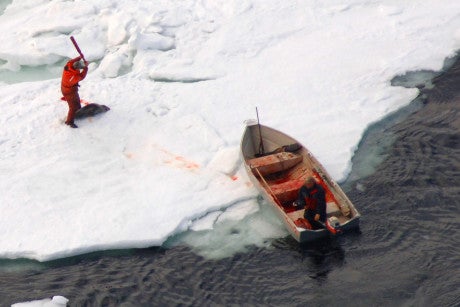
Humane World for Animals
A small, seasonal source of income
Sealing is an off-season activity conducted by a few hundred fishermen from Canada's East Coast. They make, on average, well under one-twentieth of their incomes from seal hunting and the rest from commercial fisheries. Even in Newfoundland, where most sealers live, income from the hunt accounts for less than 1% of the province's economy and less than 2% of the landed value of the fishery.
Better economic alternatives exist
The Canadian government could easily shut down the seal hunt and replace it with economic alternatives should it choose to do so. One solution, which is supported by both animal protection groups and sealers, is a federal buyout of the commercial sealing industry. This program would involve the federal government retiring sealing licenses and compensating fishermen for any lost income in the wake of the closure of the slaughter. Such a plan would be coupled with an investment in developing economic alternatives for the communities affected.
Canada has experience ending similar industries
Fishing industry buyouts are nothing new to the Canadian government; over $4 billion has been spent on Canada’s east coast on buyouts and alternative economic development plans in recent decades. Notably, when Canada ended its commercial whale hunt, it compensated whale hunters for their licenses in a similar fashion. One potential industry for the federal government to develop in place of seal hunting is marine ecotourism, including seal watching.
Does the government subsidize the hunt?
Millions of taxpayer dollars given to the sealing industry
Yes. Over the past few decades, there have been multiple economic reports that have detailed tens of millions of dollars in government funding provided to the commercial sealing industry. Those subsidies take a variety of forms, including funding for salaries, product development, capital acquisitions, research, and travel.
High taxpayer costs
In recent decades, many millions of dollars have been spent on ice-breaking for the sealing vessels, search and rescue of sealing crews, and monitoring seal populations—all at taxpayers’ expense. These costs often amount to more than the economic contributions of the industry. The Canadian government also commits considerable resources to lobbying foreign governments on behalf of the sealing industry, including overseas flights and accommodations for lobbyists.
Is it true seals are jeopardizing the Canadian cod fishery?
There is no credible evidence to support this contention. Some fishing industry lobby groups suggest seals should be culled to protect fish stocks, but nothing could be further from the truth.
The scientific community agrees that the true cause of the depletion of fish stocks off Canada's East Coast is human over-fishing. Blaming seals for disappearing fish is a convenient way for the fishing industry to divert attention from its irresponsible and environmentally destructive practices that continue today.
In truth, seals, like all marine mammals, are a vital part of the ecosystem of the Northwest Atlantic. Harp seals, which are the primary target of the hunt, are opportunistic feeders, meaning they eat many different species. So while approximately three percent of a harp seal's diet may be commercially fished cod, harp seals also eat many significant predators of cod, such as squid. That is why some scientists are concerned that culling harp seals could further inhibit recovery of commercially valuable fish stocks in the Northwest Atlantic.
Are seals overpopulated?
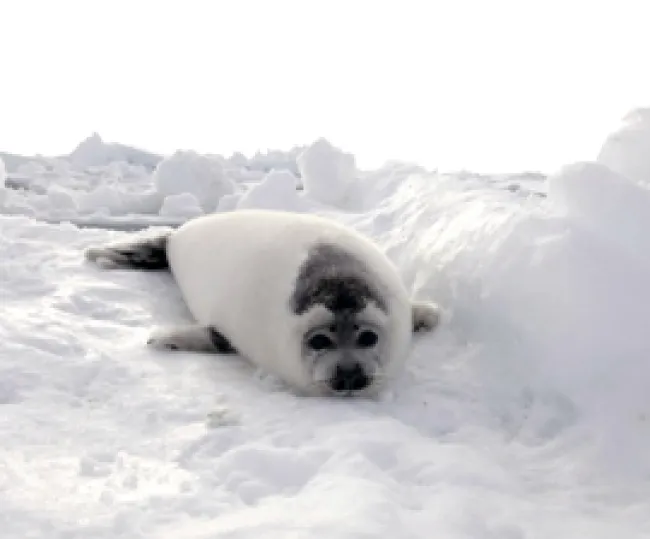
No, harp seals are not overpopulated
No. While the harp seal population in the Northwest Atlantic is the world's largest; it is a migratory population that spans the distance between Canada and Greenland and is supposed to number in the many millions. Today, the ice breeding harp seals are contending with the impacts of climate change, which is fast destroying their sea ice habitat. Notably, in 2025, Canada quietly reduced its estimate of the harp seal population by more than 41%.
This confirms what we have been saying all along. Harp seals are not there in the numbers previously claimed by the Canadian government and sealing industry. In the same year, the IUCN updated its Red List of Threatened Species, moving harp seals from Least Concern to Near Threatened.
Overhunting reduced the harp seal population significantly
In the 1950s and '60s, overhunting reduced the harp seal population by as much as two-thirds. By the early 1970s, senior Canadian government scientists were warning that the population could be lost altogether if commercial sealing was not suspended for at least a decade.
EU policy helped the harp seal population recover in the 1980s
In the early 1980s, the European Union banned the import of whitecoat seal skins, effectively removing the principal market for the hunt at the time. For the next decade, the number of seals killed in the hunt dramatically declined and the harp seal population began to recover.
Renewed subsidies increased number of seals killed
In the 1990s, the Canadian government rejuvenated the commercial seal hunt through massive subsidies. And as seals now contend with both the slaughter and the impacts of climate change, we can only wonder what the outcome will be for harp seals in the coming years.

Photo by Michael Bernard/HSI
For decades, Humane Society International and the Humane Society of the United States have worked to stop Canada’s brutal commercial seal hunt, where seal pups are mercilessly clubbed and shot to
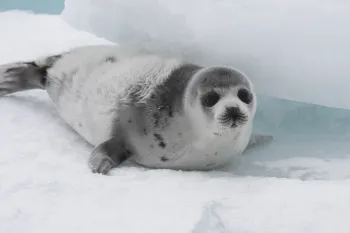
Photo by Mark Glover/Protect Seals
Canada this week once again turned its peaceful ice floes into an open-air slaughterhouse, with the reopening of the annual commercial seal hunt. Sealers are expected to club and shoot tens of
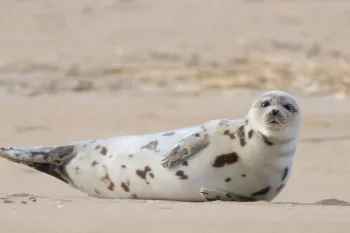
Photo by Ken Canning/iStock.com
For years, Scotland has allowed fish farmers and other fisheries to shoot seals in order to keep them from eating their fish —a brutal practice that has resulted in so much unnecessary suffering and
Your gift can do so much for animals in need
Start saving lives today by making a one-time gift—or protect animals worldwide all year long with a monthly contribution.
Rebecca Aldworth/Humane World for Animals